GSK Just Spent $1.3 Billion on a Drug That Hasn't Entered a Single Patient
GSK just committed up to $1.295 billion for a cancer drug that hasn't been tested in a single patient. The molecule attacks tumors through two targets at once, and it tells you everything about how frenzied the ADC market has become.
A Billion-Dollar Bet on a Molecule Nobody's Tested in Humans
Imagine buying a house you've only seen in blueprints. No walkthrough, no inspection, just an architect's promise that it'll be gorgeous. That's essentially what GSK just did, except the house costs up to $1.295 billion and the blueprints describe a cancer drug.
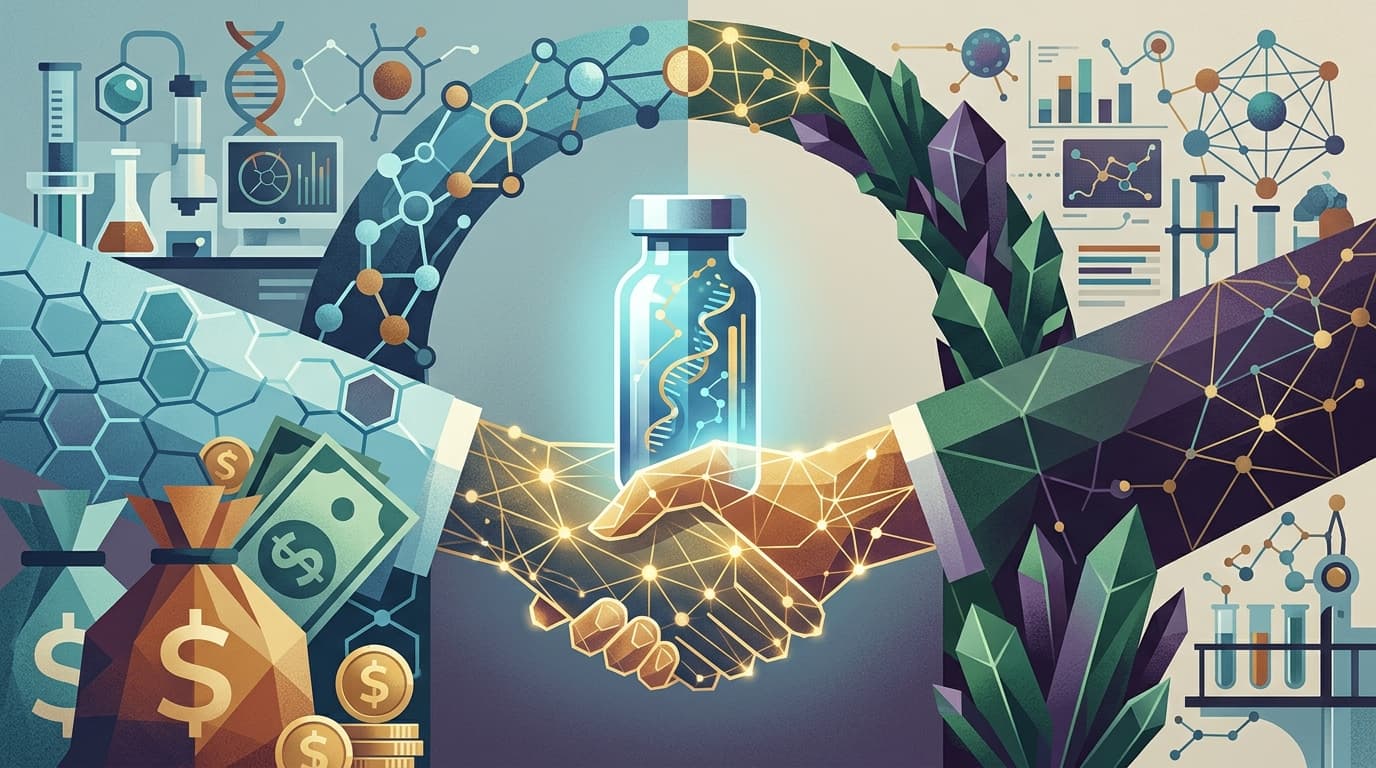
GSK scooped up the rights to HUTCHMED's HMPL-A830, a preclinical antibody-targeted therapy conjugate (ATTC), for territories outside of Greater China. The price tag: $110 million upfront, plus up to $1.185 billion in milestone payments tied to development, regulatory, and commercial wins, along with tiered royalties on sales.
The drug hasn't treated a single patient yet. A Phase 1/2 trial is registered but hasn't started enrolling. And GSK is already writing nine-figure checks.
So either this molecule is really special, or the ADC market has gone completely insane. Probably a bit of both.
What Makes This Drug Different
HMPL-A830 isn't your standard antibody-drug conjugate. In a traditional ADC, you strap a toxic payload to an antibody, let the antibody find the tumor, and watch the payload blow it up from the inside. Think of it as a guided missile: the antibody is the GPS, the payload is the warhead.
HMPL-A830 takes a cleverer approach. It's an anti-EGFR antibody linked to a KRAS inhibitor as its payload. That means it attacks cancer from two angles at once. The antibody blocks EGFR signaling on the surface of tumor cells (one of the most well-validated targets in oncology), while simultaneously delivering a KRAS inhibitor directly inside. EGFR and KRAS are like two switches on the same circuit; flip both off, and the tumor's growth engine stalls.
This dual-target strategy matters because KRAS mutations are notoriously hard to drug. They show up in some of the deadliest cancers: lung, colorectal, and pancreatic. Getting a KRAS inhibitor directly into tumor cells, rather than flooding the whole body with it, could mean better efficacy and fewer side effects.
Get tomorrow's biotech intelligence before your competitors.
Join thousands of biotech professionals who start their day with our free, daily briefing.
HUTCHMED actually prefers to call the technology an "ATTC" rather than an ADC, since the payload is a targeted inhibitor rather than a traditional cytotoxic agent. It's a subtle but meaningful distinction; the company is betting that smarter payloads will outperform brute-force cell killers.
GSK's Shopping Spree Has a Pattern
This wasn't a one-off impulse buy. It was the second major oncology licensing deal GSK announced in September. On September 3, GSK announced the HUTCHMED deal, and on September 15, GSK signed a deal with Chimagen Biosciences for a trispecific T-cell engager worth up to $750 million.
Zoom out further, and the pattern becomes even clearer. In June 2026, GSK agreed to acquire Nuvalent for $10.6 billion, adding precision oncology therapies to its roster. In 2025, it picked up an ADC from Syndivia for $357 million and completed the IDRx acquisition to bolster its GIST portfolio.
GSK is assembling an oncology franchise the way a fantasy football manager drafts before the season: aggressively, across multiple positions, with an eye toward building something that can compete for years. The company's leadership has said they evaluate deals based on unmet need, differentiated mechanisms, and fit with their strategic disease areas. Translation: they want drugs that do things other drugs can't, in cancers where patients are running out of options.
The ADC Gold Rush Is Real
GSK isn't the only pharma giant throwing money at conjugate-based therapies. The ADC market in 2025 and 2026 has looked like a bidding war at a luxury auction house.
Gilead paid up to $5 billion for Tubulis's linker-payload technology in April 2026. Bristol Myers Squibb partnered with BioNTech on BNT327, putting down $1.5 billion upfront with milestones stretching to $7.6 billion. Daiichi Sankyo, Pfizer (via Seagen), and Roche continue to dominate the commercial landscape, but a second wave of Chinese innovators like Kelun-Biotech, Hengrui, and RemeGen is feeding the deal pipeline.
About 80% of clinical ADC licensing agreements still cluster around two payload types: topoisomerase I inhibitors and tubulin inhibitors. That concentration makes novel approaches like HMPL-A830's KRAS-inhibitor payload genuinely differentiated, which partly explains why GSK was willing to pay a premium for a preclinical asset.
The strongest bargaining power belongs to programs that combine validated biology, novel chemistry, clean safety data, and multi-indication potential. HMPL-A830 checks at least three of those boxes on paper. The safety data will have to come from the clinic.
HUTCHMED Plays It Smart
For HUTCHMED, this deal follows a playbook the company has refined over multiple partnerships. The model is simple: keep Greater China rights, license everything else to a deep-pocketed partner.
It's a shrewd strategy. HUTCHMED retains the commercial upside in Mainland China, Hong Kong, Macau, and Taiwan, where it has an established commercial operation. Meanwhile, GSK takes on the expensive, risky job of running late-stage global trials and navigating Western regulatory approval.
The $110 million upfront payment doesn't hurt either. HUTCHMED has said it plans to use its strong cash resources to accelerate its broader ATTC pipeline, which now includes two assets in global Phase 1 trials and a third cleared for clinical development. The company reiterated 2026 revenue guidance of $330 million to $450 million for its oncology and immunology business, and it's now in its fourth consecutive year of profitability.
Investors liked the news. HUTCHMED shares jumped roughly 14% to 17% after the announcement. Trinity Delta, a research firm covering the company, called the deal "clear external validation" of HUTCHMED's ATTC platform and maintained a company valuation of $5.80 billion.
The Big Question Nobody Can Answer Yet
All of this excitement rests on a foundation that hasn't been tested where it matters most: in patients. HMPL-A830's dual-target approach is elegant on a whiteboard. The preclinical data was apparently compelling enough to make GSK commit over a billion dollars in potential payments. But biology has a nasty habit of humbling even the best-designed molecules once they enter clinical trials.
The global Phase 1 program will be run initially by HUTCHMED, which means GSK is trusting its partner to generate the first human data. If the drug works as designed (selectively hitting EGFR-expressing tumors while suppressing KRAS signaling inside them), it could become a new paradigm for treating some of the most stubborn solid tumors in oncology.
If it doesn't, GSK is out $110 million and a lot of executive confidence. In a market where every big pharma company is scrambling for differentiated ADC assets, that's the price of admission. You pay to play, and you hope the blueprints match reality.
Clinical & Regulatory4 min read
AstraZeneca's Breast Cancer Pill Had One Job. It Didn't Deliver.
AstraZeneca's oral breast cancer pill camizestrant missed its primary endpoint in the pivotal SERENA-4 trial, failing to prove a statistically significant benefit in first-line advanced breast cancer. The setback narrows the drug's commercial ceiling just as Eli Lilly's competing therapy racks up its second FDA approval.