
GSK's Hansoh-partnered ADC just delivered the first-ever Phase 3 survival win for a B7-H3-targeted drug in any cancer, and it happened in one of oncology's deadliest diseases. The numbers aren't out yet, but the signal is unmistakable.
Small-cell lung cancer is the oncology equivalent of a final boss fight. It responds to chemo at first, almost eagerly, then comes roaring back with a vengeance. After that initial platinum-based treatment fails, options are grim. Median survival in extensive-stage disease hovers around 12 months. Five-year survival? Under 10%.
So when GSK reported positive results for its Hansoh-partnered antibody-drug conjugate (ADC) in a trial for relapsed small-cell lung cancer, the signal was loud and clear: something actually worked in a disease where almost nothing does.
The trial, called ARTEMIS-008, randomized roughly 460 patients in China to receive either the ADC (known as HS-20093/GSK5764227) or standard chemotherapy. The primary goal was overall survival: does the drug help patients live longer?
Progression-free survival (the time before cancer starts growing again) also improved. And the safety profile looked manageable, with no new red flags.
There's a catch, though. GSK and Hansoh didn't release any actual numbers. No hazard ratios, no median survival figures, no response rates. Just the headline: "it worked." Think of it like your friend texting "I got the job!" without telling you the salary. Exciting, but you want the details.
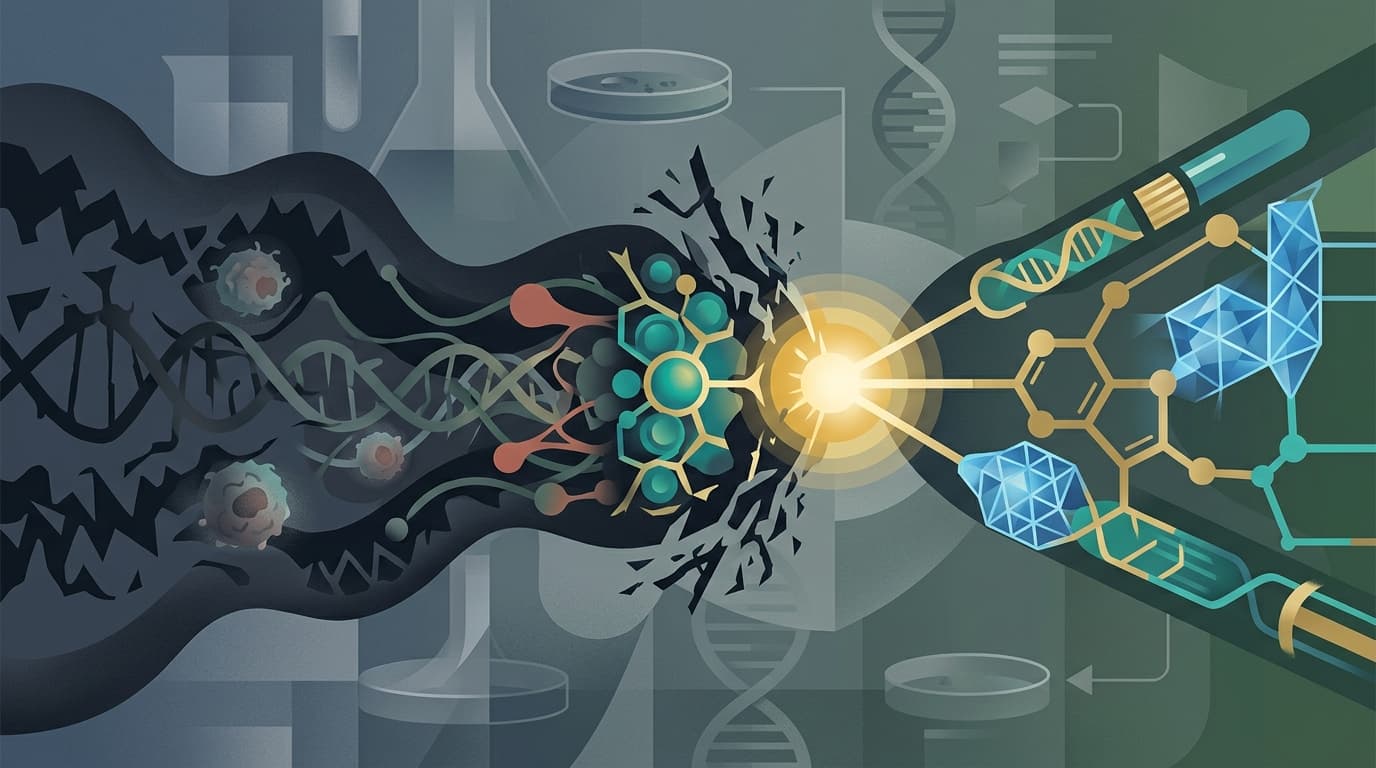
To understand why this result is a big deal, you need to understand the weapon. The ADC works like a guided missile. The antibody portion locks onto a protein called B7-H3 that's plastered all over SCLC tumor cells. Once it docks, the ADC delivers a toxic payload (a topoisomerase inhibitor, which scrambles the cancer cell's ability to copy its DNA) directly into the tumor.
The beauty of ADCs is precision. Instead of carpet-bombing the whole body with chemotherapy, you're FedEx-ing poison straight to the cancer's front door. B7-H3 turns out to be an excellent address label because it's highly expressed in SCLC tumors.
A positive result for a B7-H3-targeted ADC in SCLC is not just a win for GSK; it validates B7-H3 as a drug target across the entire field.

The FDA approved a wearable on-body injector version of Sanofi's myeloma drug Sarclisa, making it the first cancer therapy in the U.S. delivered this way. It won't dethrone J&J's Darzalex overnight, but it just erased one of the biggest reasons doctors defaulted to the competition.


Join thousands of biotech professionals who start their day with our free, daily briefing.
GSK didn't develop this drug from scratch. It licensed HS-20093 from Chinese pharma company Hansoh in December 2023, paying $185 million upfront with up to $1.525 billion in milestone payments. GSK got exclusive rights everywhere outside Greater China, while Hansoh kept its home turf.
At the time, some observers wondered if GSK was overpaying for a Chinese-origin ADC in early development. The drug already has FDA Breakthrough Therapy Designation and EMA PRIME status for relapsed extensive-stage SCLC, which are regulatory fast passes that could accelerate its path to approval in Western markets.
For Hansoh, the result sets up a regulatory filing in China and validates its ADC platform on the global stage. Not bad for a company that many Western investors still couldn't pick out of a lineup.
This isn't a one-off bet. GSK has been methodically assembling an ADC portfolio that flies under the radar compared to flashier players like Daiichi Sankyo or AbbVie.
The Hansoh partnership actually includes two ADCs: the B7-H3 drug for lung cancer and solid tumors, plus a B7-H4 ADC (HS-20089) licensed in late 2023 for $85 million upfront, aimed at gynecologic cancers. GSK plans to combine that B7-H4 ADC with its PD-1 checkpoint inhibitor Jemperli.
Beyond Hansoh, GSK picked up a preclinical prostate cancer ADC from Syndivia and licensed DB-1324 from Duality Biologics for gastrointestinal cancers at $30 million upfront (with milestones up to $975 million). Add in Blenrep, its BCMA-targeted ADC for multiple myeloma, and GSK now has ADC programs spanning lung, prostate, GI, gynecologic, and blood cancers.
Total upfront ADC spend in roughly 18 months: approximately $570 million. That's less than what some competitors paid for a single asset. GSK is shopping at the farmers' market while others are buying organic at Whole Foods.
GSK isn't alone in chasing SCLC with ADCs. Daiichi Sankyo has ifinatamab deruxtecan, another B7-H3 ADC, in clinical trials for relapsed extensive-stage disease. Zai Lab's DLL3-targeted ZL-1310 already has FDA fast track designation and showed a 74% response rate in early studies. AbbVie is running two separate SEZ6-targeted ADC programs (ABBV-011 and ABBV-706) in Phase 1.
The competitive picture is heating up fast. But the GSK/Hansoh ADC has a crucial first-mover advantage in the B7-H3 space. In oncology, being first with proof that your drug helps patients live longer is like having a cheat code for regulatory discussions.
The China win is a strong proof of concept, but the bigger prize is global approval. GSK is running its own Phase 3 trial in extensive-stage SCLC outside China, with results expected around 2027. That readout will determine whether the drug becomes a global standard of care or stays a regional success story.
GSK is also expanding the drug into genitourinary cancers and other solid tumors, aiming to turn it from a niche SCLC drug into a multi-tumor franchise. Early Phase 1 data showing tumor shrinkage in 7 of 9 SCLC patients and an 85% disease control rate across tumor types suggest the drug has legs beyond lung cancer.
For now, Wall Street's reaction is cautiously optimistic. Analysts see the China result as de-risking the asset and the Hansoh partnership, but they're holding off on blockbuster projections until they see the actual numbers from ARTEMIS-008 and the global trial data.
The full dataset will likely be presented at a major oncology conference in the coming months. Until then, GSK has something it rarely gets in oncology: genuine momentum. And for the thousands of SCLC patients who run out of options every year, momentum might be exactly what they need.
Bayer just pulled €3 billion from Apollo without giving up control of its blockbuster IUD franchise. It's a clever financial move, but the real story is why the German pharma giant needed the cash so badly in the first place.