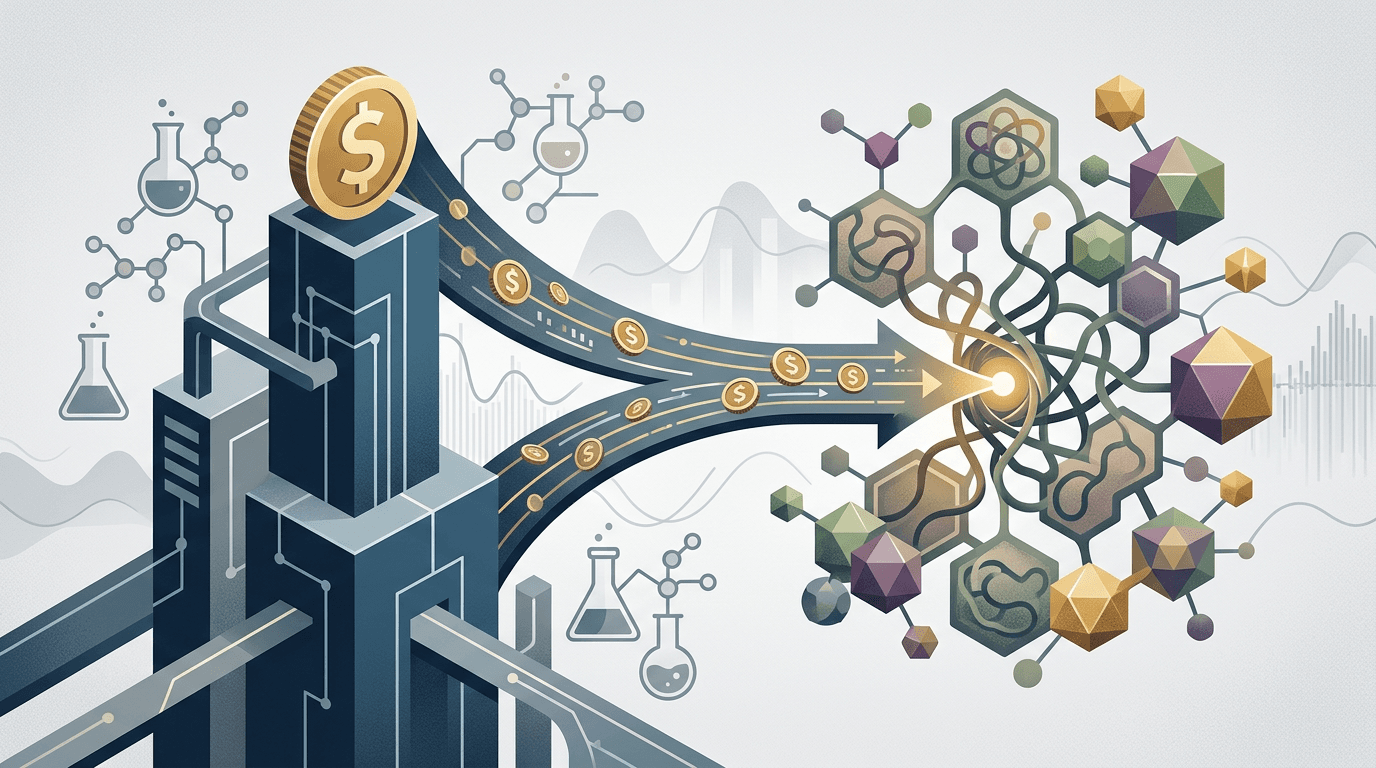

GSK just dropped £44 million on a London biotech trying to do something most scientists thought was impossible: reverse scar tissue. The deal with Engitix is the latest piece of a fibrosis strategy that's quietly become one of pharma's biggest bets.
Scar tissue is supposed to be permanent. That's basically the first thing you learn in biology class: your body patches damage with tough, fibrous tissue, and that patch stays forever. It's why old knee injuries still ache and why liver cirrhosis is considered a one-way street.
GSK just put £44 million on the table to prove that wrong.
The pharma giant signed a research collaboration with Engitix, a London-based biotech that specializes in the extracellular matrix (the scaffolding that holds your cells together, basically your body's construction framework). The goal: find brand-new drug targets that can actively reverse liver fibrosis, not just slow it down.
Engitix is eligible for up to £44.5 million in upfront and near-term payments. If the collaboration discovers promising targets, those payments could balloon to £118 million per target in milestones, plus low single-digit royalties on any drugs that eventually reach pharmacy shelves.
The structure is what's called a "collaboration and option" deal. Engitix does the early digging, building human tissue models and crunching multi-omics data (think of it as running thousands of biological experiments simultaneously to map how fibrosis works at the molecular level). GSK then gets the option to license whatever targets, data, and tools come out of that work. If they exercise those options, GSK takes the wheel on everything from clinical trials to commercialization.
Wall Street shrugged. GSK's stock actually dipped about 1% on the news. Analysts called it "early-stage research, not a near-term product catalyst." Fair enough; this is discovery-phase science, not a Phase 3 readout. But the strategic signal here is louder than the stock ticker suggests.
Imagine your kitchen sink is clogged. Current fibrosis drugs are like turning down the faucet: they slow the water, but the clog stays. What GSK and Engitix are hunting for is the biological equivalent of Drano, something that actually dissolves the blockage.

Incyte just dropped $2 billion on a single Phase 3 drug for a bleeding disorder most people have never heard of. With Jakafi's patents expiring in 2028 and 70% of revenue on the line, this is either the smartest move in mid-cap pharma or the most expensive panic buy of the year.


Join thousands of biotech professionals who start their day with our free, daily briefing.
The antifibrotic drug market sits at roughly $3.5 to $3.8 billion today, with forecasts pushing it toward $7 to $8 billion by the early 2030s. But the existing options are frustratingly limited. In lung fibrosis (specifically idiopathic pulmonary fibrosis, or IPF), the two mainstay drugs, pirfenidone and nintedanib, slow lung function decline but don't reverse the damage. Annual treatment costs run approximately $100,000 to $110,000 per patient, which makes the value proposition even shakier when you're only buying time.
Liver fibrosis has seen slightly better luck. Resmetirom, a metabolism-targeting drug approved in 2024 for a type of fatty liver disease called MASH, showed that 26% of patients had meaningful fibrosis improvement at one year versus 14% on placebo. Semaglutide (yes, the weight-loss drug) posted even stronger numbers: 37% fibrosis improvement versus 22% on placebo in a separate trial. Those are real wins, but they highlight the gap: even the best results mean most patients don't see reversal.
The field has been littered with failures along the way. In lung fibrosis alone, interferon-gamma, TNF-alpha inhibitors, endothelin blockers, and several other drug classes either flopped or actually made patients worse. GSK itself had an integrin inhibitor for pulmonary fibrosis that failed back in 2018.
The Engitix deal doesn't exist in isolation. GSK has been quietly assembling a fibrosis empire through a string of partnerships over the past two years, and the pattern reveals a very deliberate playbook.
In December 2024, GSK signed a $45 million upfront deal (including $15 million in equity) with Relation Therapeutics, an AI-driven biotech, to discover targets for fibrotic diseases and osteoarthritis. That deal included up to $200 million per target in milestones. Around the same time, GSK partnered with Boston University's Center for Regenerative Medicine to study pulmonary fibrosis using stem-cell-derived lung models.
Then came the big one: GSK paid $1.2 billion upfront (with up to $800 million more in milestones) to acquire efimosfermin alfa, an FGF21 hormone analog headed for Phase 3 trials in fatty liver disease. That's a $2 billion bet on liver disease, anchoring a portfolio that now spans everything from early target discovery to near-commercial assets.
The strategy is clear. GSK is building a layered approach: platform partnerships like Engitix and Relation to generate novel targets at the discovery level; academic collaborations for biological understanding; and late-stage acquisitions like efimosfermin for near-term revenue. Think of it like a baseball farm system, except some of the prospects are already in the majors.
Engitix isn't the only UK company chasing fibrosis reversal. Resolution Therapeutics in Edinburgh is running a Phase 1/2 trial of an engineered macrophage cell therapy (immune cells reprogrammed to eat scar tissue) in end-stage liver disease. Baseimmune in London is developing an immunotherapy approach to IPF with proof-of-concept data expected in 2026 and 2027. Forth Therapeutics, a new University of Edinburgh spin-out, launched specifically to tackle multi-organ fibrosis.
For the UK biotech ecosystem, deals like the GSK-Engitix collaboration serve as important validation. They bring non-dilutive capital (meaning the biotech doesn't have to sell equity) and signal to venture investors that UK discovery platforms can attract big pharma dollars. With UK biotech financing showing signs of recovery in early 2026, that signal matters.
Can fibrosis actually be reversed in a meaningful, reliable way? The early data says "sometimes, in some patients, in some organs." That's not nothing; a decade ago, most scientists would have said fibrosis reversal was biologically implausible. But "sometimes" isn't a blockbuster drug.
The challenge GSK faces with the Engitix collaboration is that it's starting from scratch: target discovery, not even drug design. Any resulting medicine is years away, probably the early 2030s at the absolute earliest. And the history of fibrosis drug development is a graveyard of promising science that couldn't survive the clinic.
But if one of these programs cracks the code on fibrosis regression, the prize is enormous. Fibrotic diseases collectively affect tens of millions of people worldwide across the liver, lungs, kidneys, heart, and skin. A drug that genuinely reverses scar tissue wouldn't just be a blockbuster. It would redefine what we think is fixable about the human body.
For now, £44 million buys GSK a seat at the table and a chance to find out.
Everyone building obesity drugs wants to activate the GIP receptor. Antag Therapeutics just showed up at ADA 2026 with human data proving the opposite approach is safe. Their contrarian bet could reshape how we treat the patients that current blockbusters leave behind.