Gilead Just Dropped $2.175 Billion on a Company You've Never Heard Of
Gilead just paid $2.2 billion for a startup that's barely a year old, with one drug and no pivotal data. The Ouro Medicines deal reveals Gilead's aggressive push into autoimmune disease, and a clever cost-sharing trick that cuts the risk in half.
From Antiviral King to Autoimmune Shopper
Gilead Sciences just wrote a check for $2.175 billion to buy a company that didn't even exist two years ago.
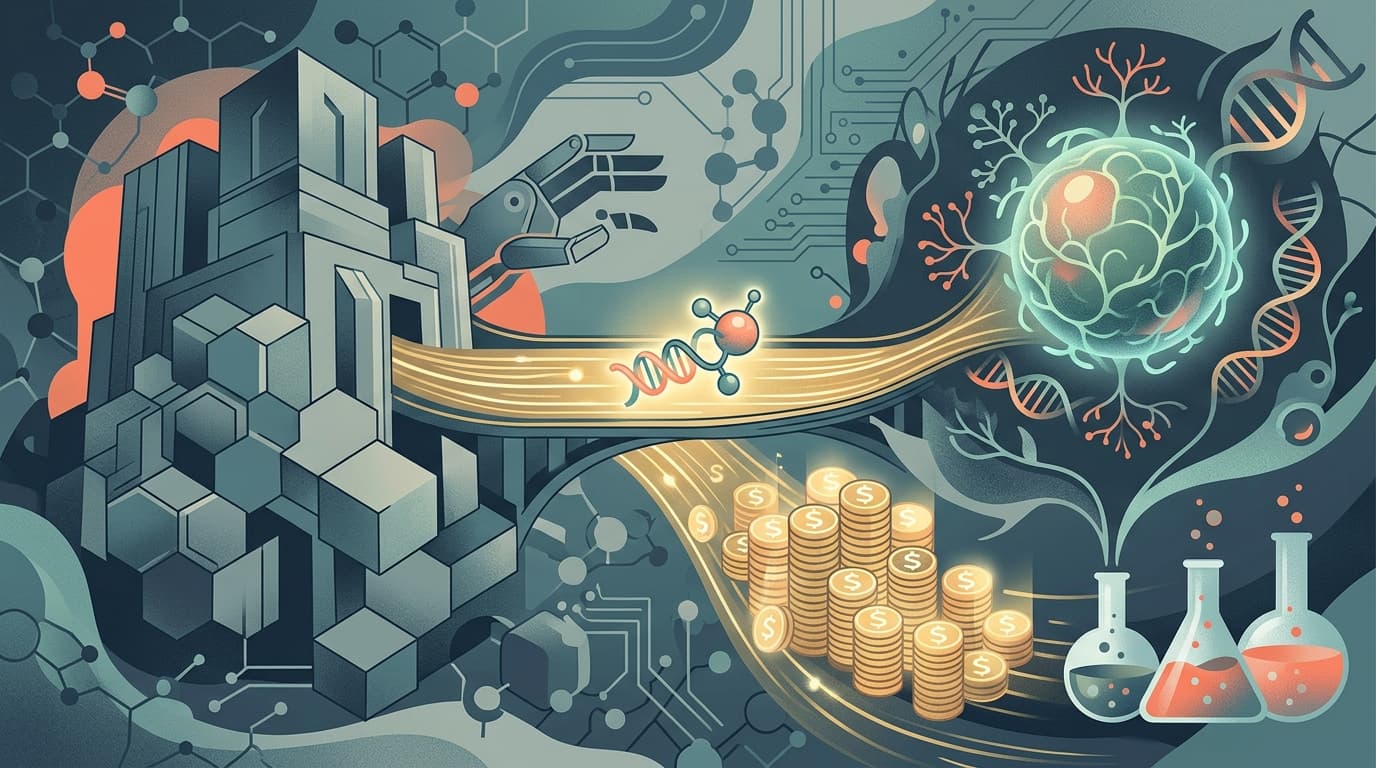
Ouro Medicines, a San Francisco biotech launched in early 2025, caught Gilead's eye with a single drug candidate and a bold thesis: that T-cell engagers (proteins engineered to redirect your immune cells toward a specific target) could reset the immune system in people with serious autoimmune diseases. Gilead apparently liked the pitch enough to pay $1.675 billion in cash upfront, with another $500 million in milestone payments tied to future development and commercial wins.
For a company that raised $120 million in its Series A just last year, that's roughly an 18x return on invested capital before the ink is dry. Not bad for a startup with one drug in early-stage trials.
One Drug, One Big Bet
The centerpiece of the deal is OM336, also known as gamgertamig. It's a bispecific T-cell engager, which is a fancy way of saying it's a molecule designed to grab two things at once: a protein called BCMA on the surface of rogue B cells, and CD3 on T cells. Think of it like a molecular matchmaker that introduces your immune system's hitmen to the cells causing trouble.
The target diseases? Autoimmune cytopenias, a group of rare conditions where the immune system destroys its own blood cells. That includes autoimmune hemolytic anemia (where your body attacks red blood cells) and immune thrombocytopenia (where it goes after platelets). Ouro also had its sights on Sjögren's disease and idiopathic inflammatory myopathy, both driven by overactive B cells.
Gilead said OM336 showed "transformative efficacy" and a differentiated safety profile in ongoing Phase 1/2 studies after just a single treatment cycle. No detailed data tables have been released publicly, but the language is about as enthusiastic as pharma companies get without a PowerPoint deck.
The plan is to push OM336 toward registrational studies (the final trials needed for FDA approval) by .
Get tomorrow's biotech intelligence before your competitors.
Join thousands of biotech professionals who start their day with our free, daily briefing.
2027
The Galapagos Twist
If you're thinking $2.175 billion sounds like a lot for one early-stage drug, you're not wrong. But Gilead structured this deal with a clever financial cushion.
Gilead is in advanced discussions with Galapagos, its longtime European partner, to split the bill. Under the proposed arrangement, Galapagos would cover 50% of both the upfront and milestone payments, essentially halving Gilead's out-of-pocket cost. Galapagos would also take over most of Ouro's employees and day-to-day operations, covering development costs through the start of registrational studies. After that, the two companies would share those costs equally.
In return, Gilead keeps sole worldwide commercialization rights (outside Greater China, where a company called Keymed already holds the license). Galapagos would receive royalties of 20% to 23% on net sales.
It's a bit like buying a house with a roommate who pays half the mortgage but you keep the deed. Gilead gets the commercial upside; Galapagos gets a steady royalty stream and a pipeline asset to develop.
Why Gilead Can't Stop Shopping
This isn't a one-off impulse buy. Gilead has been on an acquisition tear, and 2026 is shaping up as a peak year.
The company built its empire on antiviral drugs: hepatitis C blockbusters like Sovaldi and Harvoni, then HIV treatments that became the backbone of its revenue. But antiviral growth has a ceiling, and Gilead's leadership has been telegraphing for years that diversification is the plan.
In 2024, Gilead acquired CymaBay Therapeutics to push into liver disease. In 2025, it racked up about $800 million in spending tied to acquisitions of Interius and collaborations with LEO Pharma and Pregene. Then 2026 arrived, and the floodgates opened: Gilead closed its purchase of Arcellx (cell therapy for cancer), announced the Tubulis acquisition (next-generation antibody-drug conjugates for oncology), and now Ouro Medicines.
Three major deals in rapid succession. Gilead is building a pipeline the way some people build IKEA furniture: buying the pieces separately and hoping the final product holds together.
What Wall Street Thinks
Analyst reactions landed somewhere between "makes sense" and "show me the data."
Truist Securities reiterated a Buy rating with a $152 price target. Cantor Fitzgerald maintained its Overweight rating at $155 and even bumped its 2026 sales forecast for Gilead's existing products. Goldman Sachs, playing the skeptic, kept a Neutral rating with a $125 target.
BMO Capital's Evan Seigerman noted that the Ouro deal strengthens Gilead's immunology and inflammation exposure while still leaving financial room for more acquisitions. That last part is key: analysts don't think Gilead is done shopping.
The broader analyst backdrop was already bullish before this deal, with firms like Jefferies ($180 target) and Citi ($165) sitting well above Goldman's cautious stance. The Ouro acquisition didn't move the needle dramatically; most viewed it as a logical next step rather than a surprise.
The Bigger Picture
Autoimmune disease is becoming one of the hottest spaces in biotech, and the concept of "immune reset" is at the center of it. The idea is simple in theory: instead of suppressing the immune system forever with drugs that leave patients vulnerable to infections, you wipe out the problematic cells and let the immune system rebuild from scratch. CAR-T therapies have shown this can work in lupus patients. T-cell engagers like OM336 aim to do something similar, potentially with a simpler, off-the-shelf approach.
Gilead is betting that autoimmune disease will be its next major franchise, sitting alongside HIV and oncology. The Ouro deal is a declaration of intent: Gilead wants to own this space.
But declarations of intent are cheap (well, $2.175 billion, but you get the point). OM336 is still in Phase 1/2 trials. No pivotal data. No FDA filing timeline beyond a vague "2027" target. Gilead is paying a premium for potential, not proof.
If OM336 delivers on its early promise, this deal will look like a steal. If the data disappoints, it becomes another expensive reminder that buying early-stage biotech is, at its core, a very expensive coin flip.
For now, Gilead seems comfortable with the odds. And with Galapagos picking up half the tab, the downside is at least a little more manageable.
Clinical & Regulatory
4 min read
The First Drug for an 'Always Hungry' Disease Just Hit a Wall
The first-ever drug for the relentless hunger of Prader-Willi syndrome is under scrutiny after seven deaths and over 100 serious adverse events surfaced in post-marketing reports. Experts aren't saying pull it; they're saying pay closer attention.