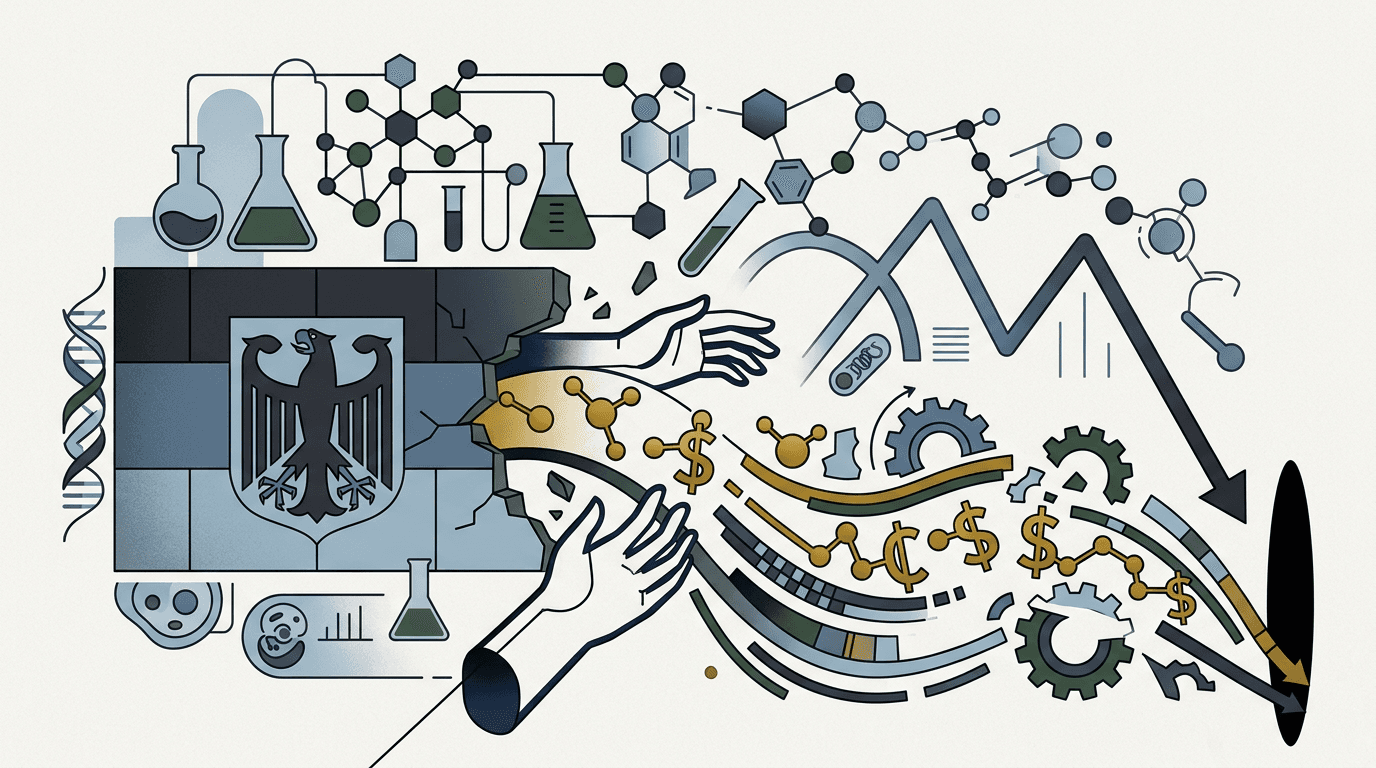
Germany Just Lost $2 Billion in Pharma Investment. It Asked For It.
Eli Lilly and Boehringer Ingelheim each slashed over €1 billion from their German investment plans in the same week, citing a sweeping healthcare reform bill. When two pharma giants retreat from Europe's largest economy simultaneously, it's not a coincidence; it's a continent-wide wake-up call.
Two of the world's biggest drugmakers just pulled the emergency brake on Germany. In the same week.
Eli Lilly slashed its planned German manufacturing investment roughly in half. Boehringer Ingelheim scrapped about €900 million in domestic expansion projects. Combined, that's more than €2 billion in pharmaceutical investment that was headed to Germany and now isn't. The reason? A sweeping healthcare reform bill that the pharma industry says makes Germany a bad bet for long-term capital.
This isn't a coincidence. It's a warning shot.
The Lilly Side: A $2.5 Billion Plant, Cut in Half
Back in November 2023, Eli Lilly announced a massive plan. The company would build a $2.5 billion high-tech injectable manufacturing facility in Alzey, a town in the Rhineland-Palatinate region. The site was supposed to churn out diabetes and obesity medications (think: GLP-1 drugs like tirzepatide). It would create up to 1,000 permanent jobs and nearly 1,900 construction positions. Operations were slated for 2027.
Lilly had already poured over €1 billion into the ground. Then the German government started drafting its healthcare savings law, and Lilly's enthusiasm cooled fast.
The company announced it would halve the remaining scope of the project. That means roughly €1.1 to €1.2 billion in planned spending just vanished from Germany's ledger. The Alzey plant will still open, but at reduced capacity, with about 500 jobs instead of 1,000.
CEO Dave Ricks told the German financial newspaper Handelsblatt that the scrapped investment would likely be redirected to the United States, with Pennsylvania as a prime candidate. Europe, he noted, isn't "completely off the table." But it's clearly not at the head of it either.
Boehringer's Quieter Retreat
Boehringer Ingelheim's pullback is less dramatic in headline terms but arguably more symbolic. This is a German company, headquartered in Ingelheim, canceling nearly in investments at its own home turf.
Get tomorrow's biotech intelligence before your competitors.
Join thousands of biotech professionals who start their day with our free, daily briefing.
€900 million
The cuts target future expansion and modernization projects across German production and development sites. No existing jobs are being eliminated (these were planned facilities, not operating ones). But hundreds to potentially thousands of future positions that would have come with those investments now won't materialize.
Company representatives pointed directly at the federal government's savings plans. The message was blunt: Germany no longer offers the reliability and attractive market conditions needed to justify pouring billions into new capacity.
When a German pharma giant starts pulling investment out of Germany, that's not just a business decision. That's a statement.
The Reform That Spooked an Industry
So what exactly is Germany doing that sent two pharma heavyweights running?
The culprit is a draft law with an appropriately German name: the GKV-Beitragssatzstabilisierungsgesetz, or GKV-BStabG for short. (Even the abbreviation needs an abbreviation.) It's a sweeping cost-containment package designed to close a projected multi-billion-euro deficit in Germany's statutory health insurance system.
The government expects the law to deliver roughly €20 billion in healthcare savings in 2027, with about €1.9 billion coming specifically from pharmaceutical spending cuts. By 2030, the total savings target exceeds €42 billion.
For drugmakers, the details read like a greatest-hits album of pricing pain:
Higher mandatory rebates on patented drugs. The current 7% manufacturer rebate would jump by 3.5 percentage points in the first half of 2027. After that, it shifts to a dynamic model tied to how fast spending on patented medicines is growing. If the system spends more than expected, rebates go up automatically. Think of it like a thermostat, except it only turns in one direction: colder.
A price freeze extended through 2030. Germany has had a reimbursement price freeze on medicines since 2010. The new law would extend it four more years and make it tougher by applying it to new entrants with the same active ingredient. If a generic or similar drug hits the market, it's locked into the frozen price from day one.
Tender-style contracts for patented medicines. This is the one that really raised eyebrows. The draft law would allow insurers to run competitive bidding for groups of "therapeutically comparable" patented drugs. That's a mechanism typically reserved for generics. Applying it to innovative, on-patent medicines is like making luxury car brands compete in a sealed-bid auction alongside economy sedans.
Steeper discounts for blockbusters. The draft law includes provisions for additional rebates on high-revenue drugs, though the exact formula and thresholds remain under discussion. The bigger you are, the more you pay.
Higher patient co-pays. The minimum prescription co-payment would rise from €5 to €7.50, and the maximum from €10 to €15. Not a direct hit to manufacturers, but higher out-of-pocket costs can dampen demand and give insurers more negotiating leverage.
Taken together, the package is designed to plug a budget hole. But industry leaders see it as something more corrosive: a signal that Germany views pharmaceutical innovation as a cost problem to be managed, not an investment to be nurtured.
The Domino Effect Nobody Wants to Talk About
Lilly and Boehringer aren't the only ones sounding alarms. Novartis CEO Vas Narasimhan called himself "very disappointed" by the scale of proposed healthcare savings measures, expressing concern about the investment climate. BioNTech, the Mainz-based company that became a household name during COVID, warned that the reforms could negatively affect its own investment decisions in Germany.
That last one should sting. BioNTech is perhaps the most prominent symbol of German biotech success in a generation. If even they're hedging, something has gone sideways.
The broader analyst consensus is darkening, too. Bloomberg characterized the reforms as "more pain for big pharma," noting that Germany (one of Europe's largest drug markets) is following the U.S. in ratcheting up pricing pressure. Strategy analysts see the moves as accelerating a trend where companies prioritize launches and capacity investments in regions with friendlier economics.
Europe's Slow-Motion Talent Show
Germany's loss could be someone else's gain. The question is: whose?
Ireland remains the go-to European manufacturing hub for U.S. pharma companies. It saw a major production spike in 2025 as companies front-loaded exports ahead of potential U.S. tariffs. Its workforce, regulatory track record, and export infrastructure keep it at the top of the list, even as its old corporate tax advantage fades.
Denmark has carved out a specialized niche in biologics manufacturing, anchored by Novo Nordisk's booming diabetes and obesity drug empire. The country landed a $220 million raw materials plant from Novo, with more in the pipeline. It's not trying to be everything to everyone; it's trying to be the best at one thing.
France is playing catch-up, using direct subsidies and industrial policy to lure strategic manufacturing. It's competitive but weighed down by a more complex labor and regulatory environment.
And then there's the United States, which is vacuuming up the lion's share of new global pharma capacity. When Lilly's CEO says the cut German investment will likely go to Pennsylvania, he's describing a pattern, not an exception. AstraZeneca, Sanofi, Novo Nordisk, and Roche have all announced massive U.S. build-outs in recent years.
The European Federation of Pharmaceutical Industries (EFPIA) has warned that Europe is "ceding ground" in attracting pharma investment compared with the U.S. and China. Manufacturing investment in the EU grew at about 15% annually between 2018 and 2022, which sounds impressive until you realize the biggest new waves of global capacity are landing elsewhere.
The Real Price of Saving Money
Germany's government faces a genuinely difficult problem. Its statutory health insurance system is staring down a massive deficit, and drug spending is one of the fastest-growing line items. Doing nothing isn't an option.
But there's a difference between cost containment and capital flight. When two companies simultaneously yank €2 billion in investment from your country, citing your own legislation, that's not a policy success. That's a policy trade-off you'd better understand clearly.
The jobs that won't be created in Alzey aren't abstract. The modernization projects Boehringer won't build aren't theoretical. These are real economic consequences of treating pharmaceutical pricing as a dial you can turn without anything else moving.
Other European governments should be paying close attention. Germany isn't some outlier; it's the continent's largest economy and a traditional pharma powerhouse. If Berlin can't strike a balance between fiscal discipline and investment attractiveness, what hope does anyone else have?
The pharmaceutical industry has a long memory and a global map. Every time a country makes itself less attractive, the capital doesn't disappear. It just books a flight somewhere else.
Clinical & Regulatory
4 min read
The Autoimmune CAR-T Race Has a New Mantra: Make It Last
Cabaletta Bio is betting that the autoimmune CAR-T winner won't be whoever gets to market first, but whoever keeps patients in remission longest. Their EULAR data just made the case more interesting.