Foghorn Blew Through $300M of Lilly's Cash and Has Nothing to Show for It
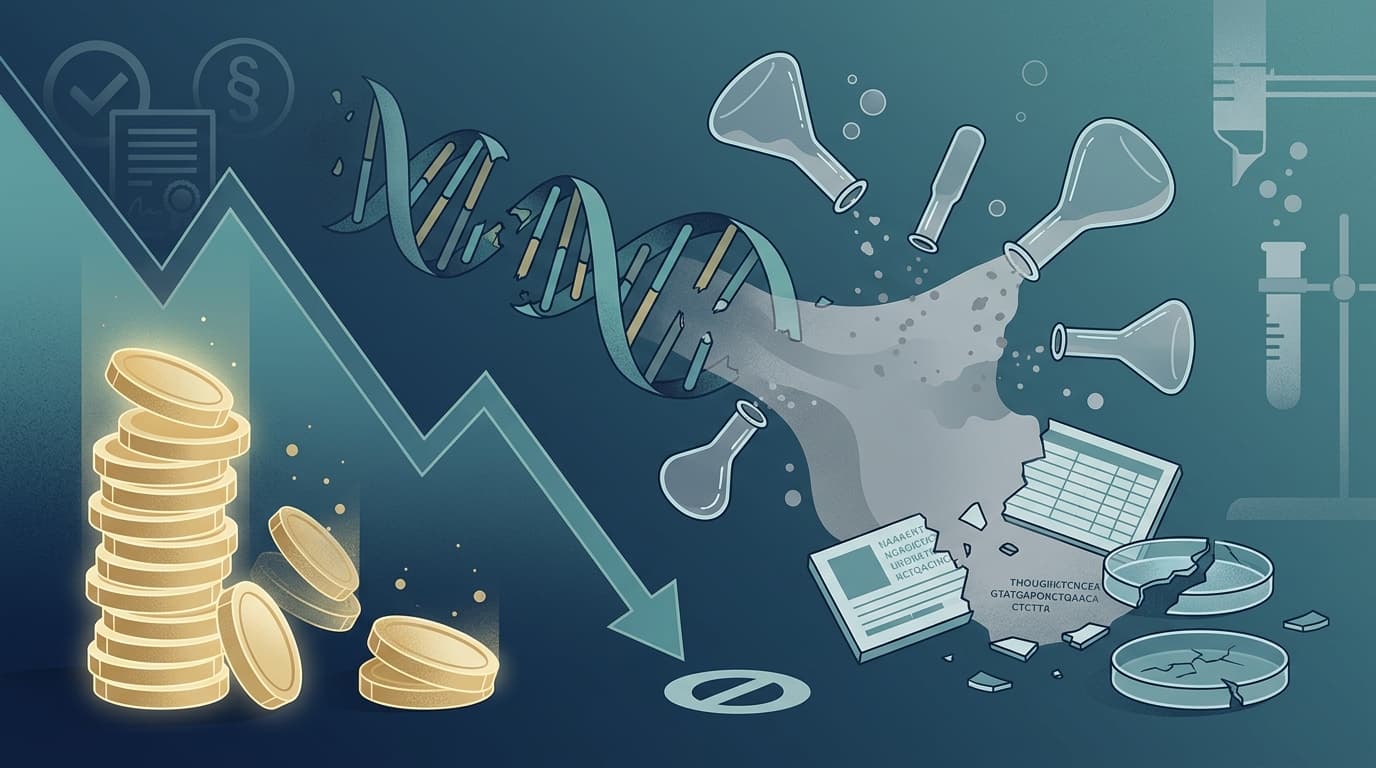
Foghorn Therapeutics axed 40% of its workforce after its Eli Lilly-partnered cancer drug flopped in Phase 1. The $1.6 billion collaboration is over, the stock is at $2, and the wreckage tells a cautionary tale about one of oncology's trickiest frontiers.
Three years ago, Foghorn Therapeutics landed one of the splashiest deals in chromatin biology: a partnership with Eli Lilly worth up to $1.6 billion, including $300 million upfront and an $80 million equity investment at $20 per share. It was the kind of deal that screams "we've cracked the code on a new frontier of cancer biology."
Foghorn's stock now trades at about $2 a share. The Lilly partnership is dead. And 40% of the company's workforce just got pink slips.
The Drug That Couldn't Deliver
The centerpiece of the Foghorn-Lilly collaboration was FHD-909, a first-in-class oral drug designed to exploit a clever vulnerability in certain cancers. The target: a protein called SMARCA2 (also known as BRM), which helps control how genes get read inside cells. Think of it like an engine in a machine that opens and closes your DNA so the right genes turn on at the right time.
In some cancers, particularly certain lung cancers, a related protein called SMARCA4 (BRG1) is already broken. The theory was elegant: if one engine is busted and you knock out the backup engine (SMARCA2), the cancer cell stalls and dies. Normal cells, which still have both engines running, survive just fine. This concept is called synthetic lethality, and it's one of the most exciting strategies in modern oncology.
Lilly dosed the first patient in a Phase 1 trial back in October 2024. By September 25, 2026, the verdict was in. The drug was safe enough, but it simply didn't work well enough. Efficacy was insufficient to justify moving into the expansion phase of the trial. The companies formally pulled the plug, and Foghorn confirmed that further collaboration "is not anticipated."
When the Music Stops, People Lose Their Jobs
Within days of announcing the partnership's end, Foghorn revealed it was cutting roughly 40% of its staff. That leaves the company with about 65 full-time employees. The layoffs are expected to wrap up by the end of Q4, with roughly $2.3 million in related charges.
Get tomorrow's biotech intelligence before your competitors.
Join thousands of biotech professionals who start their day with our free, daily briefing.
Foghorn framed the cuts as a "strategic reprioritization" meant to extend its cash runway into the second half of 2029. Translation: we lost our biggest partner and our most advanced program, so we need to shrink fast enough to survive on what's left in the bank.
The company says it will now focus on its wholly owned pipeline, which includes programs targeting CBP, EP300, and ARID1B, other proteins in the chromatin regulatory system. There's also an oral immunology and inflammation program and something called an "induced-proximity platform." Whether any of these can sustain a public company remains an open question.
Wall Street Saw This Coming (Sort Of)
Analysts didn't exactly panic, because the stock had already been punished. HC Wainwright maintained a Buy rating but slashed its price target from $13 to $5. The broader analyst consensus sits around $6. Optimistic? Maybe. But when a stock trades at $2, even a modest pipeline win could produce outsized returns.
The bigger number that stings: Lilly's original $80 million equity stake was purchased at $20 per share. At today's price, that investment has lost roughly 90% of its value. For Lilly, that's a rounding error on a roughly $1 trillion market cap. For Foghorn's shareholders, it's a gut punch.
Revenue estimates have also been trimmed, falling from $33.9 million to $28.7 million for 2026. Not catastrophic numbers, but the trend line is pointing the wrong direction.
The Bigger Problem: Chromatin Biology Is Really, Really Hard
Foghorn's failure isn't happening in a vacuum. The broader field of epigenetic and chromatin-targeted cancer drugs has a rough track record, especially in solid tumors. The pattern keeps repeating: drugs look promising in the lab, synthetic lethality stories make scientific sense, and then patients don't respond the way anyone hoped.
The reasons are frustratingly consistent. Tumors are heterogeneous, meaning not every cancer cell in a patient shares the same vulnerability. Drugs often can't engage their target deeply or long enough inside the body. And cancer cells are disturbingly good at rewiring their chromatin to escape treatment, like a city rerouting traffic around a blocked road.
HDAC inhibitors have failed repeatedly as single agents in solid tumors. LSD1 inhibitor programs have been shelved after toxicity and limited efficacy. Even combination strategies, pairing epigenetic drugs with immunotherapy or chemo, have mostly flopped in late-stage trials despite looking great in mice.
The success stories are real but narrow. Menin inhibitors have shown meaningful activity in specific leukemias. IDH and EZH2 inhibitors are established in select blood cancers. The FDA approved revumenib in 2024 for relapsed or refractory acute leukemia with a KMT2A translocation, raising the bar for what counts as clinical proof in this space. But the winners share a common trait: they work in genetically defined blood cancers with clear biomarkers, not in the messy world of solid tumors where Foghorn was playing.
What Happens Next
Foghorn is doing what small biotechs do when their lead program craters: retreating to earlier-stage assets, cutting costs, and hoping the remaining pipeline holds a surprise. The company has enough programs (CBP degraders, ARID1B degraders, immunology assets) to tell a story about reinvention.
But the math is unforgiving. Sixty-five employees, a $2 stock, no big pharma partner, and a pipeline full of preclinical or early-stage programs in one of the hardest areas of drug development. The cash runway through 2029 buys time, but time without clinical wins is just a slow bleed.
For the broader chromatin biology field, the lesson is familiar: elegant science doesn't guarantee effective medicine. Synthetic lethality is a beautiful concept on a whiteboard. Translating it through the chaos of human biology, tumor heterogeneity, and pharmacology remains one of the hardest challenges in oncology.
Lilly will move on. It always does. Foghorn will try to reinvent itself with a smaller team and a humbler ambition. And somewhere in a lab, another biotech is probably pitching investors on a chromatin biology story that's going to change everything. The pitch will sound amazing. It always does.
5 min read
Bayer's $2.2 Billion Bet on American Soil
Bayer is dropping $2.2 billion on its first-ever pharma manufacturing campus in North America, picking New Albany, Ohio, as the site for a massive bet on domestic drug production. It's part of a reshoring tidal wave that's rewriting the rules of where medicine gets made.