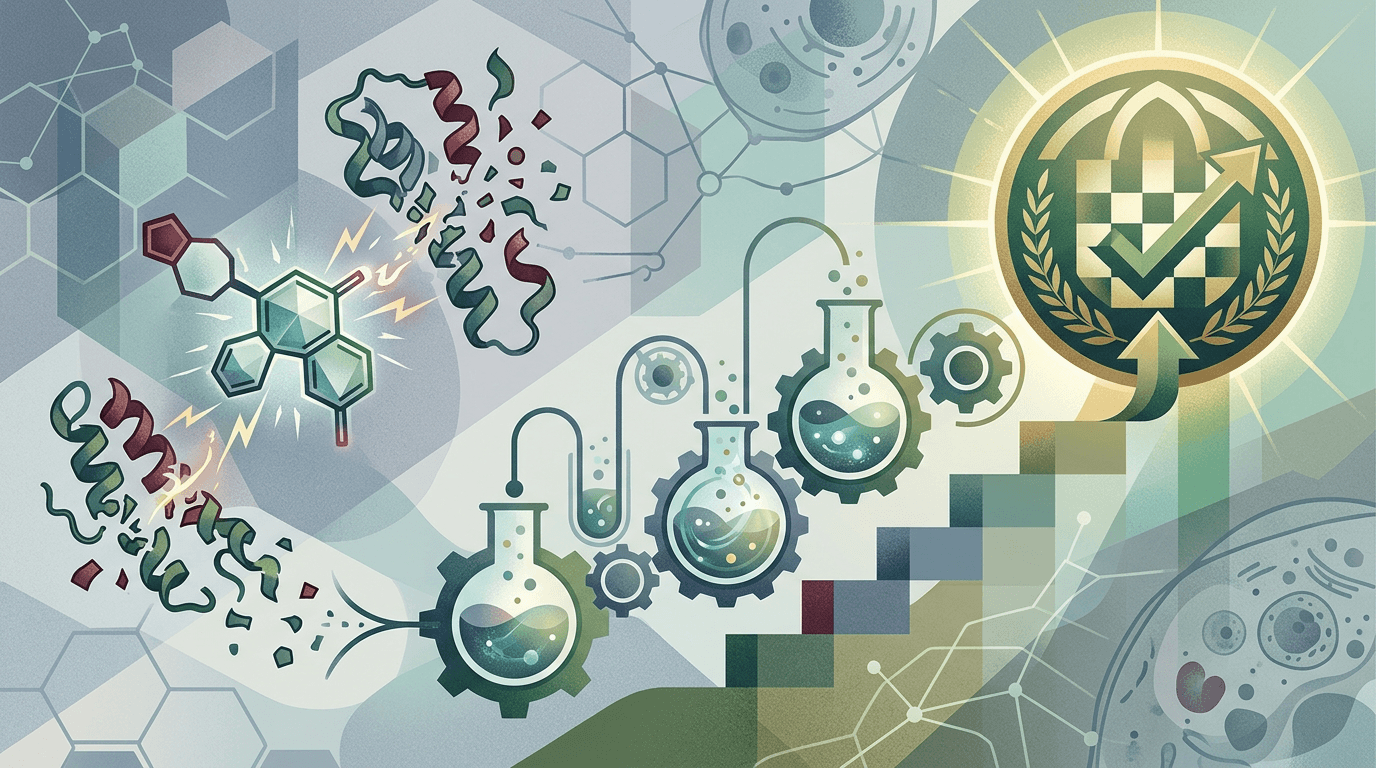

The FDA just approved the first-ever PROTAC drug, a class of medicine that destroys disease-causing proteins instead of blocking them. After 25 years of development, vepdegestrant's green light could reshape how the entire industry thinks about drug design.
For 25 years, the idea sounded almost too clever to work. Instead of blocking a disease-causing protein the way most drugs do (think of a key jammed in a lock), what if you could just destroy the protein entirely? Trick the cell's own recycling system into chewing it up and spitting it out?
That concept now has a name on a prescription bottle. Vepdegestrant, brand name Veppanu, became the first-ever PROTAC drug to win FDA approval on May 1, 2026. And the implications stretch far beyond one breast cancer drug.
Most drugs work like bouncers at a nightclub: they block a troublesome protein from doing its job. PROTACs (proteolysis-targeting chimeras) take a radically different approach. They work more like a matchmaker who introduces a bad protein to the cell's garbage disposal. The PROTAC molecule grabs the target protein with one arm, grabs an enzyme called an E3 ligase with the other, and forces them together. The cell then tags the target for destruction and breaks it down.
The beauty of this trick? One PROTAC molecule can destroy multiple copies of the target protein before moving on to the next one. It's catalytic, not one-and-done.
Craig Crews, a Yale professor, and collaborators published the first proof of concept back in 2001. Their original molecule was a clunky peptide that only worked in a test tube. It took nearly two decades of tinkering (shrinking the molecules, making them orally bioavailable, finding the right cellular machinery to hijack) before the first PROTAC entered human trials in 2019. Arvinas, the company Crews founded in 2013, sponsored that trial and has been the standard-bearer for the technology ever since.
Seven years from first-in-human to FDA approval. Not bad for a drug class that many skeptics once called "too big, too weird, and too complicated to ever work."
Veppanu targets the estrogen receptor (ER), which fuels growth in roughly 70% of breast cancers. Specifically, the drug is approved for adults with that carries a mutation in the ESR1 gene, a genetic change that helps tumors resist standard hormone therapies.

A single IV infusion of Verve's gene-editing therapy slashed LDL cholesterol by 62% and kept it there for over a year. If the safety data hold up, the era of lifelong cholesterol pills might have an expiration date.


Join thousands of biotech professionals who start their day with our free, daily briefing.

This is a population with a real unmet need. The current playbook for ER-positive metastatic breast cancer starts with hormone therapy plus a CDK4/6 inhibitor (drugs like palbociclib or ribociclib). That combination works well initially, but nearly all patients eventually progress. Once they do, options get thin fast. Fulvestrant, the existing ER-targeting injection, offers modest benefit at best in patients whose tumors have picked up ESR1 mutations.
Vepdegestrant goes after those mutant receptors directly, degrading them rather than merely blocking them. Patients take a 200 mg oral tablet once daily with food. No injections, no infusion centers.
The FDA based its decision on the phase 3 VERITAC-2 trial, which pitted vepdegestrant head-to-head against fulvestrant in patients with endocrine-resistant disease.
In the ESR1-mutated population (the group that ultimately defined the label), the results were clear. Median progression-free survival, the time before tumors started growing again, was 5.0 months with vepdegestrant versus 2.1 months with fulvestrant. That translates to a 43% reduction in the risk of disease progression or death.
The response rate told a similar story: 19% of patients on vepdegestrant saw their tumors shrink, compared with just 4% on fulvestrant. The safety profile was manageable; the most common side effects included fatigue, elevated liver enzymes, and low-grade nausea. Discontinuation rates were low at 2.9%.
One important caveat: the trial missed its co-primary endpoint in the broader, all-comers population (which included both ESR1-mutant and ESR1-wild-type patients). Median PFS there was nearly identical between arms. That's why the FDA approved it specifically for ESR1-mutated tumors, with a companion diagnostic (Guardant360 CDx) required to confirm the mutation.
Vepdegestrant's approval is a big deal for Arvinas and its partner Pfizer, sure. The actual launch will depend on how aggressively oncologists test for ESR1 mutations and how quickly payers cover the drug.
But the real earthquake is what this means for every other protein degrader in development. Before May 1, 2026, every PROTAC program carried a silent asterisk: this drug class has never actually been approved. Investors, regulators, and pharma partners all had to take it on faith that a PROTAC could clear the FDA's bar. That asterisk is gone now.
The ripple effects are already visible. Arvinas has additional PROTACs in the clinic targeting the androgen receptor for prostate cancer. Kymera Therapeutics, C4 Therapeutics, Nurix, and several large pharma companies have their own degrader programs spanning oncology, immunology, and neurology. Molecular glues, a related class of protein degraders, also benefit from the precedent; Kymera signed a deal with Gilead around a CDK2-targeted molecular glue in breast cancer just last year.
Before this approval, the question was: "Can a PROTAC even work as a drug?" Now the question shifts to: "Which targets can we go after next?"
The near-term pipeline leans heavily toward oncology: more hormone receptor degraders, kinase degraders, and programs aimed at proteins previously considered "undruggable" by traditional inhibitors. Arvinas itself has flagged ambitions in neurodegenerative and neuromuscular diseases, areas where protein accumulation (think tau in Alzheimer's, or huntingtin in Huntington's) is central to the problem.
Getting a PROTAC into the brain is a different engineering challenge entirely. But the regulatory playbook, the manufacturing know-how, and the clinical pharmacology lessons from vepdegestrant all transfer. The learning curve just got shorter for everyone in the field.
Twenty-five years ago, Craig Crews published a paper about a weird molecule that could hijack a cell's trash compactor. On May 1, 2026, that weird molecule became a prescription drug. Sometimes the best ideas just need time, stubbornness, and a few billion dollars of venture capital to prove the doubters wrong.
Seven years into a clinical trial, more than half of metastatic lung cancer patients on Pfizer's lorlatinib still haven't progressed. Oncologists are starting to whisper the word "cure," and the data might actually justify it.