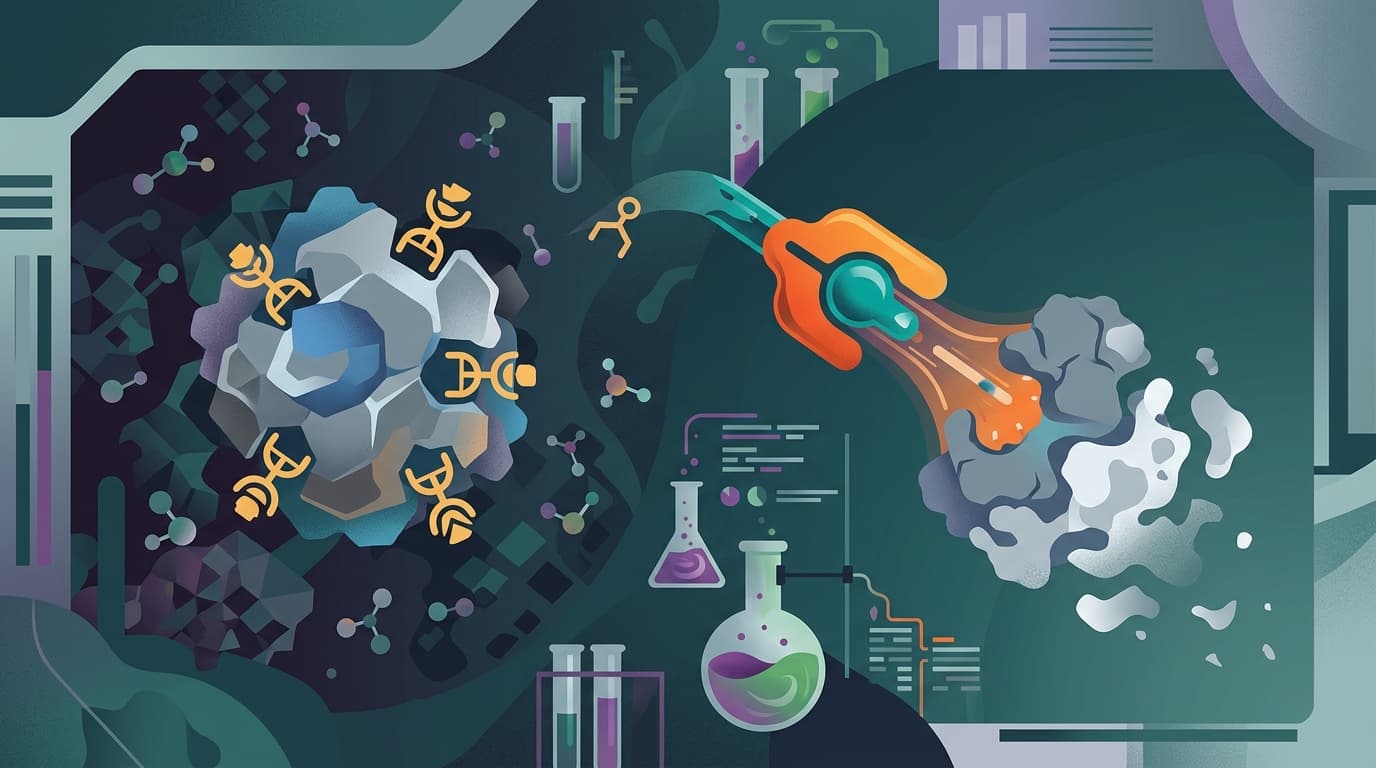

The FDA just approved the first-ever PROTAC therapy, a drug that destroys cancer proteins instead of merely blocking them. Vepdegestrant's approval validates a technology platform two decades in the making and opens a new chapter for precision oncology.
For decades, cancer drugs have worked like bouncers at a club: they block troublemakers from getting in. But what if you could just eliminate the troublemaker entirely?
That's what vepdegestrant does. And on May 1, 2026, the FDA approved it as the first-ever PROTAC therapy to reach patients. The brand name is Veppanu, developed by Arvinas in partnership with Pfizer, and it treats a specific, stubborn form of breast cancer that learns how to dodge standard treatments.
This isn't just another cancer drug approval. It's proof that an entirely new category of medicine actually works in humans.
Most breast cancers (about 70%) grow because estrogen fuels them through a protein called the estrogen receptor. Standard treatments starve these tumors by cutting off estrogen or blocking the receptor. For a while, that works beautifully.
Then something frustrating happens. The gene that codes for the estrogen receptor (called ESR1) mutates. When it does, the receptor switches on by itself, no estrogen needed. It's like a car engine that starts running without a key. Suddenly, all those estrogen-blocking drugs become useless.
This isn't rare. Roughly one-third of patients who progress after first-line treatment with CDK4/6 inhibitors and hormone therapy develop ESR1 mutations. That's tens of thousands of women every year in the U.S. alone, left with dwindling options.
Traditional drugs work by sitting on top of a protein and blocking it. Think of it like putting a padlock on a door. The protein is still there; it's just (hopefully) jammed shut.
PROTACs take a radically different approach. They act as molecular matchmakers, grabbing the target protein with one hand and the cell's own garbage disposal system (the ubiquitin-proteasome pathway) with the other. The cell then chews up and destroys the protein entirely. No protein, no problem.
The technical term is "heterobifunctional protein degrader," which is a mouthful. The simple version: vepdegestrant doesn't just block the broken estrogen receptor. It tags it for destruction. And because one PROTAC molecule can destroy multiple copies of the target, the effect is catalytic rather than one-to-one.

Novo Nordisk killed its entire cell therapy unit last year, leaving the most advanced Parkinson's cell therapy in history without a home. Now a Zuckerberg-backed AI startup has picked it up and is racing toward Phase 2 by year-end.


Join thousands of biotech professionals who start their day with our free, daily briefing.

The FDA based its approval on VERITAC-2, a Phase 3 trial of 624 patients across 26 countries. Among the 270 patients with confirmed ESR1 mutations, the results were striking.
Patients on vepdegestrant went a median of 5.0 months before their cancer progressed. The comparison group, on fulvestrant (the old injectable standard), managed just 2.1 months. That's a 43% reduction in the risk of disease progression or death.
The response rates told a similar story: 19% of vepdegestrant patients saw their tumors shrink meaningfully, compared to only 4% on fulvestrant. And the clinical benefit rate (patients who either responded or stayed stable) was 42% versus 20%.
These numbers won't cure anyone. Five months of progression-free survival is honest, not miraculous. But for patients whose cancer had already outsmarted prior therapies, more than doubling time-to-progression with a daily pill (instead of monthly injections) is genuinely meaningful.
Vepdegestrant comes as a 200 mg pill taken once daily with food. Patients need a confirmed ESR1 mutation detected by the Guardant360 CDx companion diagnostic, which the FDA approved three days after vepdegestrant on May 4, 2026. This is precision oncology in action: a blood test identifies the molecular vulnerability, then the drug exploits it.
The safety profile looks manageable. The main warnings involve QTc interval prolongation (a heart rhythm concern that requires monitoring) and embryo-fetal toxicity.
Vepdegestrant isn't entering an empty field. Elacestrant (Orserdu) won FDA approval back in January 2023 for the same patient population, and Eli Lilly's imlunestrant (Inluriyo) followed in September 2025. All three target ESR1-mutated breast cancer after endocrine therapy failure.
But vepdegestrant's PROTAC mechanism gives it a distinct identity. While elacestrant and imlunestrant are oral SERDs (selective estrogen receptor degraders that work through traditional pharmacology), vepdegestrant hijacks the cell's own protein recycling machinery. Whether that translates to better long-term outcomes remains an open question; overall survival data from VERITAC-2 weren't mature at the time of approval.
Analysts are watching closely. Arvinas stock rose nearly 10% in the days following approval.
The bigger story here might not be about breast cancer at all. It's about validation of an entire technology platform.
PROTACs have been a tantalizing idea since the early 2000s: what if you could destroy any disease-causing protein, including the ones that traditional drugs can't touch? For two decades, that remained mostly theoretical. Academic papers piled up, biotech startups raised billions, but nothing reached patients.
Now something has. Dr. Kristin Riching, an R&D scientist at Promega, called it "a landmark moment for TPD and induced proximity" that proves "rationally designed molecules with catalytic mechanism translate to meaningful clinical outcomes."
Arvinas has additional PROTAC programs in its pipeline. So do dozens of other companies watching this approval closely. If protein degradation works for the estrogen receptor, the logic goes, it should work for other targets that have resisted conventional drug design.
Vepdegestrant's approval is a two-level story. On one level, it gives oncologists a new oral option for patients with ESR1-mutated breast cancer who've run out of good choices. On another level, it proves that an entirely new way of making drugs, one that destroys proteins instead of just blocking them, actually works in the real world.
The clinical data is solid but not spectacular; five months of progression-free survival acknowledges that this disease remains enormously difficult. Combination trials will determine whether PROTACs can deliver more durable responses.
But as proof of concept? This is the kind of approval that textbooks will reference. The first PROTAC crossed the finish line. Now we find out how far the technology can go.
A US-Pfizer pricing deal sent European healthcare stocks soaring by 5.3% in their biggest daily gain since 2008. After a year of apocalyptic drug pricing fears, the actual financial hit looks more like a paper cut than a mortal wound.