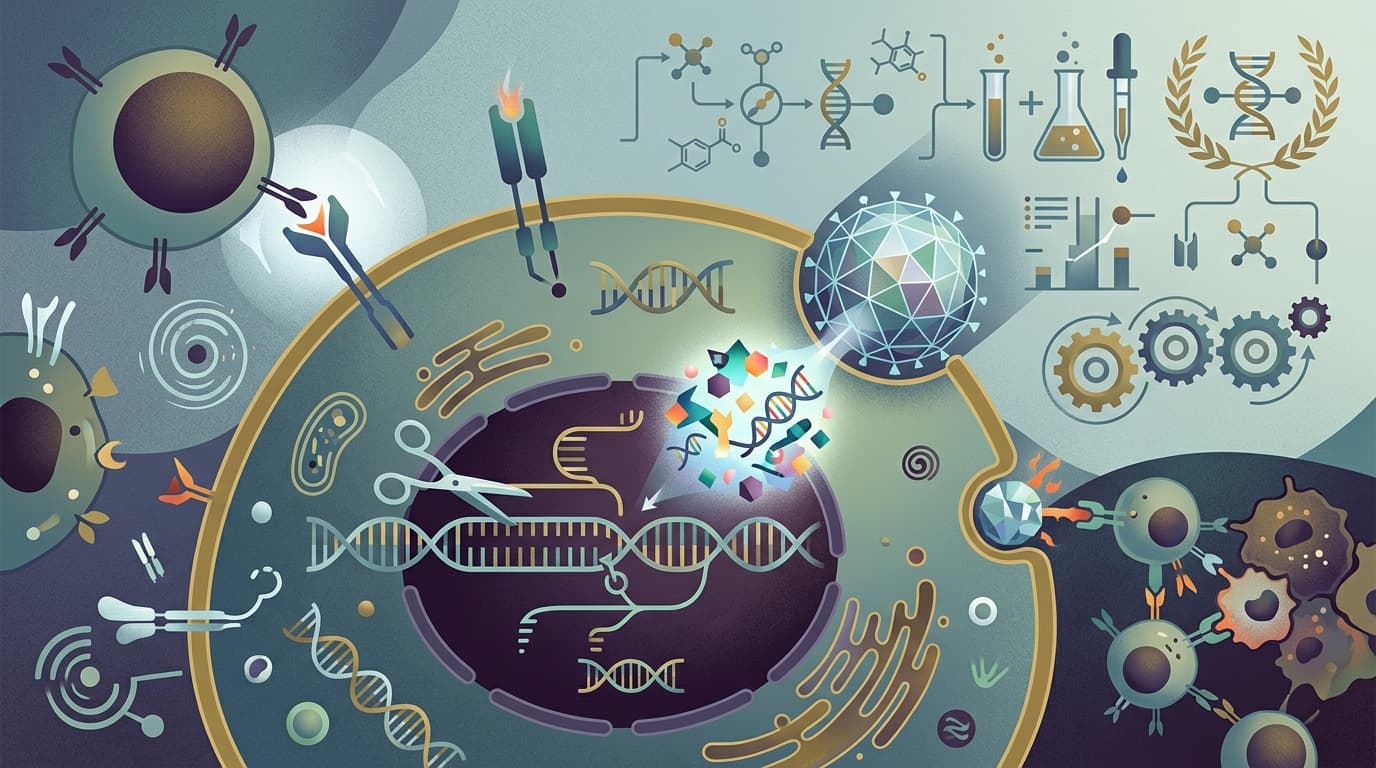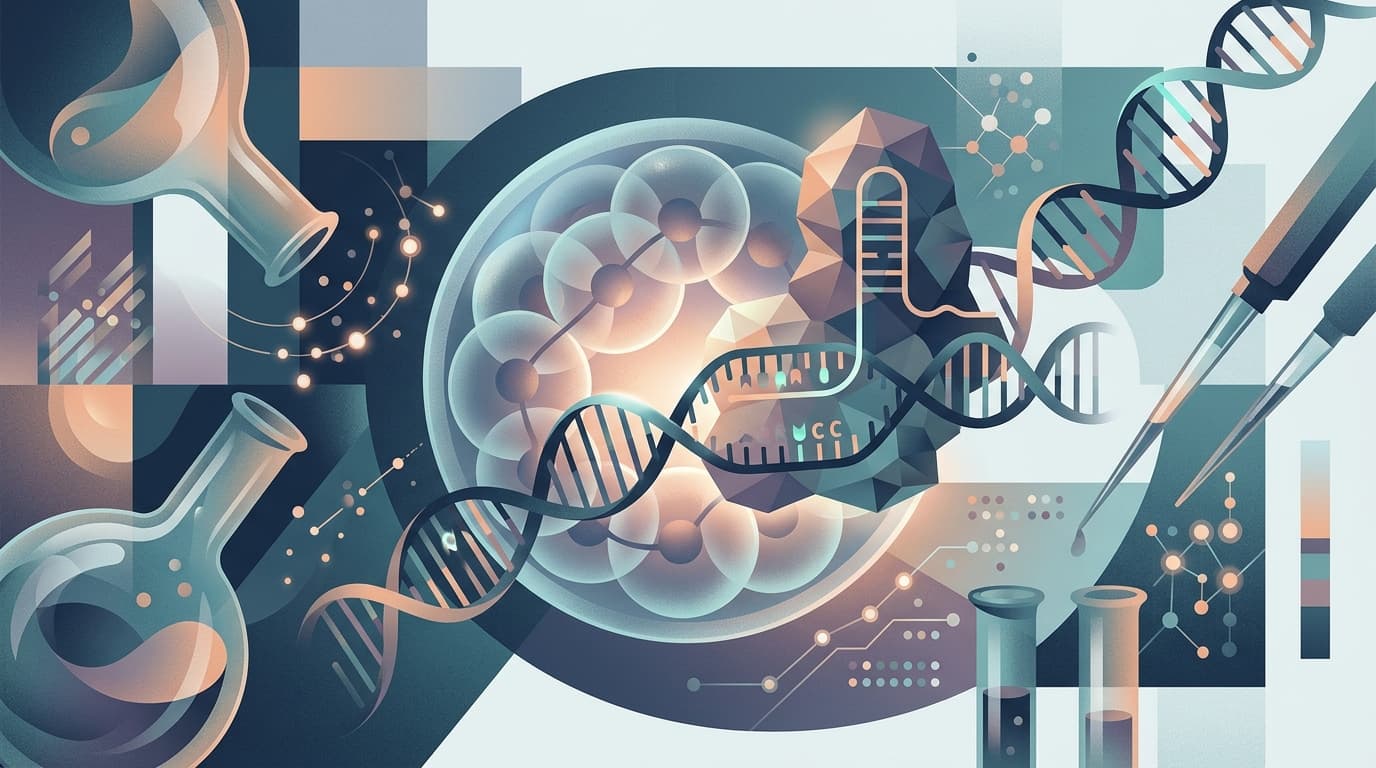

Columbia University scientists pulled off the first-ever base edit of a human embryo, swapping single DNA letters without cutting the double helix. The precision is remarkable; the ethical firestorm is just getting started.
Imagine fixing a typo in a book. You could rip out the whole page and tape in a new one. Or you could just grab an eraser and change the single letter that's wrong. Scientists at Columbia University just did the genetic equivalent of that eraser trick, and they did it in a human embryo for the first time.
This is a big deal. A really big deal.
Traditional CRISPR gene editing works like molecular scissors. It cuts both strands of DNA, then hopes the cell glues things back together correctly. Sometimes it does. Often it doesn't. The result can be messy: random insertions, deletions, even chunks of chromosomes going haywire.
Base editing skips the cutting entirely. Developed by David Liu's lab starting in 2016, the technique uses a modified version of the CRISPR protein that can't make a full cut. Instead, it chemically converts one DNA letter into another at a precise spot. Think of it as a find-and-replace function, but for your genome. One letter in, one letter out, no scissors required.
A team led by geneticist Dieter Egli at Columbia University just used this approach in human embryos for the first time. Their preprint, posted on bioRxiv, describes how they swapped single DNA letters in two genes across donated IVF embryos that were never intended for pregnancy.
Egli's team targeted two genes, each chosen for a practical reason.
First: PCSK9, which controls cholesterol levels. The team introduced a single A-to-G letter swap that shuts down PCSK9 protein production. This mimics a naturally occurring mutation that some lucky people are born with; it gives them naturally low "bad" cholesterol and dramatically lower heart disease risk. Pharmaceutical companies have spent billions developing drugs (like Repatha and Praluent) that do the same thing PCSK9-knockout people get for free.
Second: HBG1 and HBG2, the fetal hemoglobin genes. By changing one letter in a regulatory region, the team coaxed these genes to keep producing fetal hemoglobin after birth. That's significant because higher fetal hemoglobin is known to protect against sickle cell disease and thalassemia.

A tiny German biotech just got approval to test the first non-viral CAR-T therapy in humans, targeting leukemia with a manufacturing approach that costs a fraction of the industry standard. If it works, it could blow open who gets access to cell therapy.

Join thousands of biotech professionals who start their day with our free, daily briefing.
In some experiments, they edited both genes simultaneously in the same embryo. Multiplex base editing at the single-letter level, in a human embryo. That's a sentence that would have sounded like science fiction five years ago.
Getting the base editor into an embryo turned out to be tricky. When the team delivered it as RNA (the standard approach in many gene therapies), the embryos arrested early and stopped developing. Not ideal.
The breakthrough came from switching to pre-formed protein delivery at fertilization. That approach let the edited embryos develop normally all the way to the blastocyst stage, roughly five days of development. The team even derived stem cell lines from the edited embryos, confirming that the edits stuck.
Critically, unlike previous experiments using traditional CRISPR scissors on embryos, the base-edited embryos showed no chromosomal abnormalities or large deletions at the targeted sites. Random insertions and deletions were rare. That's a massive improvement over the mess that standard CRISPR-Cas9 tends to create in embryos.
Before anyone starts designing their future children, there are real limitations.
Mosaicism remains a stubborn problem. Some embryos ended up as genetic patchworks, where only a fraction of cells carried the intended edit. If you're trying to correct a disease-causing mutation in every cell, getting it in only half of them defeats the purpose.
Off-target edits showed up too, particularly with the HBG guide RNA. The PCSK9 guide was much cleaner, but the inconsistency highlights that guide RNA design still matters enormously. Every guide sequence brings its own risk profile.
Egli himself has been clear: this technology should not be used to create a baby right now. The embryos were research-only, used to study how cells repair the nicks and mismatches that base editors introduce.
You can't talk about editing human embryos without talking about He Jiankui, the Chinese scientist who shocked the world in 2018 by creating the first gene-edited babies. He used old-school CRISPR-Cas9 to hack at the CCR5 gene, hoping to confer HIV resistance. The results were sloppy: mosaic mutations, unpredictable alleles, outcomes that nobody fully understood. He went to prison for it.
Egli's work is fundamentally different in both technique and intent. Base editing is more precise, avoids double-strand breaks, and produces far fewer unintended mutations. And nobody is implanting these embryos. But the comparison is unavoidable, because each step forward in embryo editing brings the same uncomfortable question closer: When, if ever, should we allow heritable changes to the human genome?
Reactions from the scientific community have been measured but tense. R. Alta Charo, a prominent bioethicist, called the work an "exciting development" on the safety front while stressing that it forces society to confront the bigger question of whether embryo editing should ever be permitted. On the other side, David Barrett of the American Society of Gene and Cell Therapy called the work "unfortunate," arguing that "science is not ready for heritable human genome editing."
The regulatory landscape isn't much help. There's no universal binding international treaty banning heritable genome editing, though the Council of Europe's Oviedo Convention prohibits it among its roughly 30 ratifying states. The WHO's expert committee said in 2021 that clinical use shouldn't proceed, and called it "irresponsible" in 2019, but that guidance carries no legal teeth. In practice, regulation is a patchwork: the UK allows embryo research under strict licensing but bans implantation; the US effectively blocks it through funding restrictions and FDA constraints. No country currently green-lights reproductive germline editing.
But "not currently allowed" and "impossible" are very different things.
Base editing isn't just an embryo story. It's already in the clinic for non-heritable therapies. Verve Therapeutics is running Phase 1b trials using base editing to permanently lower cholesterol by targeting (you guessed it) PCSK9 in adult liver cells. Beam Therapeutics dosed its first patient with a base-editing therapy for alpha-1 antitrypsin deficiency in July 2024 and is running early trials in sickle cell disease.
The somatic applications (editing cells that won't pass changes to offspring) are advancing rapidly and relatively uncontroversially. Egli's embryo work shows that the same precision tools now work in the germline context too. The technology is converging. The only question is whether society's ethical frameworks can keep up.
We just watched a single DNA letter get changed in a human embryo without breaking anything. That's extraordinary science. What we do with it next is an extraordinarily human question.
Bristol Myers Squibb just crushed Q2 estimates and hiked its 2026 forecast by billions, thanks to a blood thinner that won't quit and a new drug lineup firing on all cylinders. There's just one problem: the biggest patent cliff in pharma history is about 18 months away.