The FDA Just Cleared a Phone App to Treat Schizophrenia. Seriously.
No drug has ever been approved for the negative symptoms of schizophrenia. Click Therapeutics just got FDA clearance for a prescription smartphone app that did what pharma couldn't, and it could reshape how we think about treating serious mental illness.
An App Instead of a Pill
For decades, psychiatrists have faced a brutal reality with schizophrenia. They could quiet the hallucinations. They could dial down the paranoia. But the other half of the disease, the part that robs people of motivation, emotion, and the desire to connect with others, had no approved treatment at all. Not a single one.
Now the FDA has cleared a smartphone app to do what no drug ever could.
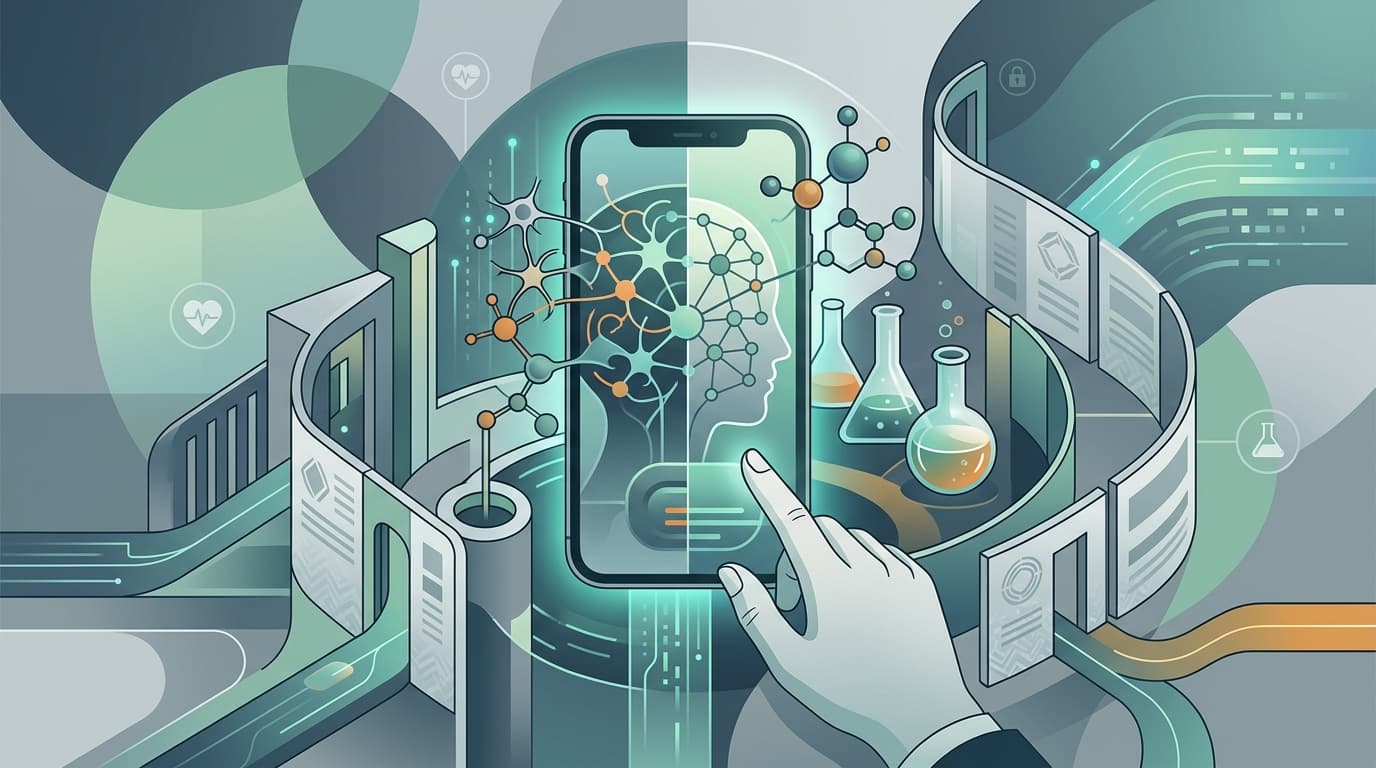
Click Therapeutics announced on October 5 that its prescription digital therapeutic, Motivista, received FDA 510(k) clearance for treating the negative symptoms of schizophrenia. It's the first FDA-authorized treatment of any kind specifically designed for those symptoms in the United States. And yes, it's software on a phone.
The Problem Nobody Could Crack
Schizophrenia's "positive symptoms" are what most people picture when they think of the disease: delusions, hallucinations, disordered thinking. These are the loud, visible features, and antipsychotic drugs can often manage them.
But the disease has a quieter, more devastating side. Negative symptoms are the absences: flattened emotions, loss of motivation, withdrawal from social life, inability to feel pleasure, and reduced speech. Think of it like a phone running out of battery. Everything technically still works, but nothing turns on.
These symptoms are strongly linked to poor long-term outcomes. They make it harder to hold a job, maintain relationships, or live independently. And the reason no pharmacologic therapy has ever earned FDA approval for them comes down to a tangle of problems. Negative symptoms are hard to measure cleanly because they overlap with depression, medication side effects, and cognitive impairment. The syndrome itself is biologically diverse across patients, making it nearly impossible to find one drug target that works broadly. Clinical trials have produced, at best, inconsistent and modest benefits.
Pharmaceutical companies have tried and failed for years. Click Therapeutics took a completely different approach: skip the molecule, ship the software.
Get tomorrow's biotech intelligence before your competitors.
Join thousands of biotech professionals who start their day with our free, daily briefing.
Motivista isn't a meditation app or a wellness tracker. It's a regulated medical device, classified by the FDA as a computerized behavioral therapy device for psychiatric disorders. Patients need a prescription to use it, and it's designed to be used alongside antipsychotic medication and outpatient care.
The specifics of the behavioral intervention haven't been fully detailed publicly, but the concept is straightforward. Instead of targeting a receptor in the brain with a chemical, Motivista delivers structured, software-based behavioral exercises that aim to improve motivation and engagement. It's the difference between fixing a car's engine and teaching someone how to drive it better.
The Trial That Made It Happen
Click's pivotal study was called CONVOKE: a phase 3, multicenter, randomized, double-blind trial. The design was clever. Rather than comparing the app against nothing (which would make blinding impossible), researchers randomized patients 1:1 to either Motivista or a carefully designed digital control app that matched the real thing in engagement and usage frequency. This is the software equivalent of a placebo pill.
Participants were adults with schizophrenia whose positive symptoms were stable on antipsychotics but who had moderate to severe negative symptoms. The intervention ran for 16 weeks, with a screening period up front and follow-up afterward.
The primary measure was the CAINS-MAP, a clinical scale specifically designed to assess motivation and pleasure deficits in schizophrenia. Motivista users improved by 6.8 points on the scale, compared to 4.2 points for the control group. The difference was statistically significant. The safety profile was also favorable, with no serious treatment-related side effects reported.
Those numbers might not sound dramatic, but context matters. In a therapeutic area where every previous attempt at targeted treatment has failed, a statistically significant, clinically meaningful result from a randomized controlled trial is a genuine milestone.
Click Therapeutics: The Company Behind the Screen
Click was founded in 2012 by CEO David Benshoof Klein with the goal of building regulated software-based treatments. The company has stayed private, raising a $52 million Series B in 2021, adding $20 million in venture debt in late 2023, then closing Series C and Series D rounds in 2025 and 2026, respectively.
The Motivista clearance is actually Click's second FDA-authorized product. In 2024, the company (in partnership with Otsuka Pharmaceutical) received clearance for Rejoyn (CT-152), a prescription digital therapeutic for major depressive disorder.
Click's broader pipeline spans insomnia, chronic pain, migraines, smoking cessation, and more. Late last year, the company launched Click SE, a new platform combining software with pharmacotherapy under the FDA's evolving regulatory framework. In total, the company says it has run three successful FDA-grade randomized controlled trials, a track record that's rare in the digital therapeutics space.
A Bigger Story Than One App
Motivista's clearance is significant beyond schizophrenia for two reasons.
First, it pushes digital therapeutics deeper into serious mental illness. Until now, most FDA-cleared digital mental health products have clustered around conditions like insomnia, ADHD, substance use disorders, and depression. A 2024 review counted just 16 FDA-authorized prescription or clinician-directed digital mental health products across all of psychiatry. Schizophrenia represents a meaningful step up in clinical severity, and success here could open the door for digital approaches in other complex psychiatric conditions.
Second, it validates the regulatory pathway. Motivista went through the 510(k) route, which requires showing substantial equivalence to an existing device. As more digital therapeutics get cleared, they create predicates that make the next approval faster. The flywheel is starting to spin.
The Big Question Mark: Will Anyone Pay for It?
This is where optimism meets reality. Click has not disclosed pricing for Motivista, and there's no public information on insurance coverage or reimbursement. The digital therapeutics industry has a well-documented commercialization problem. Even when these products work, getting payers to cover a prescription app (and getting patients to actually use it consistently for 16 weeks) has proven difficult.
The commercial model will likely hinge on positioning Motivista as part of clinician-managed outpatient care, not a standalone consumer product. If psychiatrists prescribe it the same way they prescribe medication, and if insurers treat it accordingly, the path to adoption gets much smoother.
But those are big "ifs." The digital therapeutics graveyard is littered with clinically effective products that couldn't crack the reimbursement code. Pear Therapeutics, which pioneered FDA-cleared digital treatments for substance use disorders, filed for bankruptcy in 2023 despite having approved products on the market.
The Bottom Line
For the roughly 3 million Americans living with schizophrenia, negative symptoms have been the untreatable half of the disease for as long as modern psychiatry has existed. Click Therapeutics just proved that a phone app, rigorously tested in a randomized trial, can make a statistically significant dent in those symptoms.
Whether Motivista becomes a commercial success depends on pricing, payer adoption, and real-world patient engagement. But as a scientific and regulatory achievement, this one is hard to argue with. Sometimes the best medicine isn't a molecule; it's software.
Clinical & Regulatory
4 min read
The Drug That Could Rewrite How We Treat the Most Common Blood Cancer
AbbVie and Genmab's epcoritamab just delivered a 51% reduction in disease progression when added to frontline chemo for the most common aggressive lymphoma. After 30 years of the same standard of care, the first-line DLBCL playbook may finally be getting a rewrite.