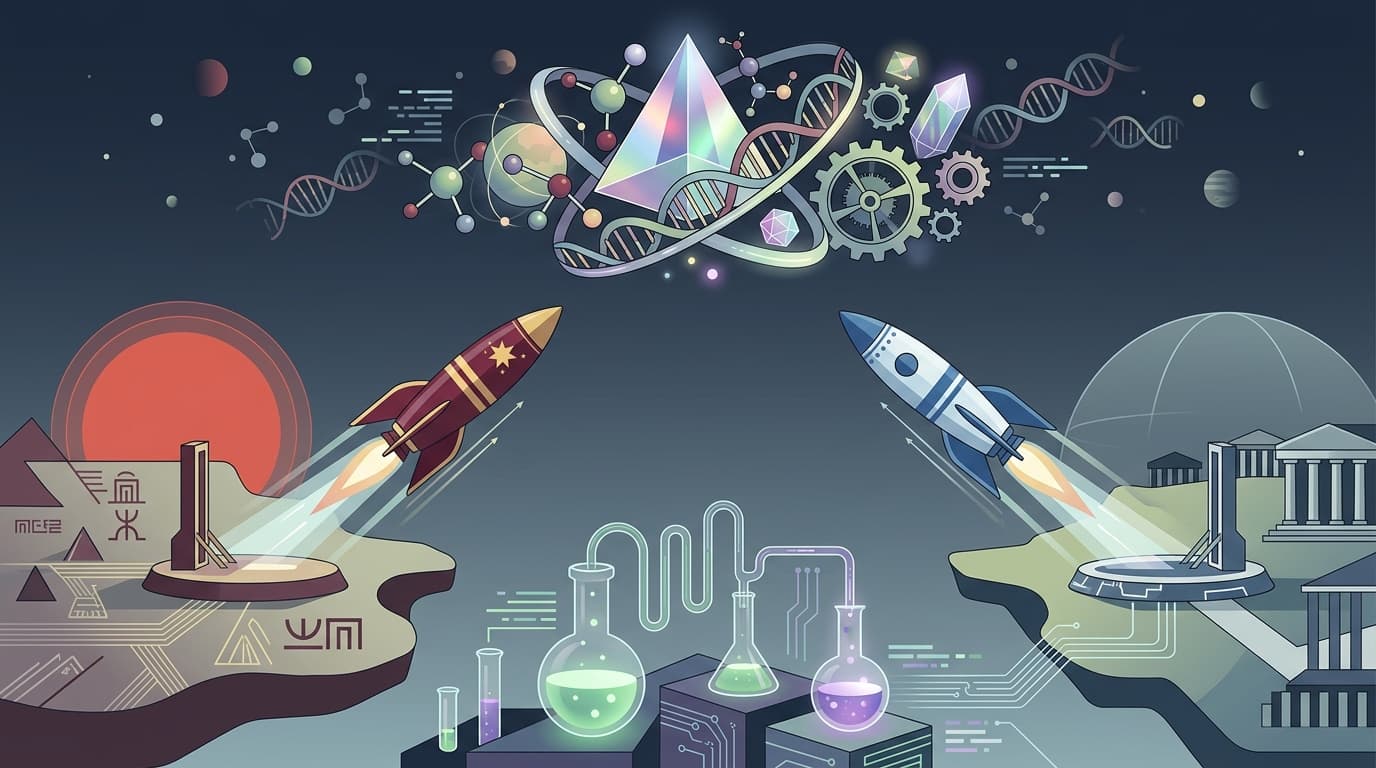
The FDA just built an entirely new office because China's drug development machine is catching up. The agency is speeding up domestic trials while tightening scrutiny on foreign data, and the competitive implications for U.S. biotech are massive.
If you told someone in 2019 that the FDA would one day build an entire office because it was worried about losing to China, they'd have laughed you out of the room. Nobody's laughing now.
On October 1, the FDA quietly stood up a brand-new unit inside its drug review center: the Office of Innovation and Clinical Trial Modernization, or OICTM. Its mission? Speed up how America develops drugs. Its motivation? China is catching up, fast, and the agency knows it.
This isn't just bureaucratic reshuffling. It's a signal that the world's most powerful drug regulator sees competitive pressure from Beijing as an existential threat to U.S. biotech leadership. And it's responding with structural change, not just memos.
The New Kid on the Org Chart
OICTM lives inside CDER's Office of Medical Policy, which already oversees the agency's clinical trial modernization work. The new office has dedicated teams for two areas the FDA clearly thinks will define the next decade: artificial intelligence and real-world evidence analytics.
Think of it like this: if CDER is a hospital, the Office of Medical Policy is the department that decides how surgeries should be done. OICTM is the new innovation lab inside that department, tasked with figuring out whether robots should be doing some of those surgeries instead.
This isn't CDER's only modernization effort, either. Earlier, the agency launched the Center for Clinical Trial Innovation (C3TI) under Kevin Bugin within the Office of New Drugs. That group focuses on expanding innovative approaches to drug development. Now OICTM adds another layer, with a sharper focus on AI tools and real-world data.
The message is clear: one team isn't enough. The FDA is building a small army.
Why China Has the FDA Spooked
Let's talk about why this is happening. China's drug development machine has gone from sluggish copycat to legitimate contender in roughly a decade.
Consider the IND review timeline (that's the application a company files before it can start testing a drug in humans). In China, that review used to take . By 2023, it had collapsed to a median of . That kind of compression is staggering; it's like watching someone go from running a marathon in eight hours to finishing in under three.
Get tomorrow's biotech intelligence before your competitors.
Join thousands of biotech professionals who start their day with our free, daily briefing.
14 months back in 2012
30 working days
The results show up in drug approvals, too. Between 2020 and 2025, China's NMPA (its version of the FDA) approved 94 novel oncology drugs. The FDA approved 87 over the same period. China is now outpacing the U.S. in sheer volume of new cancer drug approvals.
Now, before anyone panics: the FDA is still faster at reviewing drugs once they're submitted. The agency completed reviews a median of 182 days faster than China's NMPA, and approved drugs about 164 days earlier on average. American regulatory science still has a real edge in quality and speed of evaluation.
But that advantage doesn't matter much if all the early-stage research keeps drifting overseas. And that's exactly what's been happening. FDA officials have openly acknowledged that early clinical development is faster and cheaper in China, which pulls more trials out of the U.S.
The Two-Track Strategy
What makes the FDA's response interesting is that it's not just about going faster. The agency is running two plays at once.
Track one: speed things up at home. The new OICTM office is part of a broader initiative called Operation TrialBlazer, which aims to shorten the path from discovery to first-in-human testing. One concrete example is the Expedited IND Pilot Program, which launched on September 15, 2026. Instead of waiting for a company to submit a complete IND package (which can take up to two years to assemble), the FDA will use a rolling review process, evaluating pieces of the application as they come in.
The pilot will accept up to 10 sponsor-institution pairings, and applications close October 30. Partners need to qualify as Qualified Research Institutions, meaning academic medical centers, contract research organizations, or regulatory consultancies with deep expertise across nonclinical, manufacturing, clinical, and regulatory work. It's a small cohort, but it's designed to prove the concept before scaling up.
Track two: get tougher on foreign data. While loosening domestic requirements, the FDA is simultaneously tightening scrutiny of clinical trials run overseas, particularly in China. The agency is expanding its review of foreign trial data and reportedly considering restrictions on China-generated clinical evidence, especially from studies that weren't conducted under an FDA-supervised framework or recently inspected.
It's a carrot-and-stick approach. Make it easier to run trials in America, and harder to rely on data from China. Elegant, if they can pull it off.
A Decade of Quiet Reorganization
If OICTM feels like it came out of nowhere, it didn't. The FDA has been quietly restructuring CDER for the past two years.
In January 2024, the Office of Pharmaceutical Quality was reorganized into five new offices to handle supply-chain complexity. In March 2024, CDER created the Quantitative Medicine Center of Excellence, and in April 2024, it launched C3TI. Later that year, the Office of Medical Policy renamed its Division of Clinical Trial Quality to the Division of Clinical Innovations, a subtle but telling shift from "making sure trials follow the rules" to "helping trials evolve."
The October 2024 broader FDA reorganization formalized many of these changes. OICTM is the latest domino, and probably not the last.
What Modernization Actually Looks Like
So what will OICTM actually do with its AI and real-world evidence teams?
The FDA's modernization playbook for 2025 and 2026 gives us clues. The agency finalized ICH E6(R3), a major update to Good Clinical Practice guidelines that embraces flexible, risk-based approaches to trial monitoring. Instead of rigid checklists, regulators want trials designed around quality from the start.
The agency is also pushing toward decentralized and hybrid trial models, where some activities happen outside traditional hospital sites. Think wearable devices collecting data at home, mobile health units visiting communities, and digital tools replacing in-person check-ins. The December 2025 guidance on enhancing clinical trial participation addressed eligibility criteria, enrollment practices, and trial designs, making this broader direction even more explicit.
And then there's the AI piece. The FDA released draft guidance in 2025 on using AI for regulatory decision-making, covering how machine learning tools can generate or analyze evidence for drug safety and effectiveness. OICTM's dedicated AI team suggests the agency wants to move from "thinking about AI" to "building AI into the review process."
All of this ladders up to one goal: make U.S. clinical trials faster, cheaper, and more accessible without sacrificing rigor. If it works, the competitive calculus with China starts to shift back.
The Bigger Picture
China's biotech ambitions aren't slowing down. The country's current five-year plan (running through 2030) explicitly targets a major leap in global pharmaceutical influence. A McKinsey analysis found that China cut certain development-to-approval timelines from 4.5 years in 2018 to roughly 1 year by 2023. Average time to market for Chinese innovative drugs dropped to 7.2 years in 2023, down from 7.6 the year before.
The U.S. still leads in first-in-class drug development and global regulatory influence. That infrastructure matters enormously.
But infrastructure alone doesn't win a race. You also need urgency, and urgency is exactly what OICTM represents.
The FDA has essentially admitted something regulators rarely say out loud: we're in a competition, and we need to adapt or lose. That's not the language of a sleepy bureaucracy. That's the language of an institution that sees the scoreboard changing.
Whether OICTM, Operation TrialBlazer, and the Expedited IND Pilot will be enough remains an open question. Pilot programs with 10 slots won't transform American drug development overnight. But they set precedents. And precedents, once established, have a way of becoming policy.
For now, the FDA has drawn a line. The race for the future of drug development is officially on, and Washington isn't content to watch from the sidelines.
4 min read
China Just Crashed the Obesity Drug Party
Hansoh Pharmaceutical just posted Phase 3 obesity data that rivals Eli Lilly's best-in-class numbers, and the weight loss curve wasn't even done climbing. The Novo-Lilly duopoly has a new problem, and it's coming from China.