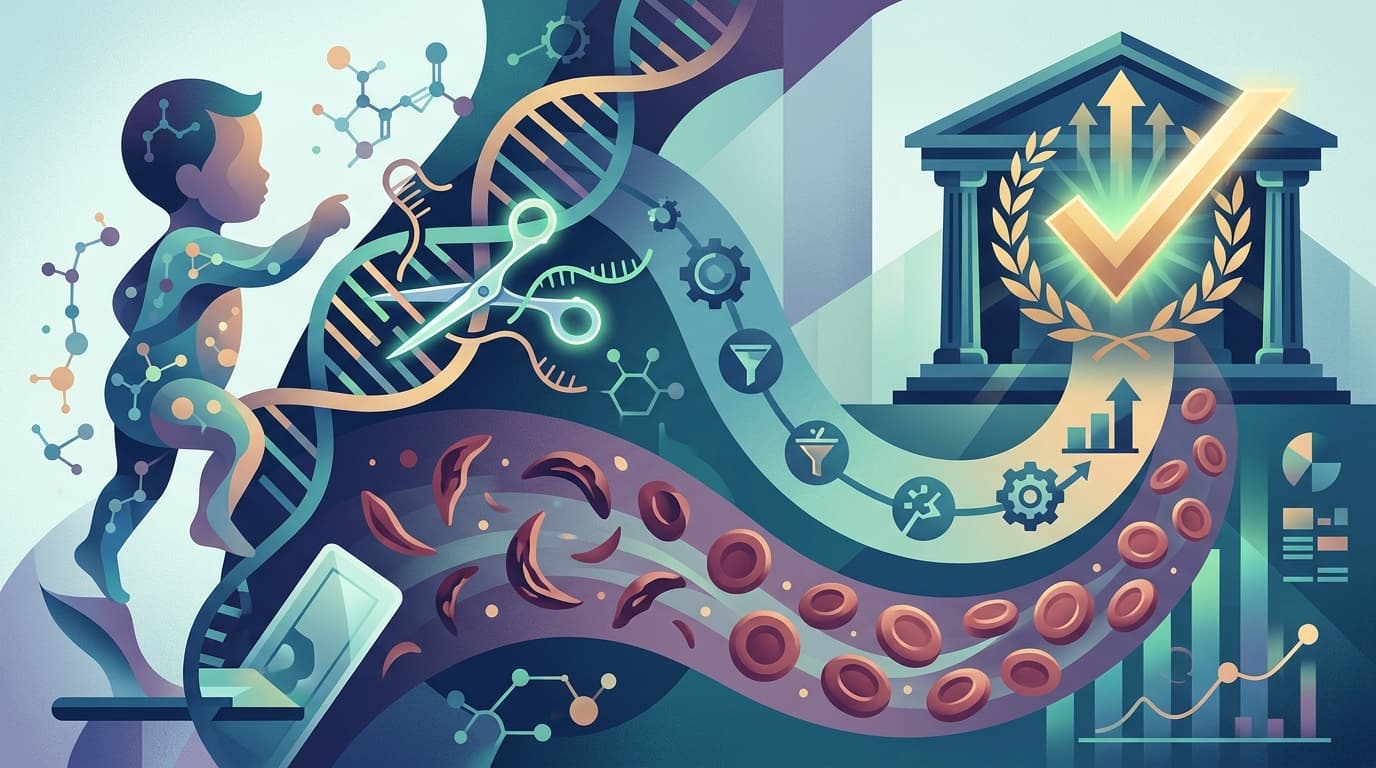
A CRISPR Cure for Two-Year-Olds With Sickle Cell? The FDA Just Said Yes
The FDA just approved Casgevy, the first CRISPR gene therapy for sickle cell disease in children as young as two. The trial data were near-perfect, but at $2.2 million per patient, the real test is whether the kids who need it most can actually get it.
The Clock Starts Ticking at Six Months Old
Imagine a disease that starts destroying your organs before you can walk. That's sickle cell disease for thousands of kids born in the U.S. every year. Misshapen red blood cells clog tiny blood vessels, causing excruciating pain crises, organ damage, and a lifetime of hospital visits. The cruelest part? Much of that damage is silent, invisible on the outside, and irreversible once it sets in.
Now, for the first time, the FDA has approved a gene therapy for children as young as two years old with sickle cell disease. The drug is Casgevy (exagamglogene autotemcel), made by Vertex Pharmaceuticals, and it's the first CRISPR-based treatment cleared for this age group. Previously, the therapy was only available to patients 12 and older.
This isn't just a label tweak. It's a fundamental shift in when we can intervene against one of the most common genetic diseases on the planet.
Why Waiting Until 12 Was a Problem
Sickle cell disease doesn't politely wait for a child to grow up before it starts causing harm. Complications can appear as early as five to six months of age, with painful swelling in the hands and feet (called dactylitis) and dangerous pooling of blood in the spleen. By six months, the disease is actively damaging organs.
Think of it like water damage in a house. A small leak might not look like much at first, but by the time you notice the warped floors and mold behind the walls, the structural damage is already done. That's what happens inside the bodies of kids with sickle cell. Kidney injury, brain blood vessel problems, and lung damage can all progress silently for years, only showing up on screening tests. Once established, much of that damage is permanent.
So when the only gene therapy option required waiting until age 12, doctors were essentially watching the leak for a decade before they could call the plumber. The pediatric expansion to age two changes that calculus entirely.
Get tomorrow's biotech intelligence before your competitors.
Join thousands of biotech professionals who start their day with our free, daily briefing.
Casgevy uses CRISPR-Cas9 gene editing, which works a bit like a molecular find-and-replace tool. Doctors collect a patient's own blood stem cells, edit them in a lab to fix the underlying genetic problem, and then infuse them back into the patient after chemotherapy clears out the old, faulty cells.
The goal: get the body to produce healthy red blood cells instead of the sickle-shaped ones that cause all the trouble. It's not a pill you take every day. It's designed to be a one-time, potentially curative treatment.
The catch? The whole process takes roughly 8 to 12 months from start to finish and requires treatment at specialized transplant centers. It also comes with a list price of $2.2 million. (We'll get to that.)
The Data That Made the FDA Move
The approval for younger kids leaned heavily on a study called CLIMB-151, which tested Casgevy in children ages 5 to 11 with severe sickle cell disease. The results were striking: 100% of evaluable children were free of painful vaso-occlusive crises (the hallmark agonizing pain episodes) for at least 12 consecutive months. Every single one also stayed out of the hospital for severe crises during that period.
For context, the earlier pivotal study in patients 12 and older showed 93.5% of patients achieving the same milestone. A perfect score in the younger group is a high bar to clear, and it gave regulators the confidence to push the age floor all the way down to two.
On average, treated children in the pediatric study remained crisis-free for 19 months during the follow-up window. For kids who were previously cycling in and out of emergency rooms, that kind of result is transformative.
$2.2 Million: The Elephant in the Waiting Room
Casgevy's sticker price is $2.2 million per patient, and that doesn't include the months of hospitalization, chemotherapy, and supportive care that surround the treatment. For comparison, the other FDA-approved sickle cell gene therapy, Lyfgenia (a different technology using lentiviral gene addition), costs $3.1 million.
About 100,000 Americans live with sickle cell disease. More than 90% are Black or African American, and a disproportionate share are covered by Medicaid. The intersection of a multi-million-dollar therapy with a patient population that already faces systemic healthcare disparities creates an obvious access problem.
Treatment is only available at large, specialized transplant centers. Insurance coverage remains uncertain in many states. And the manufacturing process is complex and individualized, which limits how many patients can be treated at once. The therapy might be revolutionary in theory; whether it reaches the kids who need it most is a different question entirely.
The Experts Are Cautiously Thrilled
Children's Hospital of Philadelphia (CHOP), which contributed to the evidence base, welcomed the approval as a transformative development. That's not language you hear from a major academic medical center every day.
The Sickle Cell Disease Association of America's MARAC chapter expressed excitement but also urged caution. The group specifically flagged the need for families to discuss infertility risk with a sickle cell specialist before treatment, since the required chemotherapy can affect fertility. They also stressed the importance of long-term follow-up for children this young.
The FDA's labeling reflects those concerns, carrying warnings for potential complications including neutrophil engraftment failure (when the new cells don't take hold properly), delayed platelet recovery, allergic reactions, and the theoretical risk of off-target genome edits. CRISPR is precise, but it's not perfect, and editing the genes of a toddler carries stakes that demand serious family counseling.
The Bigger Picture: A Race Against the Disease
Right now, the standard of care for young children with sickle cell is hydroxyurea, a decades-old drug that reduces pain crises and can improve survival. But real-world data paint a sobering picture: in a 2019 Medicaid population, less than half of eligible children were actually using it. Screening for stroke risk, recommended annually for kids ages 2 to 16, also reached fewer than half of those who needed it.
Bone marrow transplants from matched donors have been the only other curative option, but suitable donors are hard to find, and the procedure carries significant risks. Gene therapy sidesteps the donor problem entirely by using a patient's own cells.
With roughly 1,800 to 2,000 babies born with sickle cell disease in the U.S. each year, the pipeline of children who could benefit from earlier treatment is large and growing. The FDA's decision to approve Casgevy for kids as young as two signals a broader belief: when you have a disease that starts destroying organs in infancy, waiting for a cure is a luxury these patients can't afford.
The science is here. The question now is whether the healthcare system can keep up.
Deals & M&A
4 min read
Tarsus Just Bet $800 Million on a Disease With Zero Treatments
Tarsus Pharmaceuticals is spending up to $800 million to acquire Alkeus and its late-stage Stargardt disease therapy, a rare eye condition with zero approved treatments. It's a bold bet on rare disease pricing in a market where nobody has planted a flag yet.