
The FDA just approved the first-ever treatment for Sanfilippo syndrome, a fatal childhood brain disease. Ultragenyx's one-time gene therapy costs $3.95 million per dose, and the company desperately needed the win after its stock cratered weeks earlier.
Imagine watching your toddler hit every milestone: first words, first steps, first time stacking blocks into a wobbly tower. Now imagine all of it slowly unraveling. Speech fading. Motor skills disappearing. Personality slipping away.
That's Sanfilippo syndrome type A, a rare genetic disease that destroys a child's brain from the inside out. It's progressive, it's brutal, and until this week, there was zero FDA-approved treatments for it. Parents could only watch.
On September 17, 2026, the FDA changed that. It granted full approval to Fayuvi, a one-time gene therapy made by Ultragenyx Pharmaceutical, for pediatric patients with Sanfilippo syndrome type A (also called MPS IIIA). It's the first approved treatment for this disease, ever.
The price tag? $3.95 million for a single dose.
Sanfilippo syndrome type A is caused by a missing enzyme that normally breaks down a sugar molecule called heparan sulfate. Without that enzyme, heparan sulfate builds up in the brain like trash piling up when the garbage trucks stop coming. Over time, it destroys neurons and steals a child's cognitive and physical abilities.
The disease is ultra-rare. In the U.S., prevalence sits around 0.52 per million people. Globally, estimates suggest roughly 3,000 to 5,000 patients live in commercially accessible regions. Many more likely go undiagnosed because the early symptoms (behavioral issues, sleep problems, developmental delays) can mimic other conditions.
Until now, the only "treatment" was supportive care: managing seizures, helping with feeding, controlling behavior. Essentially, making children as comfortable as possible while the disease ran its course. It's the kind of unmet medical need that makes you wonder why it took this long.
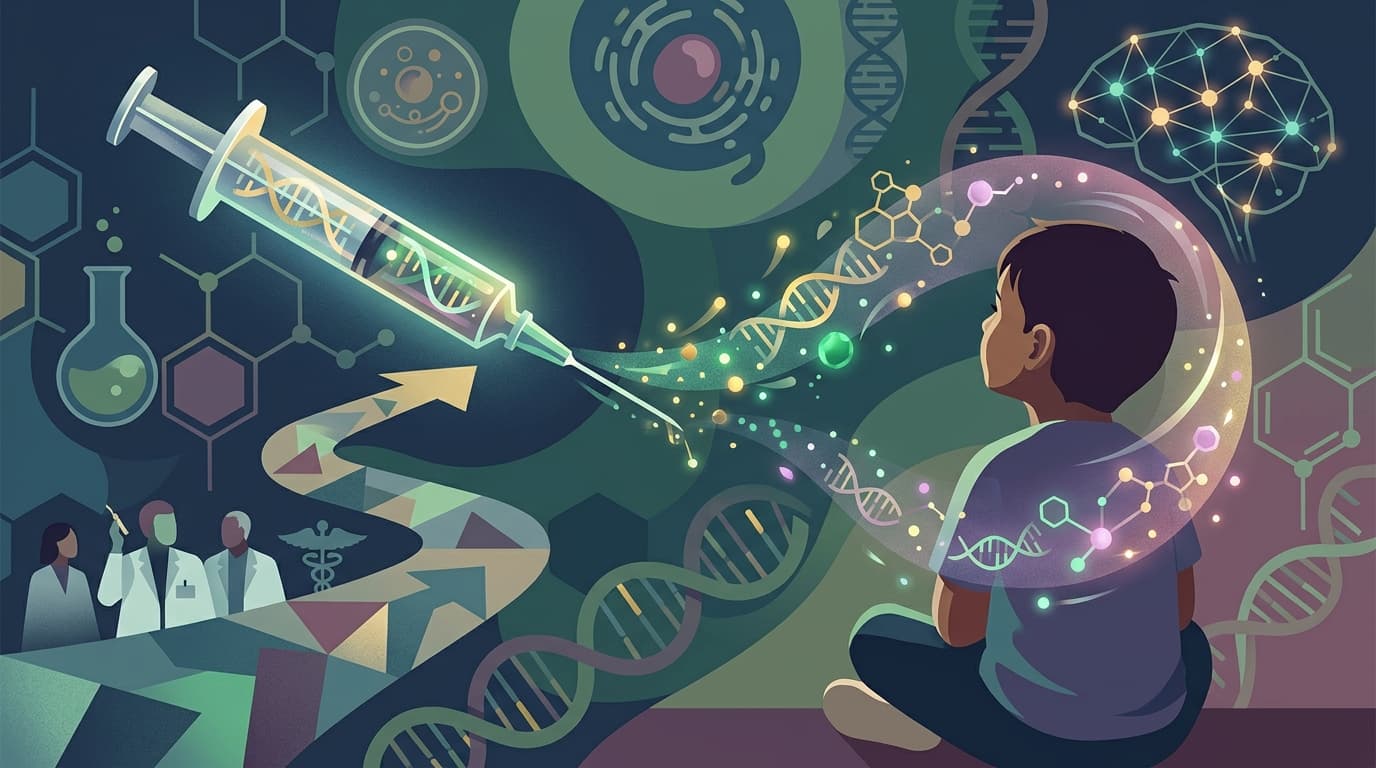
Fayuvi works by delivering a functional copy of the missing gene directly into a patient's body using an AAV vector (think of it as a tiny biological delivery truck that drops off genetic instructions to cells). One infusion. One shot at rewriting the trajectory of the disease.

Bristol Myers Squibb just killed a $100 million drug program before its trial even finished, and the fallout goes way beyond one company's balance sheet. The world's only clinical-stage degrader-antibody conjugate is now dead, leaving an entire emerging drug class without proof it works in humans.


Join thousands of biotech professionals who start their day with our free, daily briefing.
The pivotal trial, called Transpher A, compared 17 treated kids to 27 untreated children from a natural history study.
The results were striking. Treated children scored 23.5 points higher on cognitive testing than their untreated counterparts, with a p-value below 0.0001. In plain English: the difference was enormous, and it almost certainly wasn't a fluke.
Even more encouraging, long-term follow-up data showed the benefit held up for nearly eight years. Kids maintained or improved their cognitive function, communication skills, and motor abilities. For a disease defined by relentless decline, stabilization alone would be remarkable. Improvement borders on extraordinary.
The safety profile included some expected issues: elevated liver enzymes, nausea, fever, and drops in white blood cell and platelet counts. The label also carries a warning about thrombotic microangiopathy (TMA), a serious blood vessel condition. These aren't trivial risks, but for a fatal disease with no alternatives, the calculus looks very different.
Let's talk about the number everyone will fixate on. At $3.95 million, Fayuvi is the second most expensive therapy in the United States, trailing only Lenmeldy (for metachromatic leukodystrophy) at $4.25 million. It leapfrogs Hemgenix for hemophilia B ($3.5 million), Casgevy for sickle cell disease ($2.2 million), and Zolgensma for spinal muscular atrophy ($2.125 million).
Is that price justified? The math depends on your perspective. Ultragenyx would argue (and they're not entirely wrong) that a one-time treatment for a fatal childhood disease, given to a tiny patient population, simply can't be priced like a cholesterol pill. The R&D costs get spread across hundreds of patients instead of hundreds of thousands. The economics of ultra-rare disease are genuinely brutal for drugmakers.
On the other hand, $3.95 million is still $3.95 million. Ultragenyx says it will distribute Fayuvi through Qualified Treatment Centers and offer its UltraCare program to help families navigate insurance coverage and logistics. That's corporate-speak for "we know this is going to be a nightmare to get covered, so we're hiring people to fight with insurers on your behalf."
The specialized distribution model could also slow access. Even when insurance agrees to pay, patients need to reach one of these designated centers. For a family in rural America with a sick child, that's another barrier.
The Fayuvi approval didn't happen in a vacuum. Just two weeks earlier, on September 2, 2026, Ultragenyx's stock cratered roughly 45% in after-hours trading after its Phase 3 Angelman syndrome trial for GTX-102 (apazunersen) completely missed its primary endpoint. Analysts called it a "clean fail," which is Wall Street's polite way of saying "this drug doesn't work."
The fallout was swift. JPMorgan downgraded the stock to Neutral and slashed its price target from $80 to $36. Baird cut its target from $40 to $16. The stock eventually touched a 52-week low of about $13.78, reflecting a roughly 53% decline over the prior year.
So Fayuvi's approval isn't just a win for patients; it's a lifeline for Ultragenyx's credibility. The company has been positioning itself as a multi-product rare disease company, with gene therapies for glycogen storage disease (DTX401, with a PDUFA date expected in Q3 2026), Wilson disease (UX701), and OTC deficiency (DTX301) all moving through the pipeline.
The Angelman failure threatened to undermine that entire narrative. Fayuvi's approval, backed by real clinical data and a full (not accelerated) FDA nod, at least partially restores the story.
Fayuvi's approval is a genuine milestone for the Sanfilippo community. Families who had nothing now have something. The clinical data is real, the benefit is durable, and the FDA gave it a standard approval based on actual cognitive outcomes, not a surrogate biomarker.
But it also crystallizes the tension at the heart of gene therapy's promise. These treatments can be transformative for individual patients while being almost impossibly expensive for health systems. As more ultra-rare gene therapies reach the market, each one carrying a multi-million-dollar price tag, the question of who pays (and who gets left out) only gets louder.
For one small group of children and their families, though, September 17 was the day the impossible became possible. That's worth celebrating, even as we argue about the bill.
Novartis killed its ALS drug lifonebart after a Phase 2 trial missed every endpoint, adding to a decades-long streak of industry failures against one of neuroscience's most stubborn diseases. But the company's next move tells a different story.