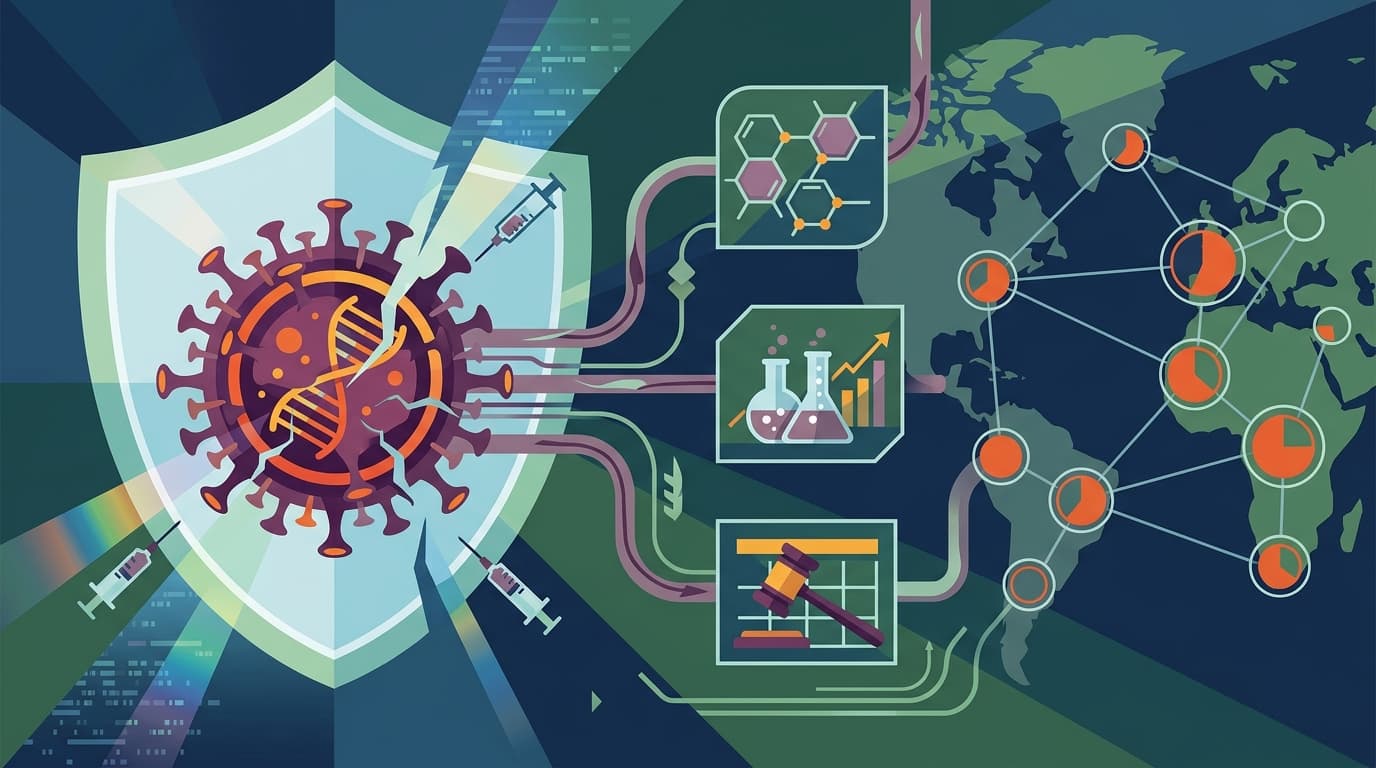

The Ebola strain spreading across Central Africa isn't the one we built vaccines for. With over 2,400 cases and no approved treatments, the U.S. just launched a crash vaccine program for a virus that's been hiding in plain sight since 2007.
Imagine if a fire broke out and every truck in the station was built to fight a different kind of fire. That's roughly where the world stands with Ebola right now.
The strain tearing through Central Africa isn't the one we prepared for. It's not the Zaire strain that killed thousands in West Africa in 2014. It's not the strain that Merck's Ervebo vaccine was designed to stop. It's Bundibugyo, a genetic cousin that differs from Zaire Ebola by more than 30% at the genomic level. And as of mid-July, it has infected 2,423 people in the Democratic Republic of Congo alone, killing 967 of them.
The U.S. government just kicked its biodefense machine into high gear to build a vaccine from scratch. The question is whether it can move fast enough.
Bundibugyo ebolavirus was first identified in 2007, when a mysterious hemorrhagic fever swept through a remote district in western Uganda. Scientists at the CDC in Atlanta confirmed it was an entirely new Ebola species, the fifth ever discovered. The outbreak killed about 39 people. A smaller flare-up hit the DRC in 2012. Then, for over a decade, Bundibugyo went quiet.
That silence was part of the problem. Global Ebola preparedness focused almost entirely on the Zaire strain, which historically kills 60 to 90% of those infected in untreated outbreaks. Bundibugyo, with a lower (but still terrifying) fatality rate of 30 to 50%, simply didn't command the same attention. No one built a vaccine for it. No one approved a treatment.
So when infections began surfacing in Ituri Province in early 2026, the medicine cabinet was essentially bare.
The timeline is sobering. Early infections likely started in January or February in Mongbwalu, a mining town in Ituri. By May 15, both the DRC and Uganda had formally declared Bundibugyo outbreaks. WHO declared it a Public Health Emergency of International Concern just two days later.
That designation isn't handed out casually; it signals that the outbreak poses a risk beyond national borders. And the numbers proved the concern justified. By early June, there were 378 confirmed cases. By July 1, the DRC had blown past .

Intellia's single-dose CRISPR therapy slashed HAE attacks by 87% in Phase 3, with zero serious side effects. Now the company is racing toward what could be the first FDA approval for a gene-editing treatment that works directly inside the body.


Join thousands of biotech professionals who start their day with our free, daily briefing.

The virus kept spreading. By mid-July, WHO counted 2,145 confirmed cases across the DRC, Uganda, and even a single imported case in France. As of July 19, DRC government figures showed 2,423 cases and 967 deaths across five provinces: Ituri, North Kivu, South Kivu, Haut-Uele, and Tshopo. What started in one province had fanned out across a region roughly the size of Texas.
With no approved vaccine or treatment for Bundibugyo, the response has become a two-track race: deploy experimental therapies right now while building strain-specific vaccines for the months ahead.
On the treatment side, Mapp Biopharmaceutical's MBP134 is the lead candidate. It's a cocktail of two engineered monoclonal antibodies (think of them as lab-made proteins that latch onto the virus and neutralize it). MBP134 was designed to work against multiple Ebola species, not just Zaire. The U.S. government shipped doses to the DRC for both compassionate use and a formal clinical trial.
That trial, launched on July 2 in Bunia, Ituri Province, is a big deal. Run by the DRC's National Institute for Biomedical Research, the University of Oxford, and the Institute of Tropical Medicine in Antwerp (with WHO backing), it's testing four approaches: standard supportive care alone, care plus MBP134, care plus Gilead's remdesivir, and care plus both drugs combined. The goal is to measure survival at 28 days. Researchers plan to enroll 700 to 1,000 patients, which means definitive results could take months.
On the vaccine front, BARDA (the U.S. Biomedical Advanced Research and Development Authority) put out a request for proposals to develop Bundibugyo-targeted vaccines using the same platform behind Ervebo, Merck's approved Zaire Ebola vaccine. Think of a platform like a chassis; you swap in a different engine (the Bundibugyo protein) and hope the vehicle still runs.
Meanwhile, the U.S. State Department committed $50 million to CEPI, the Coalition for Epidemic Preparedness Innovations, to accelerate lab work, clinical trials, and manufacturing. CEPI is already funding multiple shots on goal: Oxford and the Serum Institute of India are developing a viral-vector candidate called ChAdOx1-BDBV (up to $8.6 million in funding). IAVI has an rVSV-based candidate ($3.2 million). Moderna is working on an mRNA vaccine (up to $50 million from CEPI, the single largest commitment). Public Health Vaccines has another rVSV candidate ($1.9 million).
None of these candidates are anywhere close to deployment today.
The Bundibugyo crisis is a stress test for everything the U.S. built after COVID. The National Biodefense Strategy calls for enrolling trial participants within 14 days of identifying a viable countermeasure. It also targets domestic capacity to produce enough vaccine doses within 130 days of a major biological event. Those are ambitious benchmarks, and this outbreak is measuring them in real time.
For biotech investors, the signal is clear: pan-ebolavirus antibodies like MBP134 and modular vaccine platforms (rVSV, mRNA, viral-vector) are the technologies with staying power. A narrowly targeted product works great until the wrong strain shows up. Broadly active therapies and swappable platforms hedge against that exact scenario.
The catch? Bundibugyo is a small, urgent market with no obvious commercial payoff. Development depends almost entirely on public funding, government procurement, and organizations like CEPI. If the trial data for MBP134 look good, it could build the case for permanent stockpiles of pan-ebolavirus treatments, a kind of insurance policy for future outbreaks.
Right now, WHO still rates the risk in the DRC as "very high." The virus is reaching new health zones. Cases are climbing. And the only tools in the field are experimental, unproven, and limited in supply.
The post-COVID biodefense infrastructure was supposed to make moments like this faster and less chaotic. It's being put to the test against a virus that's been quietly waiting since 2007 for its turn on the world stage. Whether the response is fast enough will depend on how quickly trials produce answers and how fast factories can turn molecules into vials.
The fire is burning. The trucks are being built on the way to the scene.
A tiny biotech called Oruka just posted psoriasis clearance rates that numerically beat AbbVie's $17.6 billion juggernaut Skyrizi, and it might only need one shot a year. Wall Street is losing its mind.