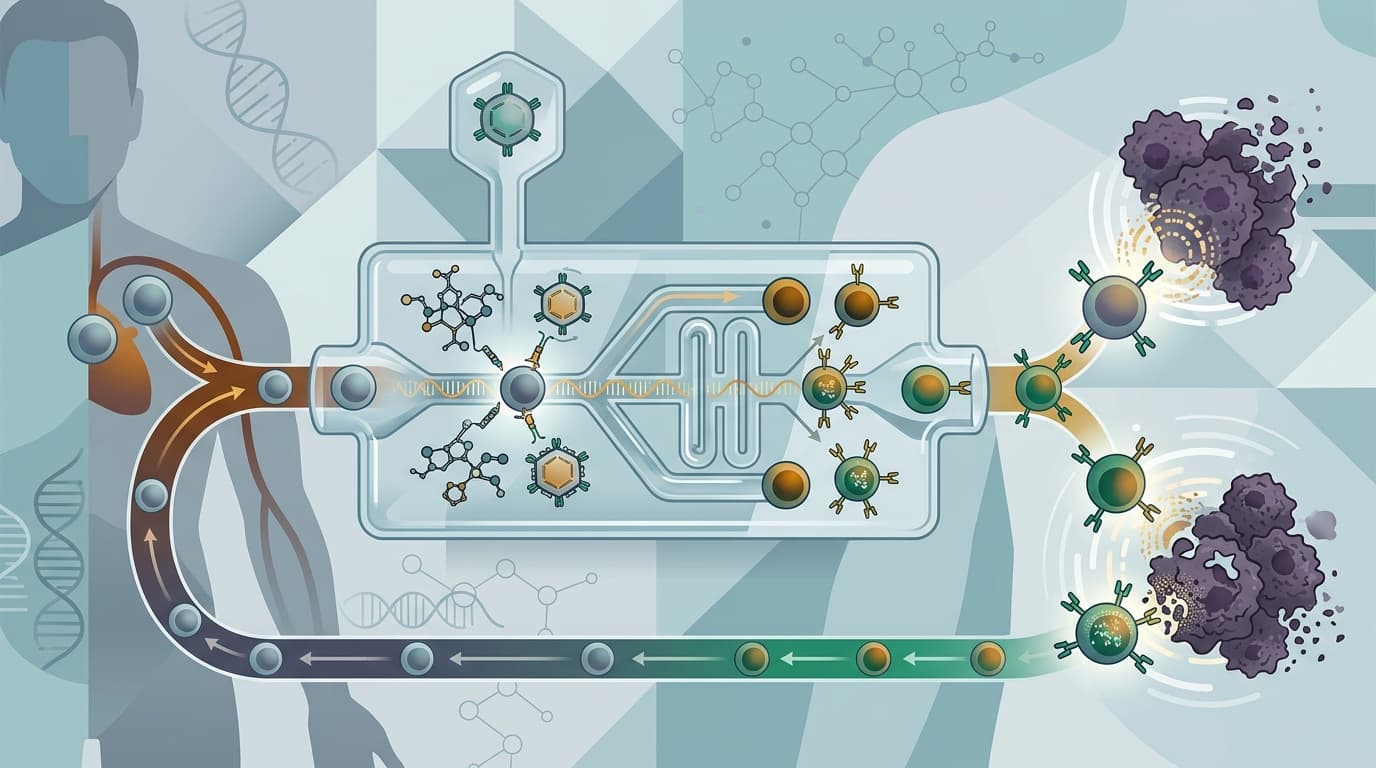

RiboX Therapeutics just got FDA clearance to test the first circular RNA-based in vivo CAR-T therapy in humans. Instead of extracting and reprogramming your T cells in a factory, RXIM002 aims to do it inside your body with a single injection. The Phase 1 trial could rewrite the rules of cell therapy.
Traditional CAR-T therapy is a logistical nightmare. Doctors extract a patient's T cells, ship them to a specialized facility, genetically reprogram them over several weeks, then ship them back and infuse them. It's like sending your car to a factory in another state every time you need an oil change. The process works, but it's slow, expensive, and limited to a handful of patients at a time.
Now a small biotech wants to skip the factory altogether.
On August 8, RiboX Therapeutics announced that the FDA cleared its investigational new drug (IND) application for RXIM002, a therapy that programs your T cells inside your body using a single injection. No extraction. No factory. No weeks of waiting. The company calls it the world's first circular RNA-based in vivo CAR-T therapy to reach this regulatory milestone, and it's heading into a Phase 1 trial called POPULUS-1.
If the concept works, it could reshape how we think about cell therapy for millions of autoimmune disease patients.
Let's unpack the science without making your eyes glaze over.
CAR-T therapy teaches your immune cells to recognize and attack specific targets. In traditional CAR-T, that teaching happens in a lab. RiboX's approach delivers the lesson plan directly into the body using two key innovations stacked on top of each other.
First, there's the delivery vehicle: a targeted lipid nanoparticle (tLNP). Think of it as a tiny, GPS-enabled envelope that finds your T cells and drops off a package. LNPs are the same basic technology that powered COVID mRNA vaccines, but RiboX's version is designed to seek out specific immune cells rather than just floating around.
Second, there's the cargo inside that envelope: circular RNA. Regular mRNA (the kind used in COVID vaccines) is a straight strand with exposed ends that your body chews up pretty quickly. Circular RNA, as the name suggests, forms a closed loop with no free ends for enzymes to grab onto. That means it sticks around longer and produces protein more steadily. It's the difference between a candle and a slow-burning log.

Join thousands of biotech professionals who start their day with our free, daily briefing.

The circular RNA inside RXIM002 encodes a CD19-targeting CAR, which is the molecular instruction set that tells T cells to go after CD19-expressing B cells. CD19 is the same target used in blockbuster CAR-T therapies like Kymriah and Yescarta, so the biology is well understood. The novelty here is entirely in how the instructions get delivered.
RiboX isn't starting with cancer. Instead, the POPULUS-1 trial will enroll patients with relapsed or refractory autoimmune cytopenias, a group of conditions where the immune system attacks its own blood cells. Patients cycle through steroids, rituximab, immunosuppressants, and sometimes even splenectomy, but many relapse repeatedly. The unmet need is real: current treatments often work initially but don't provide lasting control, leaving patients trapped on chronic immunosuppression.
Autoimmune disease has become the new proving ground for CAR-T approaches because the risk-benefit math is different from cancer. These patients aren't terminal, so the therapy needs to be safer and simpler. An off-the-shelf injection that avoids the intensive manufacturing process of traditional CAR-T could be exactly the kind of approach that makes cell therapy practical for autoimmune conditions.
One interesting regulatory detail: the FDA reportedly allowed an accelerated dose-titration scheme and approved a subcutaneous formulation as part of the development plan. That subcutaneous angle is notable because it suggests RiboX envisions this as something closer to a routine injection than a complex hospital procedure.
RiboX isn't the only company trying to build CAR-T cells inside the body. The in vivo CAR-T field has attracted serious attention, with over 30 registered clinical trials worldwide as of 2026, nearly all in Phase 1.
Umoja Biopharma has Phase 1 plans for its lentiviral "VivoVec" platform in B-cell cancers. Interius BioTherapeutics has a similar lentiviral approach in Phase 1 for B-cell malignancies, recruiting in Australia. Capstan Therapeutics launched a Phase 1 healthy volunteer study for its LNP/mRNA platform targeting autoimmune disease.
What sets RiboX apart is the combination of circular RNA (instead of linear mRNA or lentivirus) with targeted LNP delivery. The circular RNA could theoretically produce longer-lasting CAR expression from a single dose, while the LNP approach avoids the genomic integration concerns that come with viral vectors. Whether those theoretical advantages translate to better clinical outcomes is exactly what POPULUS-1 needs to answer.
Founded in 2021, RiboX operates across Shanghai, Princeton, and Rehovot, Israel. The company was cofounded by Drs. Ling-Ling Chen, Dan Peer, and Weiyi Zhang, with Zhang serving as founding CEO. It's backed by $110 million in Series B funding from investors including Qiming VP, Boehringer Ingelheim Venture Fund, and Vivo Capital.
RXIM002 isn't even RiboX's first clinical program. In 2024, the company received FDA IND clearance for RXRG001, described as the first circular RNA therapy of any kind. That program targets radiation-induced dry mouth (xerostomia) and has already begun dosing patients in a Phase 1/2a study. So the company has a track record of moving circular RNA programs from lab to clinic, which adds some credibility to the RXIM002 announcement.
The circular RNA therapeutics field is still in its infancy. No circRNA drug has been approved anywhere in the world. Companies like Orna Therapeutics are developing circRNA platforms, and CirCode Biomed has also reportedly secured IND approval, but clinical data across the entire space remains scarce.
That's what makes RXIM002 genuinely interesting rather than just incrementally novel. It sits at the intersection of two emerging fields (circular RNA and in vivo CAR-T), each of which independently represents a meaningful departure from current medicine. Combining them is ambitious, possibly too ambitious for a single program to validate. But if the Phase 1 data looks clean, RiboX will have proven that you can program the immune system with a single injection of circular RNA, no factory required.
The POPULUS-1 trial will evaluate safety, pharmacokinetics, pharmacodynamics, and early efficacy. Translation: can this actually work, and does it hurt anyone? Those are the only two questions that matter right now. The answers will determine whether circular RNA in vivo CAR-T becomes the next chapter of cell therapy or remains a fascinating footnote.
Tarsus Pharmaceuticals is spending up to $800 million to acquire Alkeus and its late-stage Stargardt disease therapy, a rare eye condition with zero approved treatments. It's a bold bet on rare disease pricing in a market where nobody has planted a flag yet.