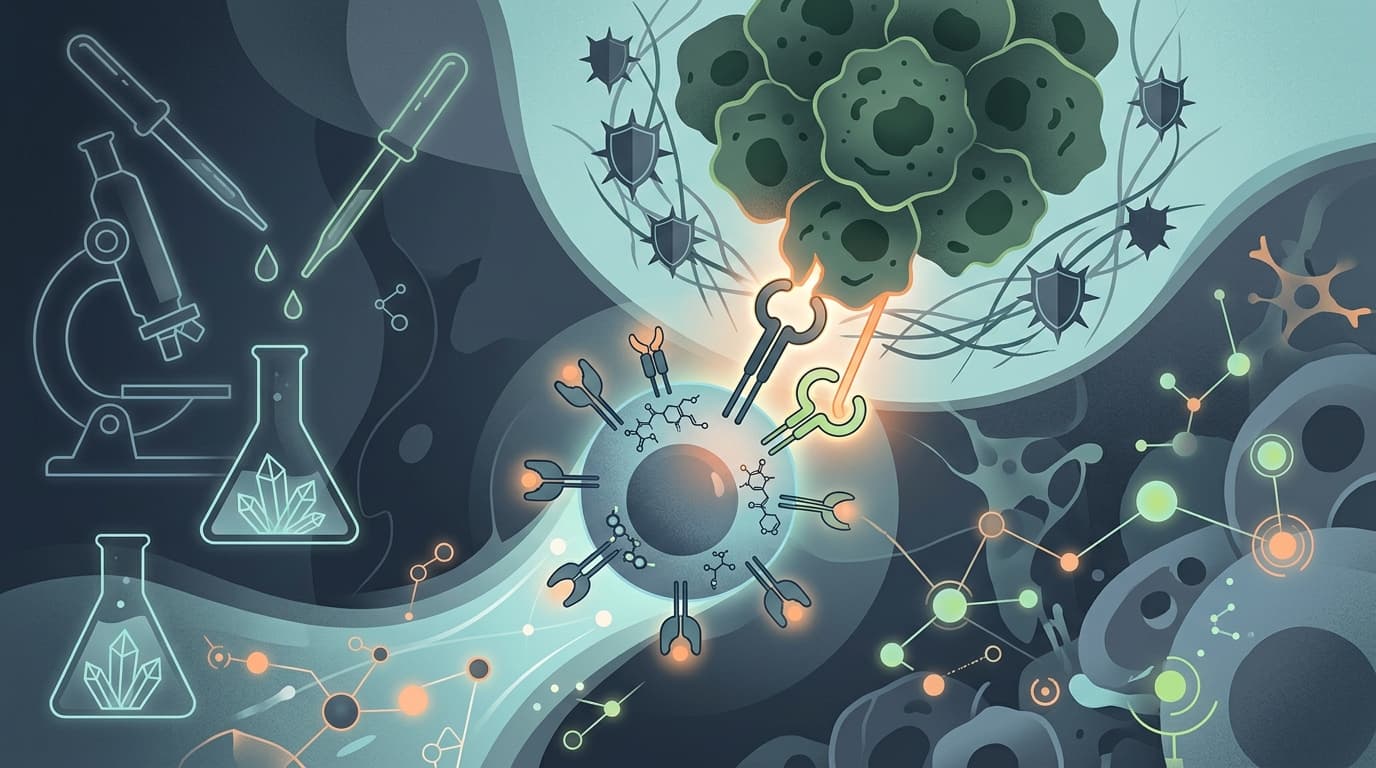
Two Nature papers unveil a CAR-T therapy that kills solid tumors and the immune cells protecting them, with the first human patient showing six months of disease control and zero serious side effects. GPNMB might be the solid-tumor target the field has been searching for.
CAR-T therapy has a dirty secret: it's basically useless against solid tumors.
Sure, it revolutionized blood cancers. Patients with leukemia and lymphoma who were out of options got second chances, sometimes cures. But the moment researchers tried pointing those same engineered killer T cells at a lung tumor, a brain mass, or a sarcoma? Brick wall. The solid tumor world is littered with failed CAR-T attempts.
Two papers published on July 1 in Nature and Nature Cancer might have just cracked open the door. And the key wasn't just finding a better target on cancer cells. It was finding a target on the cells protecting the cancer.
The Bodyguard Problem
To understand why this matters, you need to know how solid tumors survive. Think of a solid tumor like a nightclub with the world's best security team. The bouncers are immune cells called tumor-associated macrophages (TAMs), and their job is to keep your immune system's fighters out. They suppress T cells, create a hostile chemical environment, and basically roll out the red carpet for cancer to grow.
Previous CAR-T attempts focused on getting past the bouncers. The new approach? Fire the bouncers.
The target is a protein called GPNMB (glycoprotein non-metastatic melanoma protein B). It sits on the surface of cancer cells, which makes it visible to CAR-T cells. But here's what makes it special: GPNMB also sits on those immunosuppressive macrophages. One target, two birds.
Two Papers, Two Cancers, One Big Idea
The Nature paper, led by Sheila K. Singh at McMaster University, tackled glioblastoma (GBM), the deadliest brain cancer. GBM is practically a fortress of immune suppression, packed with GPNMB-rich macrophages that shut down any T cell brave enough to wander in.
In mouse models, GPNMB CAR-T cells didn't just shrink tumors. They eradicated them. In one key experiment, 12 out of 13 mice were cured, living tumor-free for months. The therapy wiped out cancer cells dismantled the suppressive myeloid network propping them up. It was a two-front war, won simultaneously.
Get tomorrow's biotech intelligence before your competitors.
Join thousands of biotech professionals who start their day with our free, daily briefing.
and
The Nature Cancer paper focused on a rare but devastating cancer called alveolar soft part sarcoma (ASPS), a type driven by a specific genetic fusion (MiT/TFE). These fusion-driven tumors pump out GPNMB at consistently high levels, making them almost tailor-made for this approach.
This paper also included something the field has been starving for: human data.
One Patient, Six Months, Zero Nightmares
The first person ever treated with GPNMB CAR-T (a product called GCAR1) was a patient with relapsed, metastatic ASPS whose lung metastases were growing fast. After a single infusion, many of those lung lesions shrank or disappeared entirely. The patient achieved stable disease for six months, with multiple non-target lesions resolving along the way.
Now, let's talk safety, because CAR-T's greatest hits include some terrifying side effects. Cytokine release syndrome (CRS) can send patients to the ICU. Neurotoxicity (called ICANS) can cause confusion, seizures, even coma. This patient had neither. The treatment was described as well tolerated, with only mild, manageable side effects.
Perhaps most remarkable: at peak expansion, more than 20% of the patient's circulating T cells were GCAR1 cells. The engineered cells didn't just survive; they thrived, remaining detectable in the blood for months. That kind of persistence is exactly what solid-tumor CAR-T has been missing.
One patient isn't a cure. The investigators are clear about that. But for a field where most solid-tumor CAR-T stories end in disappointment, this is a genuine signal.
Why GPNMB Isn't Just Another Target
Researchers have tested dozens of different antigens as CAR-T targets in solid tumors. Most fall short for predictable reasons: the protein also lives on vital organs (hello, toxicity), or the tumor stops expressing it (hello, relapse), or the target is just a bystander with no role in keeping the cancer alive.
GPNMB dodges all three problems.
First, it's overexpressed across a wide range of aggressive cancers: triple-negative breast cancer, melanoma, glioblastoma, liver cancer, and more. In many of these, high GPNMB levels correlate with worse outcomes. Second, it's not just a marker sitting passively on the cell surface. It actively drives tumor invasion, metastasis, and immune evasion. Killing GPNMB-positive cells doesn't just debulk the tumor; it dismantles machinery the cancer relies on.
Third, there's already clinical safety data from a different drug class. An antibody-drug conjugate (ADC) called glembatumumab vedotin targeted GPNMB in breast cancer and melanoma trials years ago. In GPNMB-high triple-negative breast cancer, it achieved a 40% response rate, compared to just 8% in low expressors. That prior experience gives regulators (and patients) some comfort that targeting this protein won't cause catastrophic off-tumor damage.
The Bigger Picture: A Playbook, Not Just a Paper
What makes these publications more than a cool science story is the strategic blueprint they offer for the whole solid-tumor CAR-T field.
The old playbook was simple: find a protein on the tumor, build a CAR against it, hope the T cells can fight through the hostile microenvironment. It mostly didn't work. The new playbook, exemplified by GPNMB, is multi-compartment targeting. Pick an antigen that lets you kill cancer cells and dismantle their support network in one shot.
Separately, a companion study used AI-driven analysis to nominate CAR-T targets across cancers, and GPNMB came out on top. That AI pipeline then validated GPNMB CAR-T activity in mouse models of leukemia, melanoma, and colorectal cancer. If that pans out, GPNMB could become a platform target spanning many tumor types, not a one-indication wonder.
What Happens Next
A Phase I trial (NCT07297667) kicked off in March 2026, enrolling roughly 30 patients with sarcoma, renal cell carcinoma, and triple-negative breast cancer. That will be the real test: does the single-patient magic hold up in a larger, messier cohort?
Glioblastoma trials haven't started yet, but the preclinical data is strong enough that clinical programs seem inevitable.
Plenty of questions remain. Will GPNMB expression on normal tissues (melanocytes, bone cells, some immune cells) cause unexpected toxicity at scale? Can CAR-T cells actually penetrate dense solid tumors in humans the way they do in mice? Will resistant lesions, like the one identified through spatial analysis in the ASPS patient, prove to be the rule rather than the exception?
The investigators found that the resistant lesion was loaded with PD-L1-expressing cells and other immunosuppressive features. When they combined GCAR1 with PD-L1 blockade in mice, antitumor activity improved. So the next chapter likely involves combination regimens: CAR-T plus checkpoint inhibitors, working together to break through what neither can crack alone.
For a field that's spent years explaining why CAR-T can't work in solid tumors, these papers offer a different kind of explanation: maybe we were just aiming at the wrong things.
Deals & M&A
5 min read
The Cancer Company That Just Bought a Lung Drug
Zymeworks, an oncology biotech known for its HER2-targeting cancer drugs, just dropped $929 million to buy a COPD lung treatment. The financing structure is clever, the strategic logic is surprisingly sound, and the real test comes in August.