Big Pharma's New Drug Discovery Weapon Costs More Than Most Startups
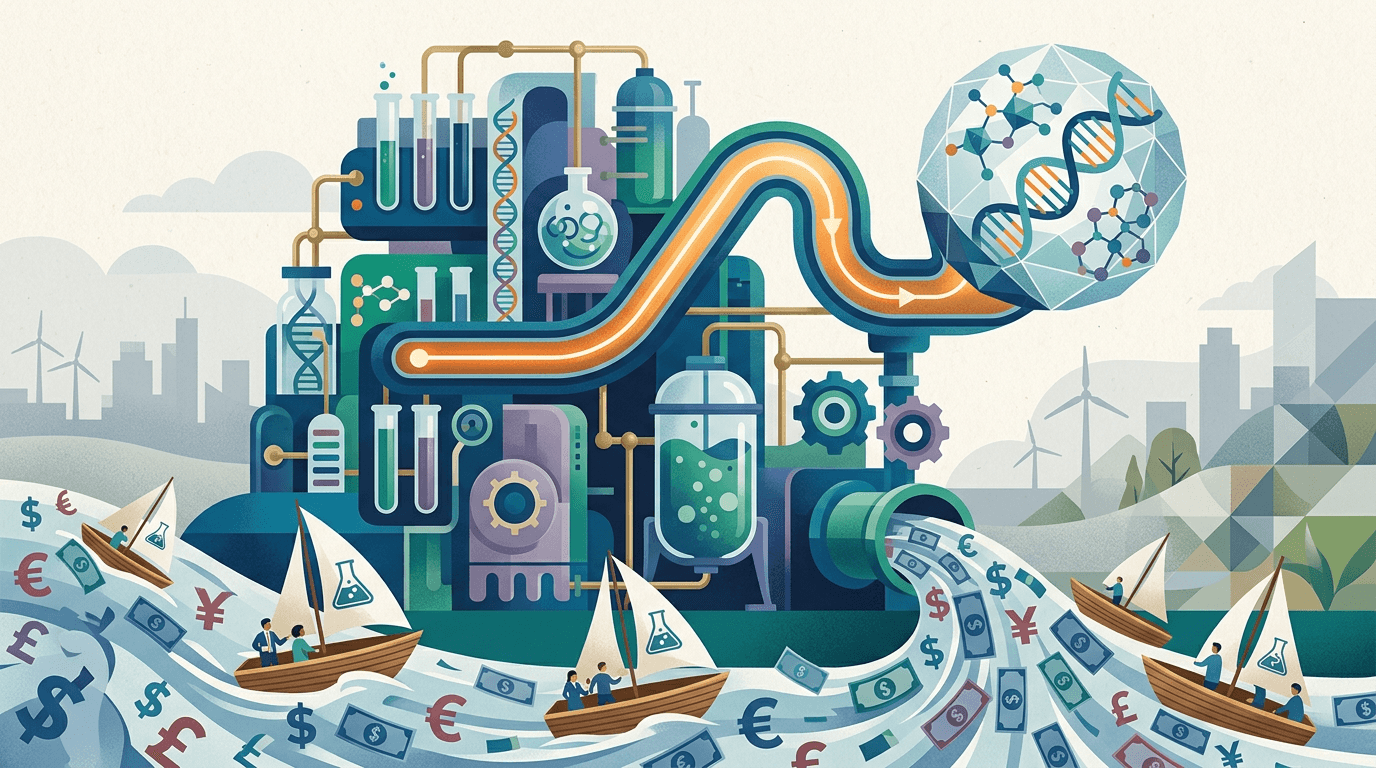
Bristol Myers Squibb just bought NVIDIA's newest AI supercomputer, leapfrogging Lilly and Roche in pharma's escalating compute arms race. The real question: can a chip that costs more than most startups actually discover better drugs?
Bristol Myers Squibb just bought a supercomputer. Not a metaphorical one. Not a "cloud partnership" dressed up in a press release. An actual, rack-mounted, liquid-cooled AI beast built on NVIDIA's newest Vera Rubin architecture.
The system is called the DGX SuperPOD, and BMS says it will be the most powerful AI infrastructure owned by any single life sciences company. Think of it as building a Formula 1 engine for drug discovery, except the racetrack is molecular biology and the finish line is getting medicines to patients faster.
Neither company disclosed the price tag. But to give you a sense of scale: NVIDIA's previous-generation enterprise systems (the DGX B300 line) carry list prices in the range of $300,000 to $530,000 per unit. BMS is deploying eight rack-scale DGX Vera Rubin NVL72 systems linked into one unified cluster. This isn't a line item. It's a capital commitment.
The Pharma AI Arms Race Is Real Now
BMS isn't the first pharma giant to go supercomputer shopping. They're actually the third in nine months.
Eli Lilly announced in October 2025 that it was building a DGX SuperPOD with over 1,000 Blackwell Ultra GPUs, calling it the most powerful supercomputer in pharma. Then in March 2026, Roche rolled out a hybrid-cloud AI factory with more than 3,500 Blackwell GPUs across the US and Europe, claiming the largest GPU footprint in the industry.
Now BMS has leapfrogged both of them, at least on paper. While Lilly and Roche built on the Blackwell generation, BMS jumped straight to Vera Rubin, which is several generations ahead. NVIDIA says the new architecture delivers up to 10x more computing power per megawatt than what it replaces. In an era when electricity costs keep climbing, that efficiency gap matters as much as raw horsepower.
This pattern tells you something important. When one top-five pharma company buys an AI supercomputer, it's a strategy choice. When three do it in under a year, it's a new competitive requirement.
Get tomorrow's biotech intelligence before your competitors.
Join thousands of biotech professionals who start their day with our free, daily briefing.
What Do You Actually Do With a Pharma Supercomputer?
Fair question. The honest answer is: everything, or at least that's the plan.
BMS wants to train next-generation foundation models on decades of its own proprietary data. Foundation models are the large, general-purpose AI systems (think GPT, but for biology) that learn broad patterns and can then be specialized for specific tasks. Trained on BMS's internal trove of molecular, clinical, and biological data, these models could spot patterns that human researchers simply can't process at scale.
The practical applications break down into a few buckets. First, drug discovery and molecular design: using AI to generate and screen potential drug candidates across both small molecules (traditional pills) and large molecules (biologics like antibodies). Second, clinical modeling: building digital simulations of how drugs behave in the body. Third, agentic AI workflows, where AI systems don't just answer questions but actively run multi-step research tasks, from identifying drug targets to designing proteins to evaluating hypotheses.
BMS is integrating NVIDIA's BioNeMo platform (a toolkit for biological AI) and its Agent Toolkit to power these workflows. The vision is what BMS calls "hybrid intelligence": AI co-scientists working alongside human researchers, handling the data-heavy grunt work while humans steer the ship.
The Numbers That Actually Matter
BMS's Chief Research Officer, Robert Plenge, put it in concrete terms. Before this kind of AI infrastructure, the company might evaluate around 10 potential drug candidates early in the discovery process. Now, with these systems, they can explore dozens.
That sounds incremental until you remember how drug discovery works. It's a brutal funnel. Most candidates fail. The more shots you take early on, the better your odds of finding something that survives the gauntlet of preclinical testing, toxicology, and clinical trials. Exploring 3x or 5x more candidates at the front end could meaningfully change what comes out the back end.
Plenge also noted that BMS's existing AI tools have already cut the time to prepare medicines for clinical trials by 20 to 30 percent. The ambition with Vera Rubin is to push that to 50 percent. And he pointed to a sickle cell disease candidate currently in early clinical development that, in his words, "would likely not have been discovered" without AI-enabled research. That's not a hypothetical efficiency gain. That's a real drug, in real patients, that might not exist otherwise.
Why BMS Needed This More Than Most
Context matters here. BMS has been on a multi-year AI infrastructure binge, and the Vera Rubin purchase is just the latest (and loudest) move.
The company already ran an older DGX SuperPOD, which it deployed in early 2024. That system, now two to three generations behind Vera Rubin, delivered 55 percent cost savings compared to BMS's previous computing setup. The new cluster will be unified with the old one into a single data environment accessible from every BMS site globally.
Beyond hardware, BMS has been assembling an unusually broad portfolio of AI partnerships. In 2024 alone, they signed deals with VantAI (up to $674 million for AI-designed molecular glues), AI Proteins (up to $400 million for computationally designed miniproteins), and a collaboration with insitro worth potentially over $2 billion for AI-driven neurodegeneration research. They partnered with Anthropic to deploy Claude Enterprise across 30,000 employees. They worked with Accenture to build over 30 generative AI solutions for R&D and operations.
The Vera Rubin SuperPOD is the engine that's supposed to power all of this. Without massive on-premise compute, those AI partnerships are sports cars without fuel.
The Billion-Dollar Bet Nobody Can Prove Yet
Here's the uncomfortable truth that everyone in pharma knows but few say out loud: no approved drug has been fully developed using AI. Not yet. The models are promising. The early data points are encouraging. But the drug development timeline means that AI infrastructure built today influences candidates that won't reach patients for years.
Lilly's leadership has acknowledged this directly, saying the advantages of their AI investments will become clear "around 2030." BMS's own risk disclosures note that "expected benefits may not be realized or may take longer."
So why spend what could easily be tens of millions (or more) on cutting-edge silicon? Because the downside of being wrong is manageable. The downside of being late is not. If AI-driven drug discovery delivers on even a fraction of its promise, the companies without this infrastructure won't be able to catch up. Training proprietary foundation models on decades of internal data creates a compounding advantage; every month of data and model iteration widens the gap.
BMS is betting that the future of pharma R&D looks more like a tech company's AI lab than a traditional chemistry department. With Vera Rubin humming in their data center, they're putting serious money behind that conviction. Whether it pays off is a question only the pipeline can answer, and the pipeline runs on its own timeline, indifferent to press releases and GPU counts.
Clinical & Regulatory4 min read
New Drug Prices Just Dropped for the First Time in Years. Don't Celebrate Yet.
Median launch prices for new drugs dropped more than 40% in 2025, falling to $216,000 from over $370,000 the year before. But before you celebrate, the reason has nothing to do with pharma companies charging less.