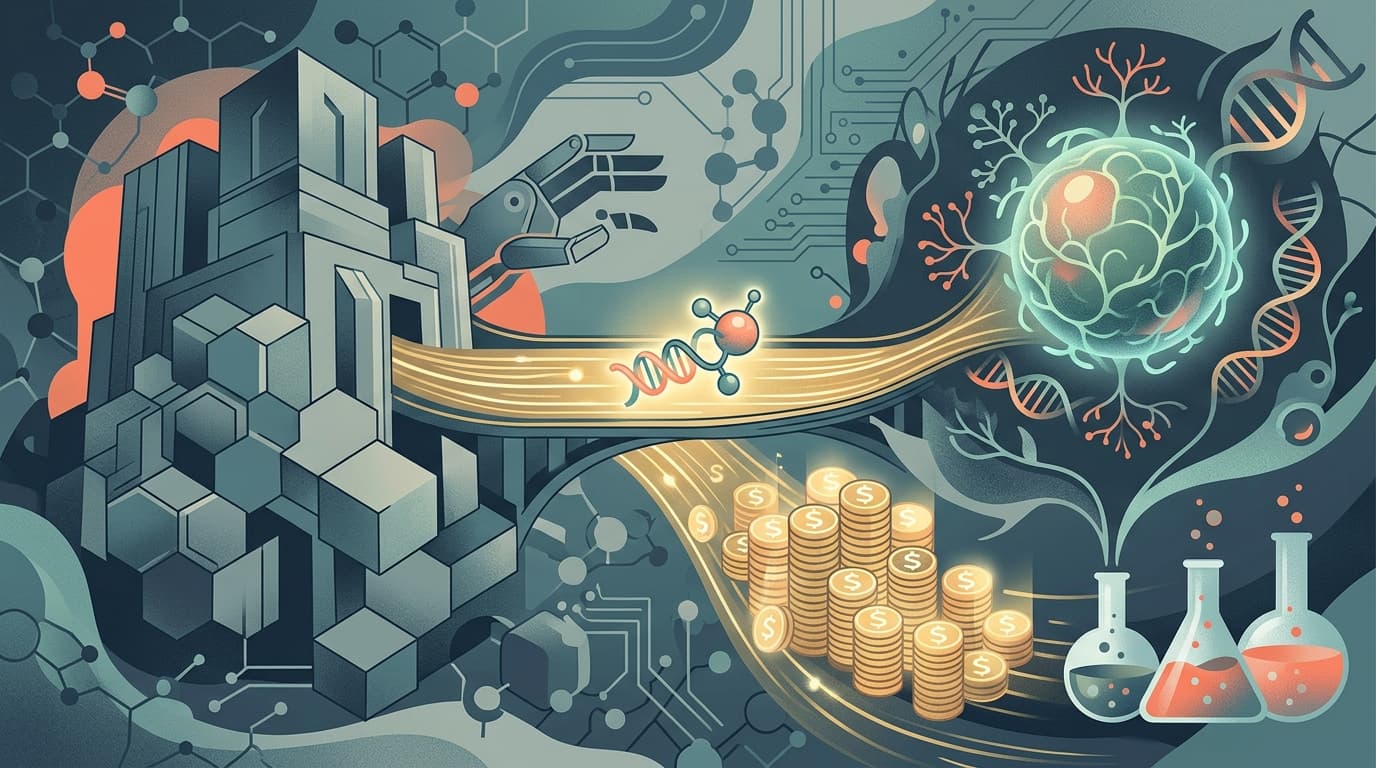
Three biotech companies raised over $1.2 billion in a single day, with Braveheart Bio leading the charge at $440 million. It's the strongest signal yet that biotech's IPO drought is officially over.
Three IPOs Walk Into a Stock Exchange
Somewhere in mid-2026, the biotech IPO market went from "cautiously optimistic" to full-on party mode.
Three biotech companies hit public markets in the first half of 2026, collectively raising over $1.2 billion in fresh capital. Leading the pack: Braveheart Bio (NASDAQ: BRVE), which hauled in a staggering $440 million after underwriters exercised every last share they could get their hands on. Kardigan pulled in roughly $400 million in its June 2026 IPO, and Eikon Therapeutics added another $381 million back in February 2026. That's a billion-dollar-plus stretch for an industry that, just one year ago, could barely convince investors to return its calls.
This isn't a blip. It's a signal.
Braveheart Goes Full Braveheart
Braveheart Bio didn't just IPO. It big-dogged the entire biotech class of 2026.
The company originally planned to sell shares in the $15 to $17 range. Demand was so strong that it upsized the offering to 21.25 million shares and priced above range at $18 per share. That alone brought in $382.5 million. Then the underwriters fully exercised their greenshoe option (the right to buy additional shares at the IPO price), adding another 3.19 million shares to the total.
Final tally: 24.4 million shares sold for approximately $440 million in gross proceeds. For a company that didn't even exist before 2024, that's a remarkable vote of confidence from Wall Street.
Braveheart was founded by Dr. Travis Murdoch and backed by a murderer's row of healthcare investors: Andreessen Horowitz's bio fund, Forbion, OrbiMed, Frazier Life Sciences, and Enavate Sciences (a Patient Square Capital platform). The company raised $185 million in a Series A back in November 2025, making this IPO a roughly 2.4x step-up in a single fundraising cycle.
Get tomorrow's biotech intelligence before your competitors.
Join thousands of biotech professionals who start their day with our free, daily briefing.
Chris Viehbacher chairs the board. If that name sounds familiar, he's the former CEO of Sanofi, which tells you something about the caliber of people who bet on this company early.
One Drug, One Big Bet
So what exactly is Braveheart building with nearly half a billion dollars? The answer is surprisingly focused: one drug.
The company's sole clinical asset is BHB-1893, an oral pill that works by inhibiting cardiac myosin, a protein that helps the heart muscle contract. Think of it like this: in patients with hypertrophic cardiomyopathy (HCM), the heart muscle is abnormally thick and stiff, making it harder for blood to flow. BHB-1893 is designed to dial down the force of those contractions, essentially telling an overenthusiastic heart muscle to relax.
HCM affects both the "obstructive" and "non-obstructive" varieties, and Braveheart is going after both. The company says BHB-1893 is already in global late-stage clinical development, with plans to initiate pivotal studies in 2026.
A single-asset company raising $440 million is either wildly confident or wildly overvalued. Investors are clearly betting on the former. The cardiac myosin inhibitor space already has validation from other players, and Braveheart's backers seem to believe BHB-1893 can compete (or win) in this increasingly crowded therapeutic area.
The IPO Triple Crown
Braveheart didn't celebrate alone. Let's zoom out to the full picture of early 2026.
Kardigan (NASDAQ: KARD) priced its IPO in June 2026 at $16 per share, also above range, and raised $400 million by selling 25 million shares. Like Braveheart, Kardigan is focused on cardiovascular disease, with three clinical-stage drugs in its pipeline: danicamtiv, ataciguat, and tonlamarsen. It's a broader bet across multiple heart conditions.
Eikon Therapeutics (NASDAQ: EIKN) took a different path entirely, pricing its February 2026 IPO at $18 per share and raising $381 million with a focus on cancer. Eikon has four clinical-stage oncology candidates, including programs targeting solid tumors with next-generation approaches.
Three companies. Three successful pricings. Over a billion dollars raised in the first half of the year. The last time biotech saw this kind of action, interest rates were near zero and SPACs were still a thing.
Why This Matters More Than the Money
Let's put this in context, because the numbers alone don't tell the full story.
In 2025, only 10 biotech companies went public the entire year. Ten. That's not a market; that's a waiting room. And 2024 wasn't much better, with just 50 IPOs across the whole sector. Companies that wanted to go public were stuck in a holding pattern, burning through private capital and hoping the window would eventually crack open.
In 2026, it didn't crack. It swung wide.
By Q2, PwC reported 13 biotech IPOs in a single quarter, with nearly half pricing at or above the top of their range. Even more telling: about 97% of those IPOs opened above their offer price, meaning investors weren't just showing up; they were actually making money on day one.
Sofinnova's Jim Healy summed it up simply: "The window's open." He expects the pace to accelerate through the back half of 2026.
But the window is open with conditions. Investors aren't throwing money at every biotech with a slide deck and a dream. They want late-stage clinical data, clear paths to commercialization, and management teams that have done this before. The three companies that dominated early 2026 checked all of those boxes, which is exactly why they priced above range while others still sit on the sideline.
Braveheart Isn't Even the Biggest IPO This Year
For all the fanfare, Braveheart's $440 million doesn't claim the 2026 crown. That belongs to Parabilis Medicines, which raised an eye-popping $770 million (including a concurrent private placement). Right behind it sits Kailera Therapeutics at roughly $719 million in gross proceeds.
Braveheart and Kardigan slot in at third and fourth, respectively, followed by Eikon. Five biotech IPOs north of $380 million in a single year would have been unthinkable 18 months ago.
The shift isn't subtle. Biotech capital markets have gone from famine to feast, at least for companies with the right combination of science, stage, and story.
The Bottom Line
Braveheart Bio just proved that a single-drug company, barely two years old, can raise nearly half a billion dollars on its first day of public trading. That says less about Braveheart specifically and more about where the market's head is at right now.
Investors are hungry for biotech again. They're just a lot pickier about what they eat. The companies getting funded in 2026 are late-stage, well-capitalized, and led by experienced teams. If you fit that profile, the window is wide open. If you don't, you're watching from the parking lot.
For Braveheart, the real test starts now. Four hundred forty million dollars buys a lot of clinical trials, but only results will determine whether this IPO was a triumph or a very expensive entrance fee. The heart drug space is competitive, and BHB-1893 still has to prove it belongs.
But in 2026? Braveheart showed up, and Wall Street gave it a standing ovation.
Clinical & Regulatory
4 min read
The First Drug for an 'Always Hungry' Disease Just Hit a Wall
The first-ever drug for the relentless hunger of Prader-Willi syndrome is under scrutiny after seven deaths and over 100 serious adverse events surfaced in post-marketing reports. Experts aren't saying pull it; they're saying pay closer attention.