The $6 Billion Wall That China's Biotech Giants Keep Walking Through
The Biosecure Act was supposed to cut China out of America's drug supply chain. Six months after becoming law, Chinese biotech giants are posting record revenue and expanding globally. Now lawmakers want even tougher measures, but pharma can't quit its most important manufacturing partner overnight.
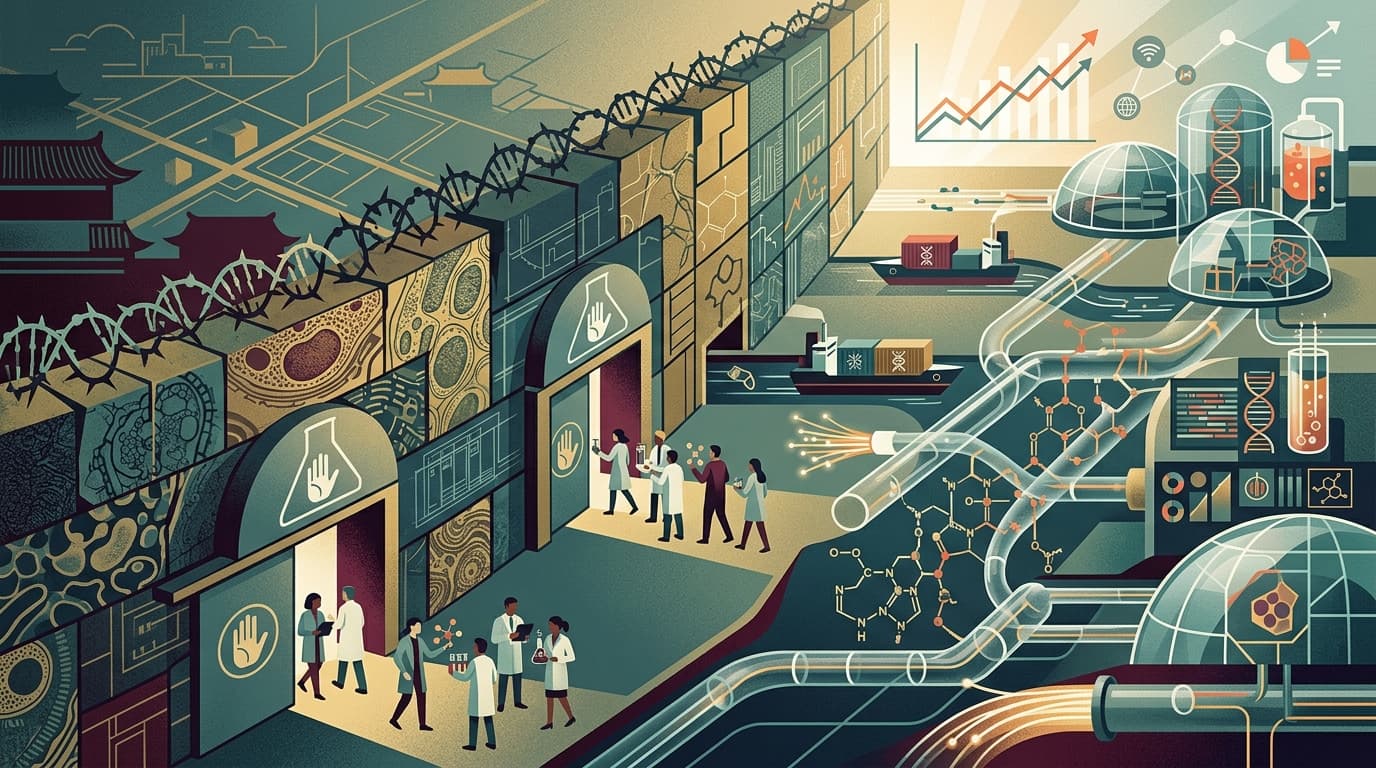
Imagine building a fence to keep your neighbor's dog out of your yard, only to watch the dog dig under it, jump over it, and occasionally stroll through the gate you forgot to lock. That's roughly where the U.S. stands with the Biosecure Act and China's booming contract research and manufacturing sector.
The law was supposed to be a landmark. Signed in December 2025 as part of the defense spending bill, it promised to sever the ties between American taxpayer-funded research and Chinese biotech firms deemed national security threats. Six months later, those firms aren't just surviving. They're expanding.
The Law That Hasn't Bitten Yet
The Biosecure Act sounds tough on paper. Federal agencies can't buy biotech equipment or services from designated "biotechnology companies of concern." Neither can anyone receiving government grants or loans. Even subcontractors are covered: if your vendor uses a blacklisted Chinese firm, you're on the hook too.
But there's a catch. Actually, several catches.
The law requires a staged rollout that stretches years into the future. The Office of Management and Budget has until roughly December 2026 to publish the official list of banned companies. After that, agencies need another 18 months or so to write the actual procurement rules. Legal analysts estimate the contracting bans won't practically kick in until late 2028 or early 2029 for most firms.
And for companies with existing contracts? Many get a five-year grace period after the rules are finalized, pushing full compliance out to the early 2030s. That's like telling someone they need to quit smoking, but not until 2033.
Meanwhile, in Shanghai and Singapore
While Washington writes regulations, Chinese CRO/CDMOs (the companies that run drug experiments and manufacture medicines on behalf of pharma clients) are playing chess, not checkers.
WuXi AppTec, the biggest of the bunch, pulled in $6.2 billion in revenue in 2025. Read that again: billions from U.S. pharma, even as Congress was actively trying to cut the cord. The company's adjusted profits grew about 41% last year.
Get tomorrow's biotech intelligence before your competitors.
Join thousands of biotech professionals who start their day with our free, daily briefing.
WuXi Biologics, its sister company focused on large-molecule drugs, expanded aggressively in 2025. New sites in Singapore. Expansions in China. Strategic partnerships with Qatar and Saudi Arabia. The company isn't retreating; it's building an empire that can serve Western clients without touching mainland China when that becomes necessary.
This is the playbook across the sector. Chinese firms are diversifying geographically so their clients can technically avoid China-based facilities for sensitive programs while still using the same corporate network. Think of it as the biotech equivalent of a VPN: the data (or in this case, the drug manufacturing) routes through a different country, but the same company controls the pipe.
Why Pharma Can't Quit China
The uncomfortable truth is that American pharma is deeply, structurally dependent on Chinese outsourcing. A BIO survey found that 79% of respondents have at least one contract supported by a Chinese CDMO. For preclinical and clinical services (early-stage drug testing, animal studies, patient recruitment), a staggering 74% of outsourced work goes to Chinese providers.
Western alternatives exist, but they cost 30 to 50% more. For cash-strapped biotech startups burning through runway, that price difference isn't academic; it's existential. And even companies willing to pay the premium face a capacity crunch. Samsung Biologics has locked up nearly $2 billion in U.S. big-pharma contracts through 2029, showing just how aggressively sponsors are booking non-Chinese capacity. But the slots are filling fast.
Industry respondents told BIO it could take up to eight years to fully switch manufacturing partners. That's not a typo. Transferring a biologic manufacturing process to a new facility requires revalidation, regulatory approval, and sometimes years of troubleshooting. It's not like switching your coffee subscription.
Congress Wants a Bigger Hammer
Some U.S. lawmakers have noticed the gap between legislative intent and on-the-ground reality, and they're not happy about it.
The latest push comes in the form of the Biotech Investment National Security Act (BINSA), which would extend restrictions beyond supply chains and into the world of money. Under BINSA, U.S. equity investments, joint ventures, and licensing deals with Chinese biotech entities would face Treasury Department review for national security risks.
The logic: if you can't stop the flow of contracts, maybe you can stop the flow of capital. The bill would cover pharmaceutical development, biologics manufacturing, and clinical research, though it carves out agricultural biotech and basic academic research.
There's also the Pentagon's "1260H list" of Chinese military-linked companies, which gained a notable new member in June 2026: WuXi AppTec itself. That designation carries real teeth under the Biosecure Act, shortening grace periods and tightening restrictions on federally connected work.
A separate federal commission has recommended $15 billion in new funding to bolster U.S. biotech independence, spanning everything from intellectual property protection to biodefense manufacturing. The message from Capitol Hill is clear: the Biosecure Act was the opening move, not the endgame.
The ADC Problem Nobody Talks About
There's one area where decoupling looks particularly difficult: antibody-drug conjugates (ADCs), the cancer-fighting "smart bombs" that attach toxic payloads to antibodies so they kill tumors without torching healthy tissue. ADCs are the hottest modality in oncology right now, and WuXi XDC holds over 24% of the global market for ADC contract manufacturing, with revenue growing more than 40% in 2025.
The number of Western firms capable of doing this specialized work at scale is small. Walking away from WuXi in ADCs isn't just expensive; for some programs, it's borderline impossible in the near term.
The GLP-1 boom (think Ozempic, Mounjaro) makes things worse. Novo Nordisk and Eli Lilly have locked up huge chunks of global manufacturing capacity for their weight-loss blockbusters. That leaves less room for everyone else, pushing smaller companies toward whoever has available capacity. Often, that's a Chinese CDMO.
Two Trains on the Same Track
What we're watching is a slow-motion collision between geopolitical reality and pharmaceutical economics. Washington wants clean decoupling. The drug industry needs time, money, and manufacturing slots it doesn't have.
The Biosecure Act changed the conversation. It forced pharma to start planning for a world where Chinese partners carry political risk. The $24.9 billion in global CDMO facility investment disclosed in 2025 (74% of it in the U.S.) proves that reshoring is real.
But planning isn't the same as executing. Chinese CROs and CDMOs continue to grow, diversify, and entrench themselves in global drug development. And Congress, watching this unfold, is reaching for tougher tools: investment controls, faster designations, bigger domestic funding.
The question isn't whether the U.S. and China will decouple in biotech. It's whether Washington can build the wall faster than Beijing can find doors. So far, the doors are winning.
Clinical & Regulatory
4 min read
Trodelvy Just Jumped the Line in Breast Cancer Treatment
The FDA just moved Gilead's Trodelvy from last-resort to first-choice in triple-negative breast cancer, the deadliest breast cancer subtype. It's a seismic shift for patients, a multi-billion-dollar opportunity for Gilead, and a surprisingly friendly outcome for Merck's Keytruda.