
A Shanghai biotech just reported 100% remission rates in sickle cell and β-thalassemia patients across four continents, using a gene editor that doesn't cut DNA. The results could reshape the competition with first-generation CRISPR therapies.
Imagine you're editing a typo in a book. One approach: rip out the entire page, hope the repair crew tapes it back together correctly. Another approach: just white out the wrong letter and pencil in the right one.
That second approach is basically what base editing does. And a new paper in Cell Stem Cell just showed it works in real patients, across multiple continents, for two of the world's most devastating blood diseases.
CorrectSequence Therapeutics, a Shanghai-based biotech founded in 2020, reported that its base-editing therapy achieved durable clinical remission in patients with both sickle cell disease (SCD) and transfusion-dependent β-thalassemia (TDT). Every single patient treated either stopped needing blood transfusions entirely or became free of the excruciating pain crises that define sickle cell. No off-target edits detected. No product-related side effects.
Across nearly 20 patients treated to date, the success rate is 100%.
You've probably heard of CRISPR. It's the gene-editing tool that won a Nobel Prize and powered the first approved gene therapies for blood disorders. Casgevy, made by Vertex and CRISPR Therapeutics, uses CRISPR's nuclease approach: it literally cuts both strands of DNA, then lets the cell's repair machinery fix the break.
That works, and the results have been impressive. But cutting DNA is inherently risky. Double-strand breaks can cause large deletions, chromosomal rearrangements, and even trigger a stress response through a tumor-suppressor gene called p53. Think of it like performing surgery with a scalpel: effective, but you'd prefer a less invasive option if one existed.
Base editing is that less invasive option. Instead of slicing DNA, CorrectSequence's transformer Base Editor (tBE) chemically converts one DNA letter to another at a precise location. No cuts. No breaks. No reliance on the cell's sometimes-sloppy repair systems.
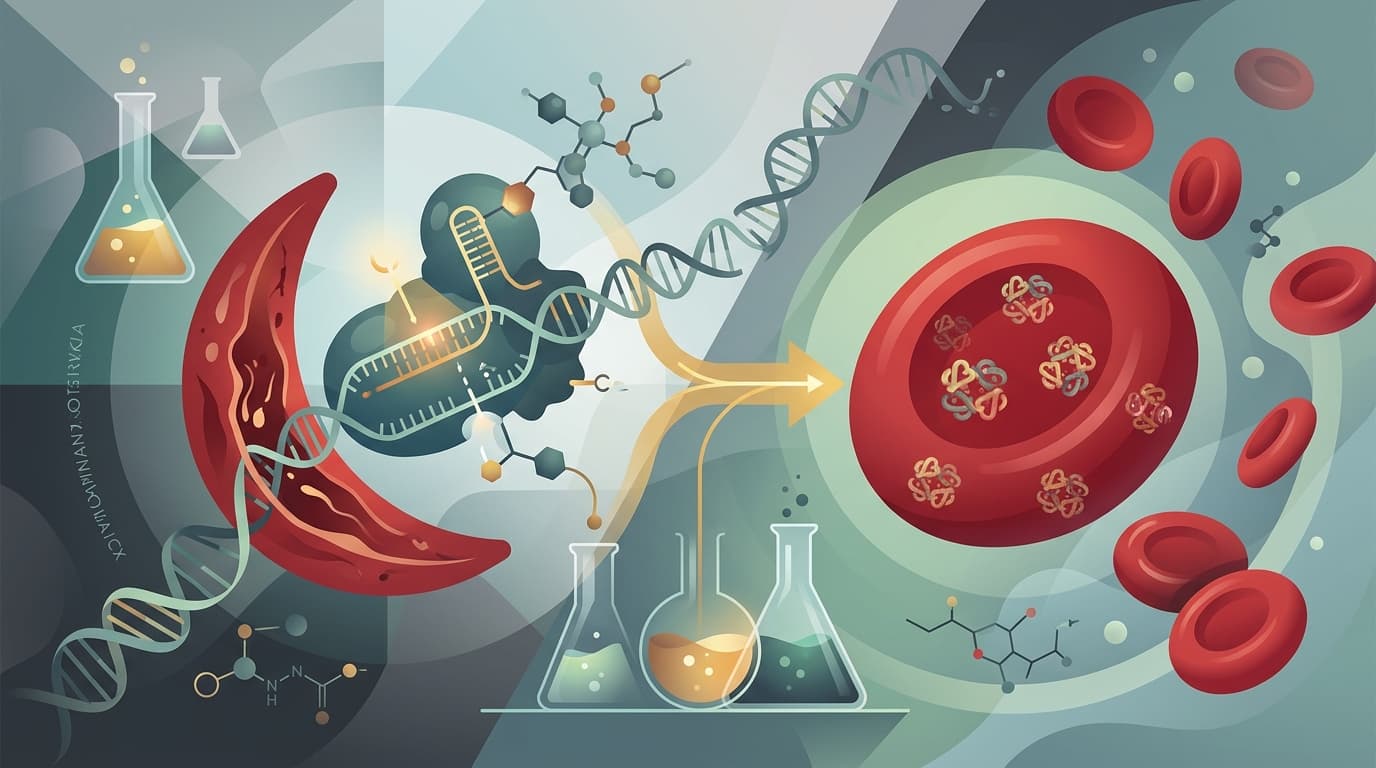
For sickle cell and β-thalassemia, the edit targets the regulatory region of the fetal hemoglobin gene, essentially flipping a switch that reactivates a form of hemoglobin most people stop producing after infancy. Fetal hemoglobin can compensate for the defective adult hemoglobin that causes both diseases. It's like finding a backup generator you forgot was installed in the basement.

Novo Nordisk's STEP Young trial showed 40% of children as young as six were no longer classified as obese after 68 weeks on semaglutide, while zero on placebo crossed that line. The results are forcing a reckoning over GLP-1 drugs in elementary schoolers, and the insurance fights haven't even started yet.


Join thousands of biotech professionals who start their day with our free, daily briefing.
The new paper's biggest contribution isn't just more patients. It's more kinds of patients.
CorrectSequence's earlier results, published in Nature, covered five Chinese patients with β-thalassemia. All five achieved transfusion independence. Impressive, but skeptics could reasonably ask: does this work in people with different genetic backgrounds?
The Cell Stem Cell paper answers that question with four new patients from Nigeria, Laos, Malaysia, and Pakistan. One had sickle cell disease; three had transfusion-dependent β-thalassemia. All of them responded.
The therapy produced rapid hematopoietic reconstitution (the bone marrow started making healthy blood cells quickly) and sustained, high-level fetal hemoglobin expression across every cell. The sickle cell patient remained free of vaso-occlusive crises, those agonizing episodes where misshapen red blood cells clog small blood vessels and cause severe pain. The thalassemia patients all stopped needing transfusions.
This cross-population consistency matters enormously. Sickle cell disease alone affects roughly 7.7 million people worldwide, predominantly in sub-Saharan Africa, South Asia, and the Middle East. A therapy that only works in one genetic context isn't really a solution; it's a proof of concept. This paper moves base editing closer to solution territory.
Casgevy currently owns the benchmark for gene-edited blood disease therapies. Its long-term data are genuinely remarkable: 95.6% of evaluable sickle cell patients stayed crisis-free for at least 12 consecutive months, with an average VOC-free stretch of 35 months. For thalassemia, 98.2% achieved sustained transfusion independence.
Bluebird bio's lentiviral therapies, Lyfgenia (for SCD) and Zynteglo (for β-thalassemia), take a different approach entirely. They don't edit genes; they add a functional copy of the β-globin gene using a viral vector. These were approved earlier and represent the first wave of gene therapy for hemoglobin disorders.
So where does CorrectSequence fit? Think of it as a second-generation contender with a potentially cleaner safety profile. The absence of double-strand breaks is a real differentiator, especially as the field worries more about long-term genomic integrity in patients who receive one-time treatments meant to last a lifetime.
But "potentially cleaner" comes with its own asterisk. Base editors aren't risk-free. They can cause bystander edits (changing nearby DNA letters you didn't mean to touch) and off-target deamination (unwanted chemical changes elsewhere in the genome or even in RNA). CorrectSequence reports no detectable off-target edits in these patients, which is encouraging. Whether that holds up across larger trials with longer follow-up is the billion-dollar question.
Nearly twenty patients with a 100% response rate sounds almost too good. And while nobody is questioning the data's integrity (it passed peer review at one of the field's top journals), the sample size is still small. Casgevy's datasets cover more patients with multi-year follow-up. CorrectSequence's longest reported follow-up stretches beyond 30 months for its first β-thalassemia patient and past 15 months for its first sickle cell patient. That's promising, but not yet definitive for a therapy that needs to last decades.
There's also the conditioning problem. Before any of these therapies can be infused, patients undergo myeloablative conditioning: essentially chemotherapy to wipe out their existing bone marrow and make room for the edited cells. This is the most dangerous part of the entire process for both CRISPR and base-editing approaches, and it's the same for both. The whole field is racing toward less toxic conditioning regimens, and whoever solves that problem may gain as big an advantage as the editing technology itself.
CorrectSequence isn't stopping at blood diseases. Its pipeline includes CS-121, an in vivo base-editing program delivered via lipid nanoparticles to the liver, targeting a gene called APOC3 to treat severe hypertriglyceridemia (dangerously high blood fats). If that program works, it would demonstrate that base editing can function not just in cells removed from the body, edited, and put back, but directly inside a living patient.
For now, the Cell Stem Cell paper marks a clear milestone: base editing is no longer theoretical for blood diseases. It works across populations, it appears safe in early data, and it offers a mechanistic advantage that first-generation CRISPR therapies can't match.
The gene-editing race just got a second lane. And the cars in that lane don't need to break anything to win.
Eli Lilly just dropped up to $2.875 billion on a startup whose lead drug hasn't even finished Phase 1 testing. The target: a precision platform that hunts down disease-causing antibodies one by one. It's either the smartest bet in autoimmune disease or the most expensive appetizer in pharma history.