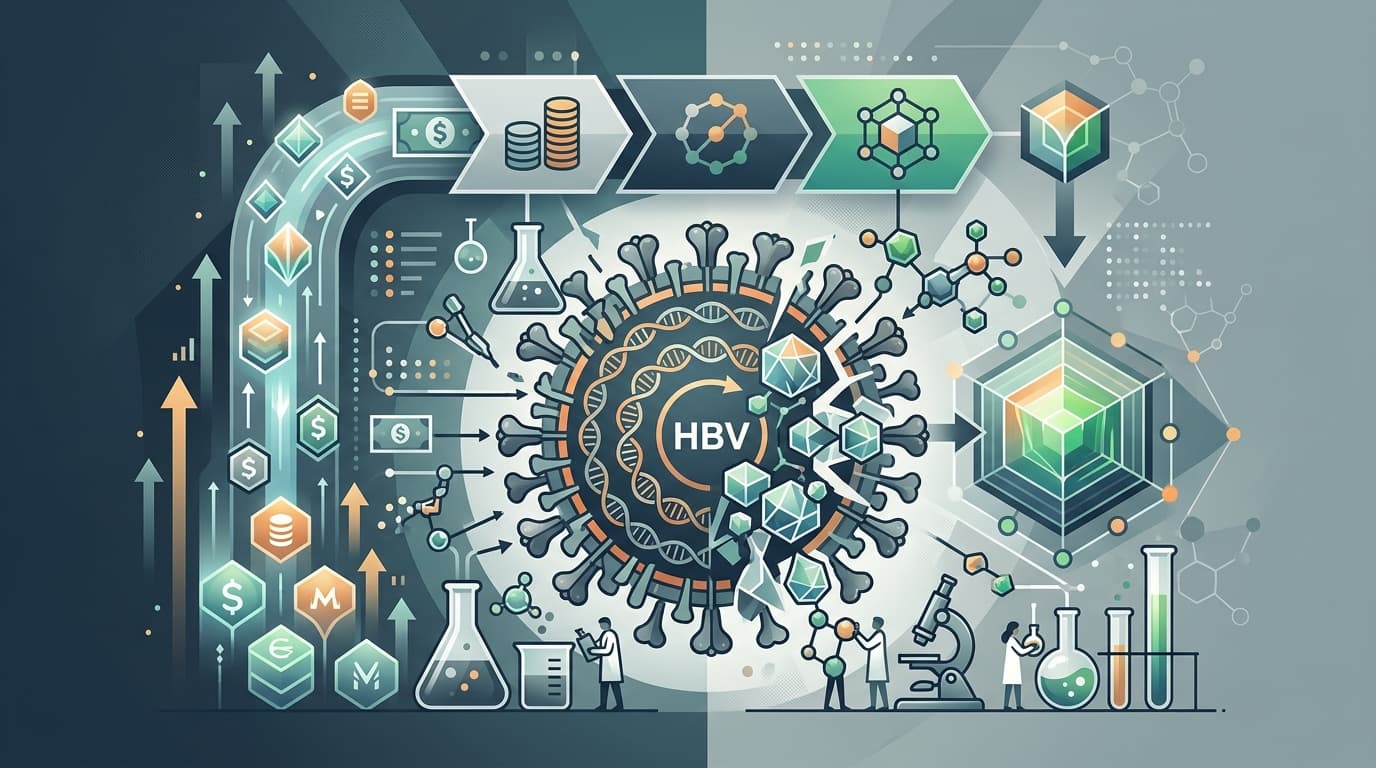

AusperBio just raised $120 million to push its hepatitis B drug into Phase 3, backed by Phase 2 data showing a 30% functional cure rate in a disease where the current standard barely hits 5% after a decade. In a field littered with clinical failures, someone is making a very big bet.
Let that sink in for a second. Hepatitis B infects more people than the entire population of Brazil. It kills roughly 1.1 million people a year, mostly from liver cancer and cirrhosis. And the best treatment we have is basically a lifelong subscription to antiviral pills that suppress the virus but never actually get rid of it.
Think of it like mowing weeds instead of pulling them out by the roots. The lawn looks fine as long as you keep mowing. Stop, and they grow right back.
That's why AusperBio is trying something different: actually pulling the weeds out.
AusperBio is a clinical-stage biotech founded in 2019, with operations in both San Mateo, California, and Hangzhou, China. Its lead drug, AHB-137, is an antisense oligonucleotide (a short piece of synthetic DNA that binds to viral RNA and shuts it down). Instead of just suppressing the virus like current treatments do, AHB-137 aims to eliminate the viral proteins that let hepatitis B hide from the immune system.
The company describes it as a "triple mechanism": suppress the surface antigen (the virus's disguise), block viral DNA replication, and wake up the immune system to finish the job. If that sounds ambitious, it is. The goal isn't treatment. It's a functional cure, meaning the virus becomes undetectable and stays that way after you stop taking the drug.
Co-founded by Dr. Guofeng Cheng (CEO) and Dr. Chris Yang (CSO), AusperBio has been quietly building momentum. The company has now raised $360 million since 2024, including a $37 million Series A in July 2024 and multiple Series B rounds before this latest haul.
Here's where it gets interesting. AHB-137 isn't just a nice idea on a whiteboard. It has Phase 2 data, and the numbers are unusually strong for a field that's used to disappointment.
In a Phase 2a monotherapy study, at Week 72 in patients with moderate baseline antigen levels. For context, the current standard of care delivers functional cure in roughly of treatment. So hitting 30% in under two years, with a single agent, is a big deal.

Bayer's PET tracer nailed 94% sensitivity in a Phase 3 trial for cardiac amyloidosis, a disease that's misdiagnosed more often than it's caught. If approved, it could unlock a massive underdiagnosed patient pool that every major ATTR drug company is desperate to find.


Join thousands of biotech professionals who start their day with our free, daily briefing.
Interim data from a separate Phase 2 cohort showed 62% undetectable HBsAg in the 300 mg group and 43% in the 275 mg group at interim 12 weeks, with 54% developing protective antibodies. Tolerability was generally favorable, with most side effects rated mild to moderate.
Those are the kind of numbers that make VCs pick up the phone.
The $120 million Series C was led by an unnamed "globally renowned strategic investor" (translation: someone big enough that the announcement alone signals credibility, but cagey enough to stay anonymous). RA Capital Management, a well-known healthcare-focused fund, came in as a new investor.
Existing backers doubled down too: Qiming Venture Partners, CDH Investments, HanKang Capital, Sherpa Capital, InnoPinnacle Fund, and YuanBio Venture Capital all participated. That kind of insider follow-on is a good sign. It means the people who've seen AusperBio's books and data up close wanted more, not less.
The money will fund Phase 3 registrational trials for AHB-137 and early commercialization prep. AusperBio also plans to advance AHB-171, a second pipeline candidate, along with next-generation combination strategies.
Valuation? Not disclosed. Terms? Not disclosed. Classic late-stage private biotech opacity.
If curing hepatitis B were easy, someone would have done it already. The field has a long, painful history of drugs that look great on biomarkers but can't seal the deal.
The core problem is durability. Lots of experimental drugs can push the viral surface antigen down during treatment. But once you stop dosing, the virus comes roaring back in most patients. That's because hepatitis B hides its genetic blueprint (called cccDNA) inside liver cells like a sleeper agent, and almost nothing can reach it there.
This is why the field has shifted toward combination regimens that attack the virus from multiple angles simultaneously: lower the antigen, block replication, and reboot the immune response. AusperBio's Phase 2 program already includes combination studies pairing AHB-137 with hepatitis B vaccines and pegylated interferon.
For reference, GSK's bepirovirsen (a rival antisense drug) showed a functional cure rate of about 20% in Phase 3 data. That's the current high-water mark from a major pharma company, and it helped re-legitimize the entire HBV cure thesis for investors. AusperBio's early-stage numbers look competitive, though Phase 3 is a different beast entirely.
Only 27% of the world's 240 million hepatitis B patients have even been diagnosed, according to the WHO. The rest don't know they're infected. The disease burden is concentrated in the Western Pacific (approximately 97 million people) and Africa (approximately 65 million), regions where screening infrastructure is thin and treatment access is limited.
A functional cure wouldn't just be a medical breakthrough; it would reshape global public health economics. Finite treatment courses instead of lifelong pills. Fewer liver transplants. Less liver cancer. The commercial opportunity, if someone actually cracks the code, is enormous.
That's the $360 million question. AusperBio's Phase 2 data is genuinely encouraging, and the investor syndicate backing this round is credible. But the jump from Phase 2 to Phase 3 is where most hepatitis B dreams have gone to die. Larger patient populations, longer follow-up, stricter endpoints.
The company has multiple Phase 2 trials running in parallel, which gives it several shots on goal across different patient populations and combination strategies. That's smart portfolio design for a field where no one knows which approach will cross the finish line first.
China remains a center of gravity for HBV drug development and financing, and AusperBio is well positioned in that ecosystem. If Phase 3 confirms what Phase 2 has shown, this could be one of the most consequential infectious disease stories of the decade.
Big "if." But somebody believes it.
Bristol Myers Squibb just dropped five years of follow-up data for Camzyos at ESC Congress 2026, and the results held up across the board. Nearly every patient hit their target, most became asymptomatic, and a billion-dollar drug just got a lot harder to argue against.