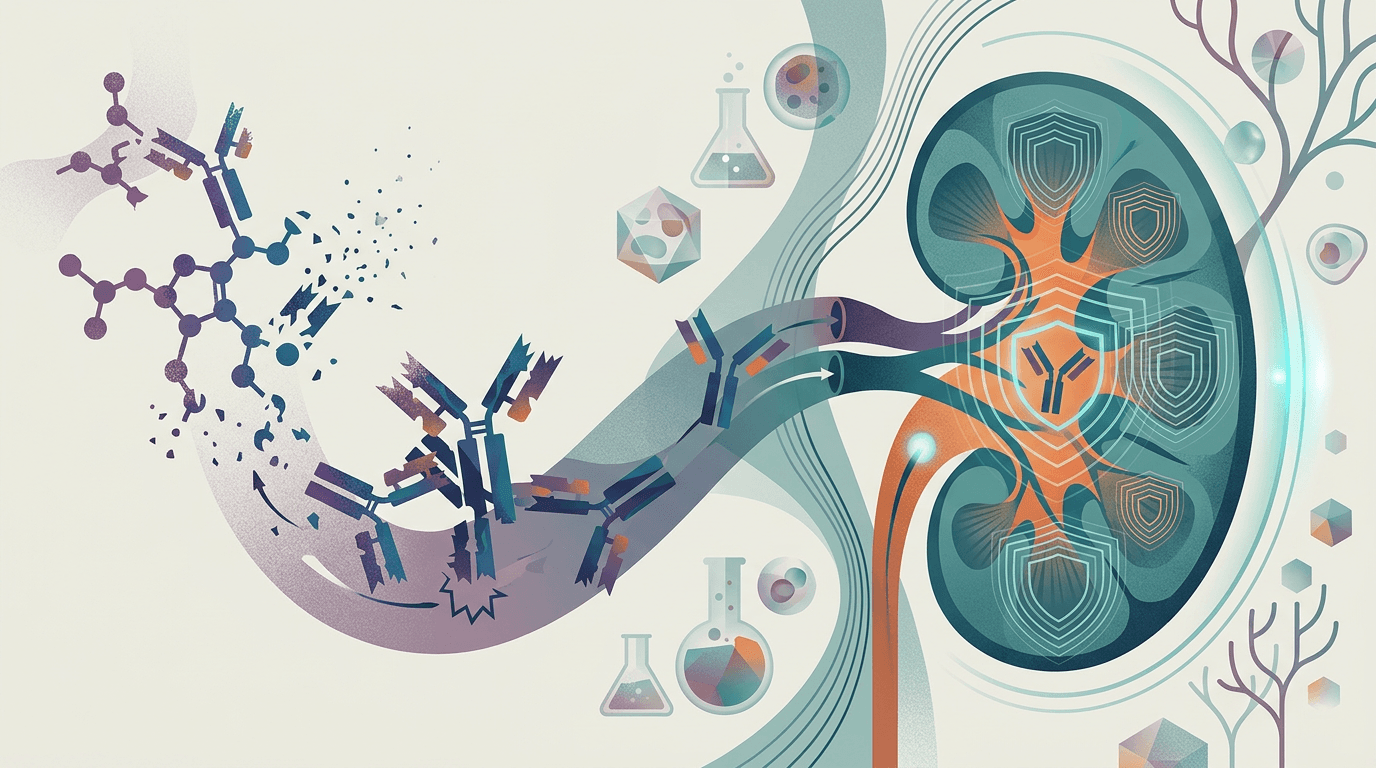

A drug that flopped in lupus and MS just posted blockbuster kidney disease data, and the FDA decision is days away. Atacicept's unlikely redemption arc could reshape the IgA nephropathy market.
Imagine spending a decade building a rocket, watching it crash, and then discovering the wreckage contains something more valuable than the original mission. That's roughly the story of atacicept, a drug that flopped in lupus and multiple sclerosis before finding its calling in a kidney disease most people have never heard of.
On July 7, 2026, the FDA is expected to deliver its verdict. And the stakes are enormous.
Atacicept started its journey at ZymoGenetics, a biotech company that designed it to fight autoimmune diseases by mopping up two proteins (called BAFF and APRIL) that keep rogue immune cells alive. Merck Serono picked up the global rights in 2008 and threw it at lupus, lupus nephritis, rheumatoid arthritis, and multiple sclerosis.
The results were, to put it gently, disappointing. The MS trials were suspended after the drug actually increased inflammatory activity. The broader autoimmune program stalled. By the mid-2010s, atacicept looked like another promising molecule headed for the pharmaceutical graveyard.
But buried in the data was a curious signal. In a small study called JANUS, Merck tested atacicept in patients with IgA nephropathy, a chronic kidney disease where the immune system produces malformed antibodies that clog the kidney's filtering system like hair in a drain. The drug showed dose-dependent improvements in key biomarkers. It was a flicker of life in an otherwise dead program.
On October 29, 2020, Merck handed atacicept to Vera Therapeutics, a small company laser-focused on kidney disease. Vera picked up the baton and sprinted.
To understand why atacicept might work in IgA nephropathy, you need to understand the disease itself. Doctors describe it using a "four-hit" model, which is basically a chain reaction of immune system failures.
First, specialized immune cells produce a defective version of an antibody called IgA1. Think of it as a misshapen key. Second, the body makes more antibodies that attack the misshapen ones, forming clumps (immune complexes). Third, those clumps deposit in the kidney's tiny filters, called the mesangium. Fourth, inflammation kicks in, damaging the kidney over time. The end result: protein leaking into your urine, declining kidney function, and for many patients, eventual kidney failure.

Roche's divarasib just outperformed both approved KRAS G12C inhibitors in a head-to-head Phase 3 trial, hitting superiority on both progression-free survival and overall survival. Wall Street says it's a solid win, but the real billions hinge on what comes next.


Join thousands of biotech professionals who start their day with our free, daily briefing.

Atacicept works like a molecular sponge. It's a fusion protein built from a piece of a natural immune receptor (called TACI) fused to an antibody backbone. It floats through the bloodstream soaking up BAFF and APRIL, the two proteins that keep the defective-antibody-producing cells alive. Starve those cells of their survival signals, and the whole chain reaction slows down.
What makes atacicept different from drugs that target only BAFF? It hits both BAFF and APRIL, which matters because long-lived plasma cells (the factories churning out bad antibodies) depend heavily on APRIL for survival. Blocking one without the other is like putting out half a fire.
Vera's Phase 3 trial, called ORIGIN, enrolled 431 patients and delivered results that turned heads. At 36 weeks, in a prespecified interim analysis of the initial cohort, patients on atacicept saw a 45.7% reduction in proteinuria (protein in the urine, measured by a ratio called UPCR) from baseline. The placebo group? Just 6.8%.
That translates to a 42 percentage-point gap between drug and placebo, with a p-value below 0.0001. In clinical trials, anything below 0.05 is considered statistically significant. This result didn't just clear the bar; it pole-vaulted over it.
The benefit held up across every subgroup the researchers examined: age, sex, race, baseline kidney function, and whether patients were already taking SGLT2 inhibitors (a class of kidney-protective drugs increasingly used as standard care). On safety, adverse events hit 59.3% of atacicept patients versus 50% on placebo, with most being mild or moderate. No major red flags emerged.
IgA nephropathy used to be a therapeutic desert. For decades, the only options were blood pressure drugs (ACE inhibitors and ARBs) and, in severe cases, steroids with all their ugly side effects. That picture has changed dramatically in the past three years.
The treatment landscape now includes targeted-release budesonide (Tarpeyo), which delivers a steroid directly to the gut's immune tissue. There's sparsentan (Filspari), a dual-action drug that blocks both angiotensin and endothelin receptors. Atrasentan (Vanrafia) targets endothelin alone but can be stacked with existing blood pressure drugs. And iptacopan (Fabhalta) goes after the complement system, another arm of the immune response.
There's even a direct competitor in atacicept's own class: sibeprenlimab, an APRIL-targeting antibody that reportedly received FDA approval in late 2025.
So where does atacicept fit? Its dual BAFF/APRIL mechanism gives it a theoretical edge over APRIL-only drugs, since it hits the immune cascade at a broader point. And that 42-percentage-point proteinuria reduction is among the strongest efficacy signals in the IgAN space. But the real differentiator will come from long-term data showing whether the drug actually preserves kidney function over years, not just months.
Vera's regulatory path has been textbook efficient. Atacicept holds Breakthrough Therapy Designation, which gives the company more frequent FDA meetings and guidance. The agency granted Priority Review, compressing the standard review timeline from about 10 months to roughly six. And the application was filed under the Accelerated Approval Program, which lets the FDA greenlight drugs based on surrogate endpoints (like proteinuria reduction) that are reasonably likely to predict real clinical benefit.
The key phrase there is "reasonably likely." Accelerated approval comes with strings attached. Vera needs to prove that cutting proteinuria actually translates into preserved kidney function. That's where the eGFR data comes in: estimated glomerular filtration rate, the gold-standard measure of how well kidneys are working.
In a savvy move, Vera aligned with the FDA in early June to pull forward its confirmatory eGFR analysis from 2027 to Q3 2026. If those numbers look good, the company plans to file a supplemental application in Q4 2026, potentially converting to full approval by 2027. That's an aggressive timeline, and it signals confidence.
Analysts are largely believers. The consensus rating sits at Buy to Strong Buy, with 14 analysts tracking the stock. Price targets range from $23 on the cautious end to $110 at the top, with the average clustered around $67 to $82.
The commercial forecasts paint a picture of a slow ramp followed by a steep climb. One model projects $56 million in 2026 revenue (reflecting a partial launch year) scaling to $2.5 billion by 2033. Bank of America's estimate pegs peak IgAN revenue at $2.2 billion.
Those are big numbers for a company built around a single asset that was once left for dead. But in a market with five approved competitors and counting, execution will matter as much as efficacy.
July 7, 2026 is the target date. If the FDA says yes, atacicept will join an increasingly crowded but still under-served IgAN market with one of the strongest clinical data packages in the field. If it says no (or asks for more data), Vera's timeline gets pushed, and the competitive window narrows.
Either way, atacicept's journey from autoimmune reject to potential kidney blockbuster is one of biotech's better redemption stories. Sometimes the drug that fails everywhere else finds the one disease where it was meant to shine.
The FDA is about to let a panel of peptide-selling doctors and pharmacists vote on whether their own products should be legal. Critics say the July advisory committee meeting is a case study in regulatory capture, with billions in gray-market sales hanging in the balance.