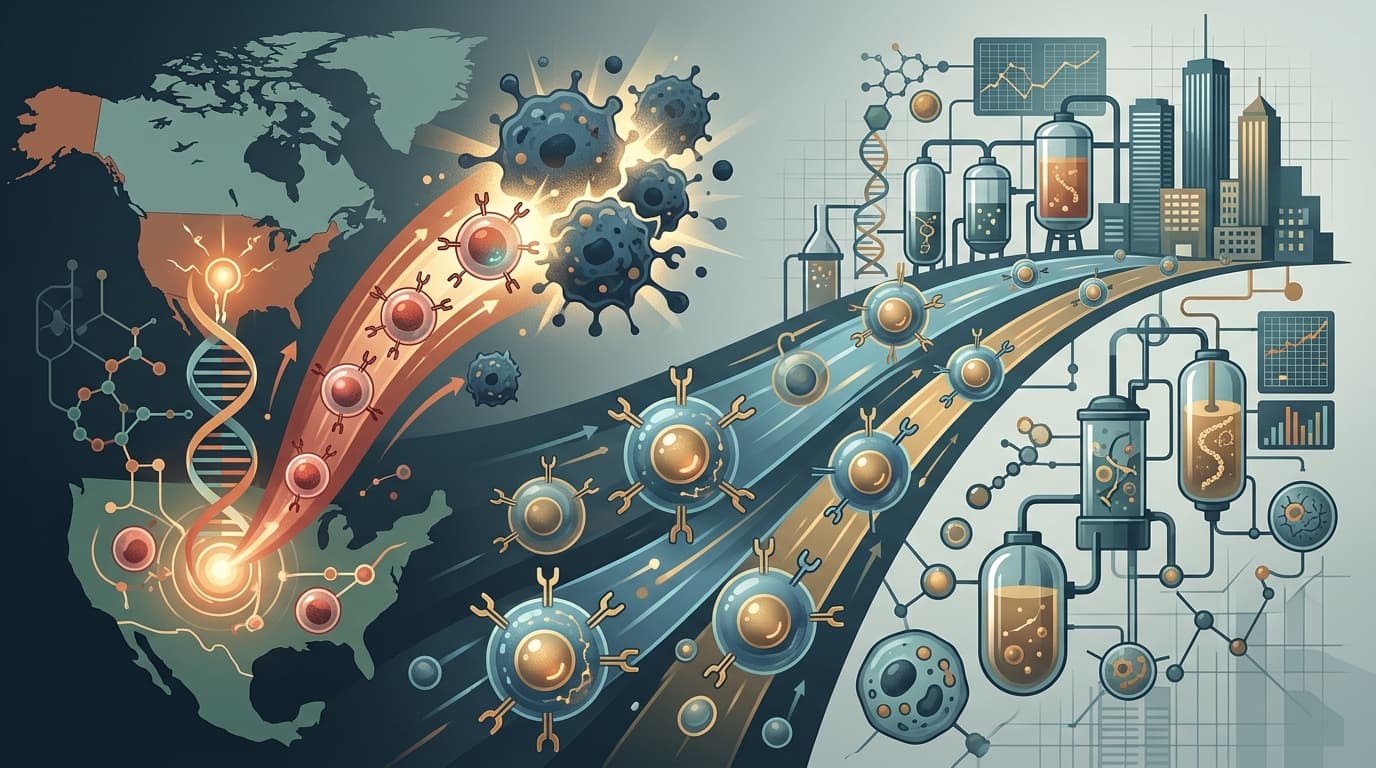

CAR-T cell therapy was invented in America, but China now runs more clinical trials and enrolls patients twice as fast. With U.S. research funding under pressure and China's R&D spending pulling even, the global biotech balance of power is shifting faster than most people realize.
CAR-T cell therapy was born in New York City. It's one of the most transformative cancer treatments ever invented: doctors pull a patient's immune cells out, reprogram them to hunt tumors, and put them back in. Living drugs, essentially. The FDA approved the first one in 2017, and it felt like the U.S. had locked up a generational lead in cell therapy.
Today, China runs more CAR-T clinical trials than the United States. And the gap is widening.
Michel Sadelain, director of the Columbia Initiative in Cell Engineering and Therapy and one of the pioneers behind the original CAR-T breakthroughs, put it bluntly at the STAT Breakthrough Summit East this week: "CAR-T cells were born in the U.S., actually here in New York City, but today there are more CAR-T cell trials in China than in the U.S."
The numbers back him up. As of early 2024, China had over 300 registered CAR-T trials, making it the global leader. The U.S. sits in second place. And China isn't just running more trials; it's enrolling patients faster, too. Since 2018, investigator-initiated trials for cell and gene therapies in China have enrolled more than 30,000 participants, roughly twice the typical enrollment numbers you'd see in comparable drug trials.
Think of it like a restaurant analogy. The U.S. invented the recipe, but China built more kitchens, hired more cooks, and is serving more tables. The food may not always be identical, but the sheer volume of iteration is staggering.
So how did China pull this off? Three things: speed, cost, and political will.
First, speed. Chinese researchers are notorious for launching trials quickly after new findings get published. The regulatory environment, particularly through China's NMPA (their version of the FDA), has been streamlined to fast-track cell and gene therapy approvals. That means fewer bureaucratic bottlenecks between a promising lab result and a patient receiving treatment.
Second, cost. A CAR-T treatment in the U.S. runs north of $370,000. In China? Somewhere between $120,000 and $200,000, with regional insurance programs cutting that bill in half for some patients. Lower costs mean more patients can access trials, which means more data, which means faster development cycles. It's a flywheel.

Embecta, the century-old insulin syringe giant, just dropped $200 million on a UK auto-injector maker called Owen Mumford. It's the clearest signal yet that the company wants to be something much bigger than needles.


Join thousands of biotech professionals who start their day with our free, daily briefing.
Third, political will. China's government has made biotech a strategic priority, pouring money into infrastructure and manufacturing. The result is an ecosystem that moves fast by design, not by accident.
While China is stepping on the gas, the U.S. is tapping the brakes on research funding.
The Trump administration proposed cutting the NIH budget by nearly 40% for fiscal year 2026, slashing it from roughly $47 billion down to about $27 billion. That would have been catastrophic. Congress pushed back hard, advancing bipartisan bills that preserved funding around $47 to $48.7 billion, even adding a $415 million increase and keeping $1.5 billion for ARPA-H (the government's moonshot health research agency).
But the damage isn't just in final numbers. The uncertainty itself is corrosive. In FY2025, NIH grant approval rates fell to approximately 20%, roughly half of prior-year levels. Projects focused on cancer, HIV/AIDS, and vaccine research got delayed or canceled outright. The total number of funded investigators dropped by nearly 2,000 in FY2025.
For biotech, this is like a football team cutting its scouting budget. You might save money today, but you're going to miss the next generation of talent.
The broader R&D picture is even more striking. According to NCSES data, total U.S. R&D spending (public and private combined) was approximately $940 billion in 2023. China's figure? Climbing every year while U.S. federal investment has stayed flat, adjusted for inflation, over two decades.
Some analysts believe China has already surpassed the U.S. in total R&D spending, depending on how you measure it. In 2024 purchasing power parity terms, the numbers were nearly identical: China at roughly $786 billion, the U.S. at about $782 billion. China's government-run research labs already spend more than 1.5 times what their American counterparts do.
And there's a hidden multiplier. Because labor costs are lower in China, every research dollar goes further. One estimate suggests $100,000 supports 2.3 researchers in China versus just one in the United States. That's not just a cost advantage; it's a productivity advantage.
The gene therapy market is projected to reach approximately $10 billion in 2026. By the mid-2030s, forecasts range as high as $78 billion. The Asia-Pacific region is expected to grow fastest, at nearly 29% annually through 2031.
Smart money is already flowing accordingly. AstraZeneca acquired Chinese CAR-T specialist Gracell Biopharma in 2023 to get access to next-generation cell therapy platforms. Legend Biotech, which co-developed the blockbuster Carvykti (one of seven FDA-approved CAR-T products), continues to build out its pipeline from its China operations.
The strategic calculus for investors is shifting. North America still holds the largest share of the global gene therapy market thanks to its deep infrastructure and private investment. But China's trial volume, cost advantages, and manufacturing scale make it the growth story. The companies that figure out how to bridge both ecosystems will likely win.
This isn't really about national pride or who plants a flag first. It's about patients. More trials mean more data. More data means better treatments, developed faster. If the U.S. slows down while China speeds up, the practical result is that American patients could end up waiting longer for therapies that Chinese patients already have access to.
The U.S. still has enormous strengths: world-class universities, a deep bench of scientific talent, the FDA's gold-standard regulatory framework, and a private sector that pours billions into biotech R&D. None of that disappears overnight.
But advantages don't last forever on autopilot. CAR-T therapy was an American invention. Whether the next generation of cell therapies will be is increasingly an open question.
MiniMed just got FDA clearance for the Flex, an insulin pump that's half the size of its predecessor and has no screen at all. In a market dominated by Insulet's tubeless Omnipod, this is MiniMed's boldest move yet to prove it can compete on lifestyle appeal.