The $3.2 Billion Bet That You'll Never Sit for an IV Again
Novartis just signed a deal worth up to $3.22 billion with South Korea's Alteogen for technology that converts IV drugs into quick under-the-skin injections. It's one of the biggest drug delivery licensing agreements ever, and it puts a little-known Korean biotech at the center of pharma's convenience revolution.
A South Korean Biotech Just Landed One of the Biggest Drug Delivery Deals Ever
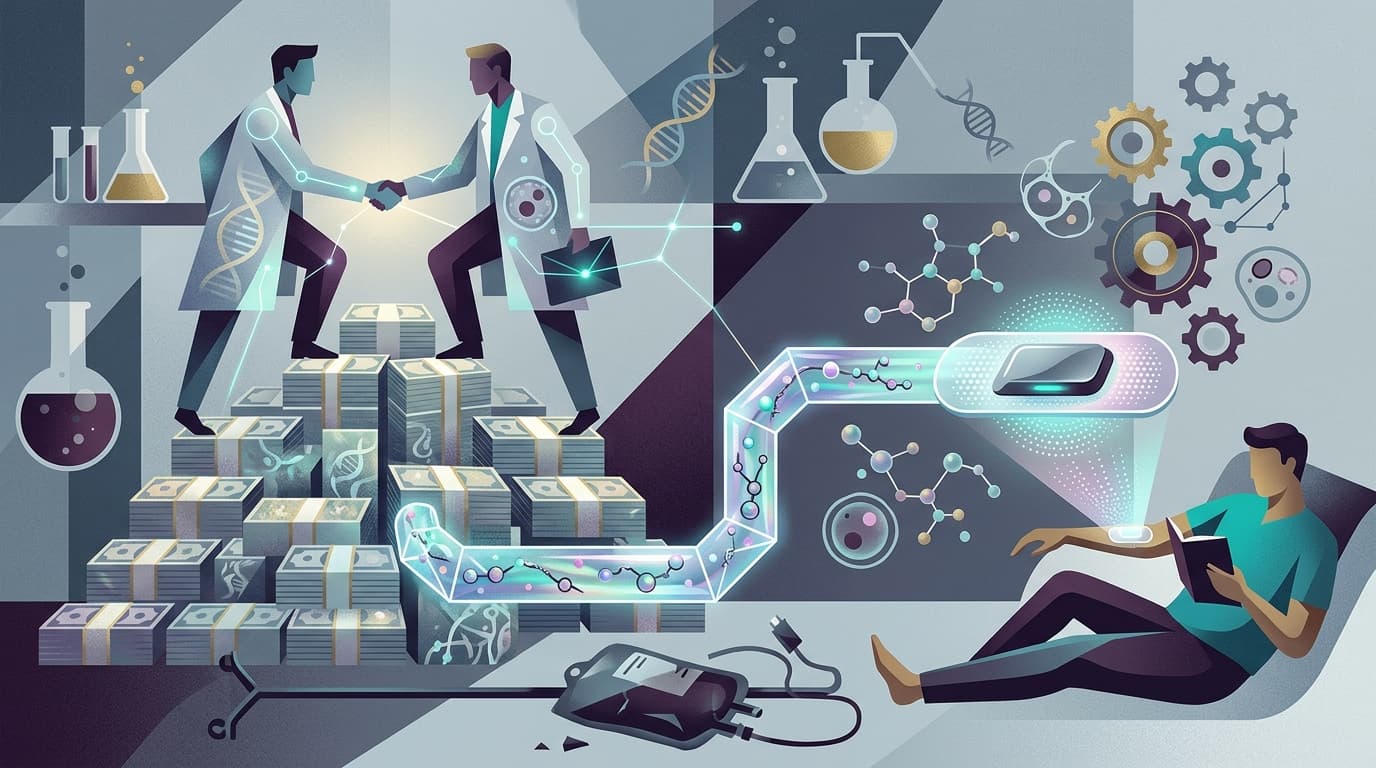
Imagine you're a cancer patient. Every few weeks, you drive to a clinic, sit in a chair, and wait for an IV drip to finish. Sometimes it takes hours. Now imagine getting the same drug as a quick shot under your skin, like an insulin injection, and going home in minutes.
That's the future Novartis just paid up to $3.22 billion to access. The Swiss pharma giant signed an option-and-license agreement with South Korea's Alteogen, a company most people outside biotech have never heard of. The deal gives Novartis the right to use Alteogen's technology for converting IV biologics (large, complex drugs normally delivered through a vein) into subcutaneous formulations (shots you can get under the skin).
It's one of the largest drug delivery licensing agreements in the industry's history. And it signals something bigger: the race to make biologics more convenient is now a multi-billion-dollar priority.
The Secret Sauce: An Enzyme That Opens Doors
Alteogen's platform, called Hybrozyme, is built around an enzyme called ALT-B4. Think of it like a biological locksmith.
Under your skin, there's a dense mesh of hyaluronic acid, a gel-like substance that acts as a barrier. Most large biologic drugs can't pass through it efficiently; that's why they need to go straight into a vein. ALT-B4 temporarily breaks down that mesh, creating a window for the drug to slip through and get absorbed into the bloodstream.
The enzyme doesn't treat anything on its own. It's a permeability modifier, co-injected alongside the actual therapeutic. Once it does its job, the tissue rebuilds itself. No permanent changes, just a brief opening that makes subcutaneous delivery possible for drugs that previously required an IV pole and a comfy chair.
If that sounds familiar, it should. Halozyme has built a billion-dollar business on a similar hyaluronidase technology called ENHANZE. Alteogen is essentially the upstart challenger, and this Novartis deal is a loud statement that the incumbent has serious competition.
Get tomorrow's biotech intelligence before your competitors.
Join thousands of biotech professionals who start their day with our free, daily briefing.
Inside the Deal: Big Numbers, Bigger Asterisks
The $3.223 billion headline is eye-catching, but let's be clear about what it actually means. This is a ceiling, not a check.
Novartis gets multiple exclusive options to use ALT-B4 across several of its biologic products (the specific drugs weren't disclosed). If Novartis exercises all those options and the resulting programs hit every development and commercialization milestone, Alteogen collects the full amount. On top of that, royalties on net sales would be paid separately, meaning they aren't even included in that $3.22 billion figure.
Analysts estimate the deal could cover roughly 10 to 11 products, though that's informed speculation rather than a confirmed number. The exact milestone schedule, royalty rates, and product targets are all under confidentiality.
So yes, there's an upfront signing payment due within 30 days (amount undisclosed), but the vast majority of the money sits behind gates that may take years to unlock. It's like signing a contract to buy a mansion: the earnest money is real, but you're not writing the big check until closing day.
Alteogen's Dance Card Is Getting Full
Novartis isn't Alteogen's first big-name partner. The South Korean company has been steadily building a portfolio of licensing deals that reads like a pharma all-star roster.
Merck signed on for worldwide rights to develop a subcutaneous version of Keytruda (pembrolizumab), the best-selling cancer drug on the planet. AstraZeneca licensed the platform for subcutaneous oncology formulations. GSK's subsidiary Tesaro grabbed rights for a subcutaneous version of dostarlimab, another cancer immunotherapy. Biogen is also in the mix for Hybrozyme-based subcutaneous biologics.
And just a month before the Novartis announcement, Alteogen signed yet another exclusive license with an undisclosed global pharma company. The pattern is unmistakable: the industry's biggest players are lining up to rent Alteogen's molecular locksmith.
Why Novartis Wants This (and Why the Market Shrugged)
Novartis already has subcutaneous biologics in its pipeline. Cosentyx (secukinumab) for polymyalgia rheumatica is a subcutaneous injection that was filed in the first half of 2026 in the US, EU, and Japan. But the Alteogen deal isn't about today's portfolio; it's about tomorrow's.
The real value is optionality. As Novartis advances new biologics through development, ALT-B4 gives them a ready-made conversion toolkit. Instead of building IV-only drugs and hoping patients tolerate clinic visits, they can plan for subcutaneous delivery from the start. Think of it as future-proofing their pipeline.
Wall Street, however, wasn't exactly popping champagne. Alteogen's stock reaction was described as muted, and the reason is simple: milestone-heavy deals are promises, not paychecks. Shinhan Securities initially raised its price target to 540,000 won on the news, then trimmed it to 520,000 won after a Novartis Phase 3 failure in a related program narrowed the expected number of subcutaneous conversions from three to two. Hana Securities kept a Buy rating on Alteogen with a target of 450,000 won, recalculated after a stock split, arguing investors care more about actual cash inflows than contract ceilings.
One broker even flagged the deal as a negative read-across for Halozyme, suggesting Alteogen's growing partnership roster is creating real competitive pressure in the subcutaneous enablement space.
The Bigger Picture: Convenience Is the New Blockbuster
This deal is part of a broader industry trend that's reshaping how drugs get delivered. Patients and payers increasingly want treatments that don't require hours in an infusion center. Subcutaneous formulations mean fewer clinic visits, shorter administration times, and (eventually) the possibility of at-home self-injection.
For pharma companies, the math is compelling too. A subcutaneous version of an existing IV biologic can extend patent protection, differentiate against biosimilar competition, and improve patient adherence. When your blockbuster drug is facing a patent cliff, giving it a new delivery method is like adding a sunroof to last year's car model: same engine, fresh appeal.
At $3.22 billion in potential value, Novartis is betting that convenience isn't just a nice-to-have. It's a competitive weapon. And Alteogen, the company that barely registered on most investors' radars two years ago, is quickly becoming the arms dealer in that fight.
The question now isn't whether subcutaneous reformulation matters. It's which IV drugs get converted first, and how fast the royalty checks start flowing.
Clinical & Regulatory
4 min read
Sarepta's Worst Week Just Rewrote the Gene Therapy Playbook
Sarepta slapped a black box warning on its Duchenne gene therapy Elevidys and cut 36% of its workforce in one brutal announcement. The fallout raises hard questions about the commercial future of accelerated-approval gene therapies in rare disease.