
The team that built Metsera into a $10 billion Pfizer acquisition target is teaming up with an AI "scientist" startup to do something nobody's tried: use artificial intelligence to systematically create and launch entire biotech companies. It's either the future of drug development or the most expensive science fair project ever.
Most biotech companies start the same way. A scientist has a hunch. They spend years testing it. Then they raise money, build a team, and pray the drug works.
What if you could automate the hunch part?
That's the bet behind a new partnership announced on June 29, 2026 between Edison Scientific, an AI "scientist" startup, and Population Health Partners (PHP), the investment team that built Metsera into a $10 billion obesity acquisition target. Their plan: use an AI platform called Kosmos to systematically discover, design, and spin out entirely new biotech companies. Not one company. Many.
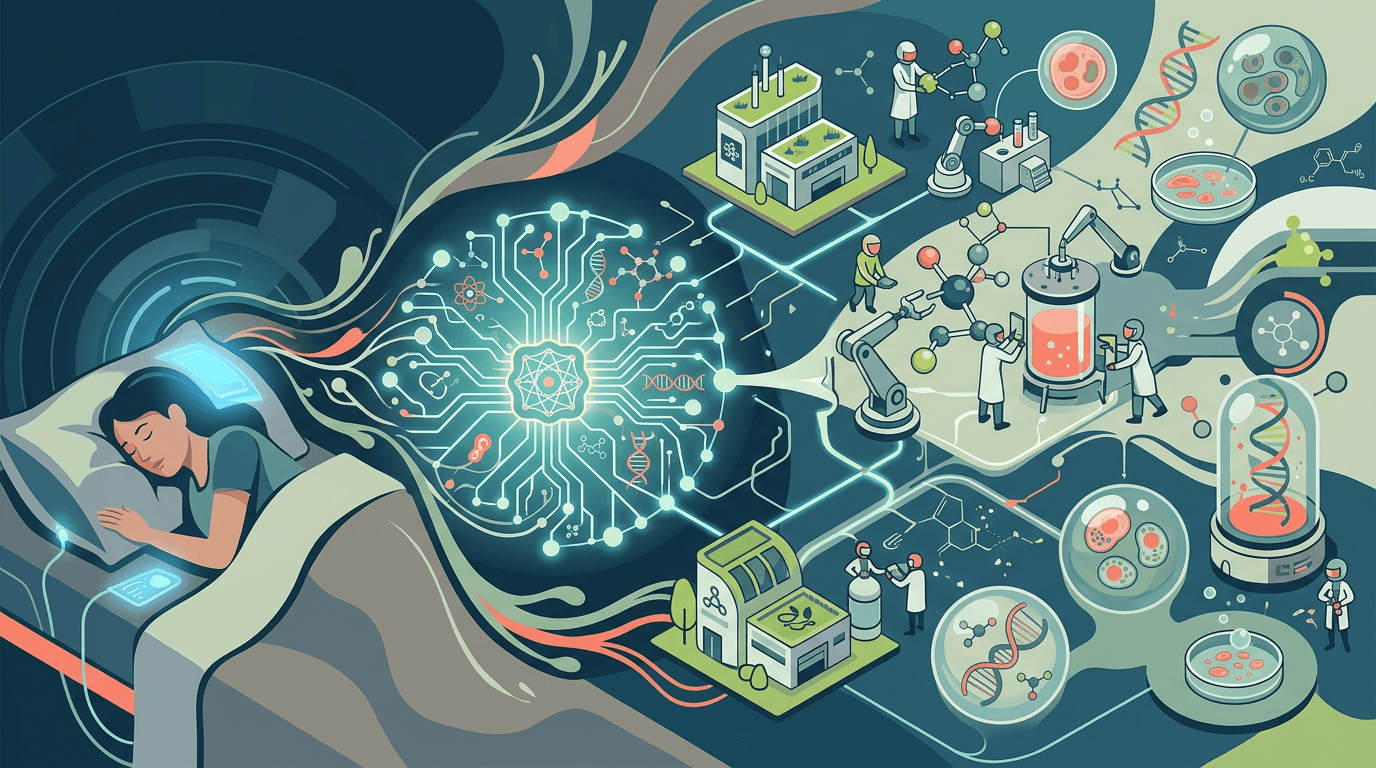
Think of it as a biotech factory where the assembly line runs on algorithms instead of lab coats.
PHP isn't some scrappy first-timer. This is the crew led by Whit Bernard and Dr. Clive Meanwell that launched Metsera in 2022, took it public on Nasdaq in January 2025 (raising $275 million at a $2.7 billion valuation), and then watched Pfizer scoop it up for roughly $10 billion by late 2025. Before Metsera, Meanwell founded The Medicines Company, which Novartis acquired. These people know how to build pharma-grade companies from scratch.
Edison Scientific, meanwhile, is the commercial spinout of FutureHouse, a nonprofit AI biology lab. Co-founded by CEO Sam Rodriques (a physicist and bioengineer from the Francis Crick Institute) and CTO Andrew White (creator of some of the first large language model agents for chemistry), Edison raised $70 million in seed funding at a roughly $250 million valuation. Investors include Spark Capital, Triatomic Capital, and notable angels like Google's Jeff Dean.
So you've got a proven biotech factory on one side and a well-funded AI research engine on the other. The question is whether mashing them together actually works.
Kosmos isn't ChatGPT for drug discovery. It's closer to a tireless postdoc who never sleeps, never forgets a paper, and never gets bored of spreadsheets.

Praxis Precision Medicine's epilepsy drug just got a three-month FDA delay, and it's far from the only biotech feeling the squeeze. With roughly 3,500 FDA employees cut since 2025, the agency's review machine is straining under its own weight.


Join thousands of biotech professionals who start their day with our free, daily briefing.
A single Kosmos "run" can last up to 12 hours, during which it reads approximately 1,500 full-text scientific papers, writes around 42,000 lines of analysis code, and cycles through roughly 20 rounds of hypothesis generation and refinement. Edison's team estimates that one run produces the equivalent of six months of a human researcher's work.
The platform doesn't just summarize literature, though. It designs computational experiments, tests hypotheses in silico (meaning inside a computer, not a petri dish), and produces fully cited research reports at the end. Another Edison tool, called Robin, has already generated a hypothesis that was validated in patient-derived cells, not just lab-grown cell lines. That's a meaningful distinction: it suggests the AI's ideas can survive contact with real human biology.
The Edison-PHP partnership isn't a consulting arrangement. It's a company-creation engine.
The model works like this: Kosmos scans disease landscapes, identifies promising targets, and evaluates therapeutic strategies at a scale no human team could match. PHP then takes the best opportunities and builds actual companies around them, with Edison's AI embedded from day one through clinical development. That means Kosmos isn't just finding targets; it's helping draft regulatory documents, analyze clinical data, and support scientific decision-making throughout a company's entire life.
Their first project focuses on a clinical-stage asset already in PHP's portfolio, one that could potentially affect about 10% of the world's population. Priority disease areas for future spinouts include cardiovascular disease, inflammatory lung disease, and gastrointestinal conditions.
If that sounds ambitious, it is. But consider the math. Traditional biotech venture creation depends on a small number of experts spotting opportunities, doing months of diligence, and placing big bets on a handful of ideas. If Kosmos can compress the discovery phase from months to days, PHP could theoretically evaluate (and launch) far more companies per year than any traditional model allows.
AI in biotech is not new. DealForma counted 114 AI/ML discovery partnerships in 2025 alone, worth $43.4 billion in potential payments. But most of those deals use AI as a tool within an existing company's pipeline: better molecule design here, faster screening there.
The Edison-PHP model is different because it makes AI the architect of new companies, not just a consultant to existing ones. It's the difference between hiring an interior designer and having an AI design the whole building.
Other players are circling similar territory. C10 Labs and LabCentral run an AI bio accelerator in Boston. Eli Lilly's TuneLab gives biotech partners access to proprietary AI models. Foundation-model startups like Bioptimus, CellType, and Boltz PBC are building generalized biology platforms that could power multiple drug programs. But nobody has quite combined a proven company-building track record (two multi-billion-dollar exits) with a purpose-built AI scientist platform the way PHP and Edison have.
Wall Street hasn't weighed in on Edison directly (it's still private). But the broader pattern is instructive. When Metsera went public, Bank of America slapped a Buy rating on it with a $38 target. Guggenheim went even more bullish at $56. The stock eventually spiked about 150% from pre-announcement trading levels once Pfizer's interest leaked.
Investors clearly love the outputs of PHP's model. The question is whether embedding AI into the creation process can make those outputs faster, cheaper, and more numerous.
Sector analysts are constructive but cautious. The consensus view: AI platforms get treated like out-of-the-money call options until they produce late-stage clinical data. Capital rewards scale, data, and execution. Experiments alone don't cut it.
The Edison-PHP partnership is essentially a bet that the bottleneck in biotech isn't money or molecules; it's ideas. If an AI scientist can surface better hypotheses faster, and a seasoned team can turn those hypotheses into real companies, then the traditional timeline for biotech creation (years of manual diligence, one bet at a time) starts looking like a horse-drawn carriage in the age of automobiles.
Of course, hypotheses are cheap. Drugs that actually work in humans are expensive and rare. Kosmos might be brilliant at reading papers and crunching data, but biology has a nasty habit of humbling even the smartest systems, carbon-based or silicon-based.
Still, if anyone has earned the right to try this experiment, it's a team with two multi-billion-dollar biotech exits and an AI platform backed by some of tech's sharpest minds. We'll be watching to see what rolls off this particular assembly line.
Vistagen's anxiety drug fasedienol just went 1-for-3 in Phase 3 trials, torching 80% of the stock's value. The company is betting a post-hoc subgroup signal and an FDA meeting can save a program that Wall Street has all but written off.