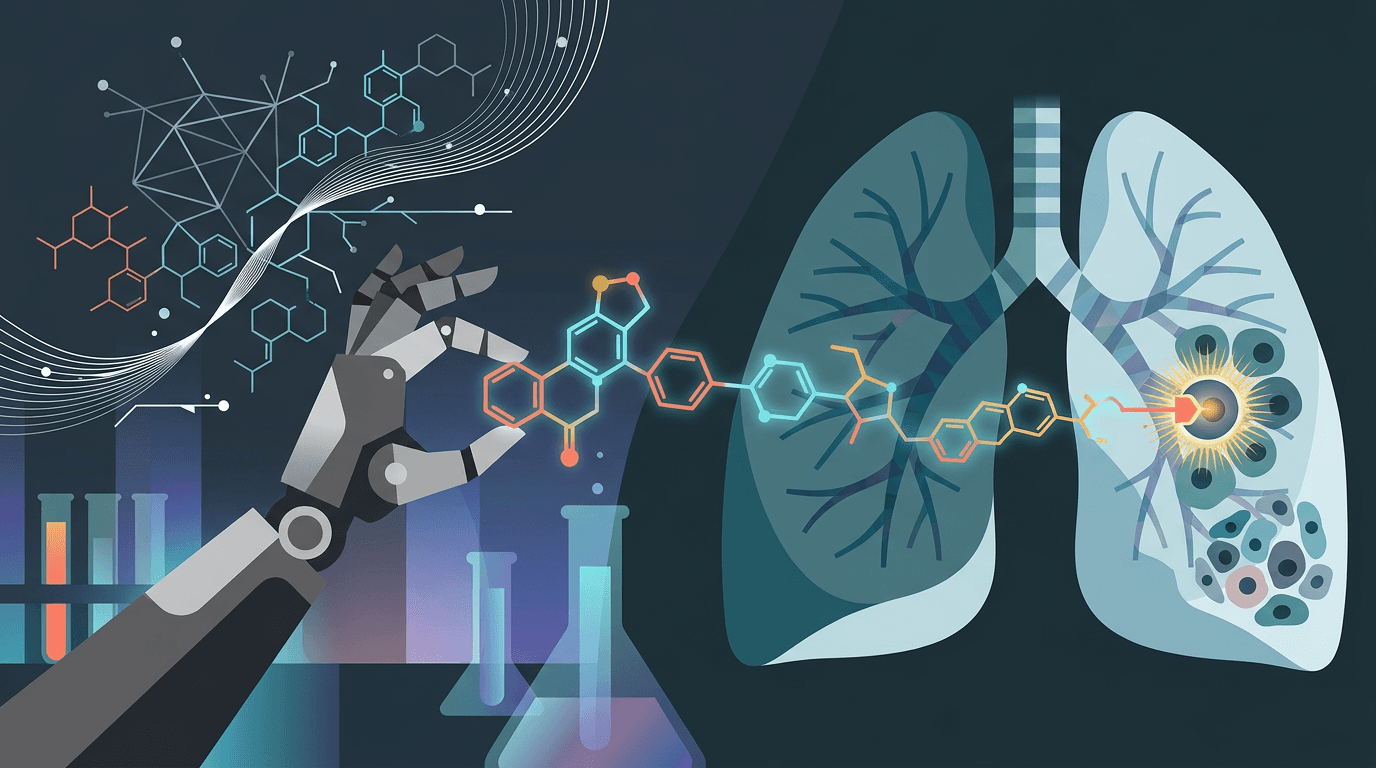

Insilico Medicine's rentosertib, a drug designed entirely by AI, just showed actual lung function improvement in an IPF trial where lungs are only supposed to get worse. It's the strongest proof yet that AI-driven drug discovery can produce real results in humans.
Most AI drug discovery stories end the same way: big promises, flashy press releases, and then silence when the data rolls in. Insilico Medicine just broke that pattern.
The company's drug rentosertib, designed end-to-end by artificial intelligence, just posted positive Phase 2a results in patients with idiopathic pulmonary fibrosis (IPF), a brutal lung disease that slowly turns healthy tissue into scar tissue. Patients on the highest dose didn't just decline slower. Their lungs actually got better over 12 weeks.
That's a sentence nobody in biotech expected to write about an AI-designed molecule. Not yet, anyway.
IPF is one of the cruelest diagnoses in pulmonary medicine. Once it starts, the lungs gradually stiffen with scar tissue, making every breath a little harder than the last. Median survival is three to five years from diagnosis, which puts it in the same ballpark as many cancers.
The three approved drugs for IPF, nintedanib, pirfenidone, and nerandomilast, are essentially speed bumps. They slow lung function decline, but they don't stop it, and they definitely don't reverse it. Think of it like bailing water out of a sinking boat: you're buying time, but the hole is still there.
So when a new drug shows actual improvement in lung function, even in a small early trial, the IPF world pays attention.
The trial enrolled 71 IPF patients across four arms: three doses of rentosertib (30 mg once daily, 30 mg twice daily, and 60 mg once daily) plus placebo. Treatment lasted 12 weeks, and the primary goal was proving the drug was safe enough to keep testing.
Safety? Check. Adverse event rates were similar across all groups, with placebo patients reporting side effects at about the same rate as treated patients.
But the real headline lives in the lung function data. Patients on placebo saw their forced vital capacity (FVC, a measure of how much air you can blow out) drop by about on average. That's expected; IPF lungs are always getting worse.

A genetically engineered pig kidney kept a man off dialysis for 271 days, setting a new record for xenotransplantation. Now the FDA has cleared eGenesis to try it in 30 more patients, marking the biggest bet yet that pig organs could solve the kidney shortage crisis.


Join thousands of biotech professionals who start their day with our free, daily briefing.
Patients on the 60 mg dose went the other direction: their FVC increased by about 98 mL. And in the subgroup of patients who weren't already taking standard antifibrotic drugs, the improvement was even more striking, at roughly 188 mL.
For context, existing IPF drugs are considered successful when they slow a decline. This drug showed a gain. In a disease where lungs only go one direction, that's like watching a car roll uphill.
What makes rentosertib different from every other IPF drug in development isn't just the clinical data. It's how it was born.
Insilico's AI platform, called Pharma.AI, handled two jobs that usually take humans years and hundreds of millions of dollars. First, its target discovery engine (PandaOmics) crunched mountains of genomic, clinical, and scientific literature data to identify a protein called TNIK as a promising drug target in fibrosis. TNIK sits at the crossroads of several pathways that drive scar tissue formation, almost like a traffic cop directing multiple lanes of fibrotic signaling.
Second, the company's generative chemistry engine (Chemistry42) designed a molecule to block TNIK. Running over 30 AI models in parallel, it optimized for potency, selectivity, and drug-like properties.
The whole process, from picking the target to nominating a clinical candidate, took under 18 months and cost roughly $2.6 million. The traditional version of that journey? Typically four to six years and tens of millions of dollars. Getting from target to Phase 1 took under 30 months total.
Rentosertib is now the first drug where both the target and the molecule were generated by AI and then validated in a randomized, placebo-controlled human trial.
Before anyone gets too excited, there's a yellow flag on the field. Seven patients dropped out due to liver-related issues, and four of those were also taking nintedanib, which has its own liver baggage. In the 60 mg group, only 12 of 18 patients (67%) completed the full 12 weeks, compared to 88% on placebo.
Insilico's CEO Alex Zhavoronkov has described the liver enzyme elevations as transient and reversible, mostly appearing in patients on background therapy. That's plausible, but it's a problem that needs a clean answer before larger trials can move forward. Drug-drug interactions with existing IPF medications will be a critical puzzle to solve.
The IPF results are genuinely interesting on their own. But the bigger story is what this means for AI-driven drug discovery as a field.
For years, the sector has been long on promises and short on clinical proof. Exscientia was the first to get an AI-designed molecule into human trials. Recursion has built the broadest clinical pipeline, with multiple Phase 2 programs. But Insilico is the first to show positive efficacy data from a trial where AI handled the entire discovery process, target and molecule alike.
That distinction matters to investors, pharma partners, and skeptics. It's one thing to say AI can speed up drug discovery. It's another to point to a peer-reviewed Nature Medicine paper showing it produced a drug that outperformed placebo in a notoriously difficult disease.
Is this proof that AI will revolutionize all of pharma? No. One Phase 2a win in 71 patients doesn't rewrite the industry playbook. The confidence intervals are wide, the trial was short, and plenty of drugs that look good in Phase 2 collapse in Phase 3.
But it's the strongest evidence yet that the AI drug discovery thesis isn't just hype. The robot designed a drug. The drug worked in humans. Now Insilico has to prove it works in a bigger trial, for longer, without melting anyone's liver.
Insilico is gearing up for larger trials. The company has also received IND clearance in China for an inhaled version of rentosertib, which could theoretically deliver the drug directly to the lungs and sidestep some of those systemic side effects.
For the IPF community, this is a cautiously hopeful moment. For the AI drug discovery world, it's the first real receipt. Not a press release, not a preclinical poster; actual human data showing that an AI-born molecule can do something meaningful in a disease that desperately needs new options.
The bar is still high. But for the first time, an AI-designed drug just cleared it.
The FDA just moved Gilead's Trodelvy from last-resort to first-choice in triple-negative breast cancer, the deadliest breast cancer subtype. It's a seismic shift for patients, a multi-billion-dollar opportunity for Gilead, and a surprisingly friendly outcome for Merck's Keytruda.