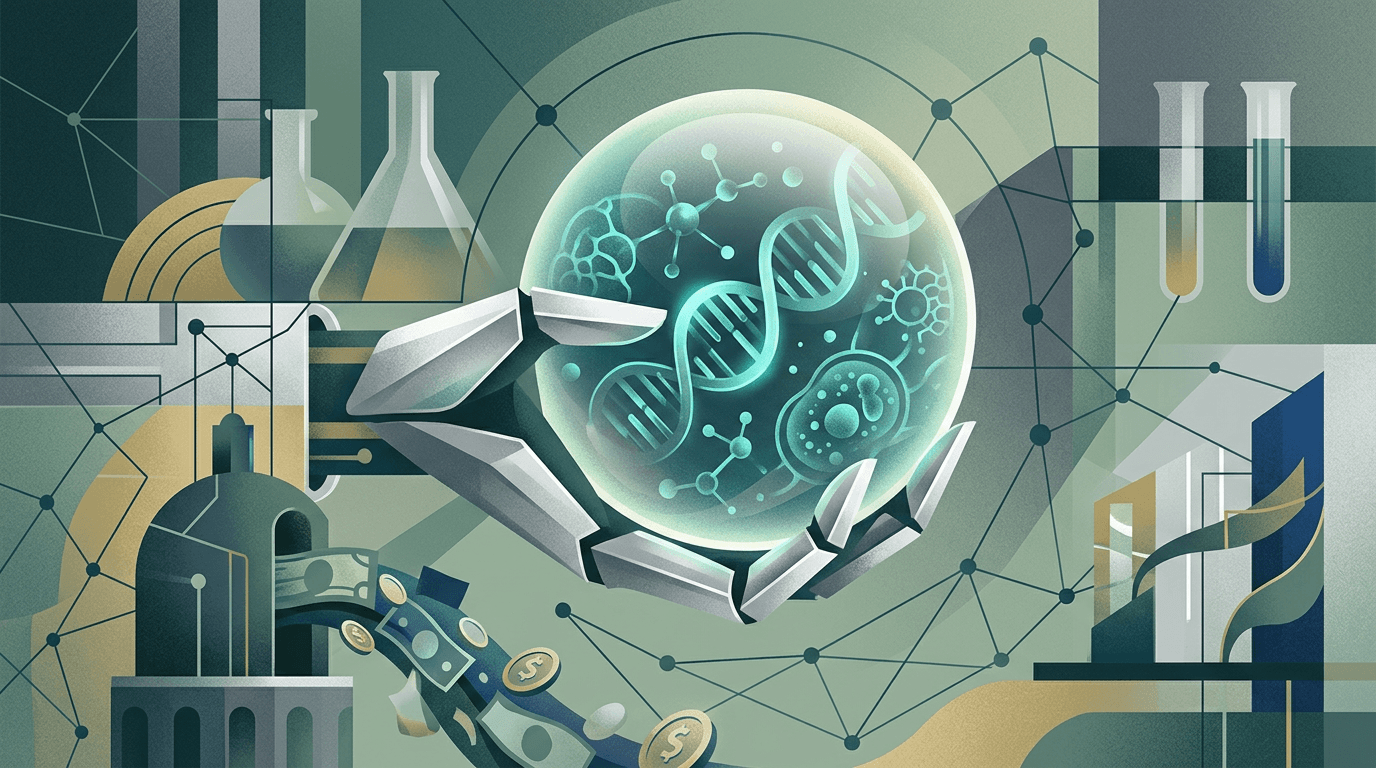

An AI designed both the target and the drug from scratch. Now it's showing real results in patients with a deadly lung disease. Insilico Medicine's rentosertib just posted Phase 2a data that could reshape how we think about drug discovery economics.
For years, the AI drug discovery crowd has been making a bold promise: give us the data, and we'll design better medicines, faster and cheaper. Skeptics (and there are many) have had a simple rebuttal: prove it.
Insilico Medicine just took a big step toward doing exactly that. The company's Phase 2a trial results for rentosertib, a drug designed almost entirely by artificial intelligence, showed that it stabilized lung function in patients with idiopathic pulmonary fibrosis (IPF), a brutal disease that slowly suffocates people by scarring their lungs. The results were published in Nature Medicine, and they mark one of the first times an AI-designed drug has demonstrated real, measurable benefit in humans.
This isn't just a biotech story. It's a proof-of-concept moment for an entire technology.
IPF is the kind of diagnosis nobody wants. It's a progressive lung disease, mostly hitting men over 50, where scar tissue gradually replaces healthy lung tissue. Think of your lungs slowly turning from sponge into leather. There's no cure. The two approved treatments, nintedanib and pirfenidone, can slow the decline, but they can't stop it and they certainly can't reverse it.
Patients on these drugs still lose lung function over time. They just lose it a little more slowly. That's the best medicine has to offer right now, and it's not nearly good enough.
Insilico ran a 71-patient, placebo-controlled trial in China. It lasted 12 weeks, which is short, but the numbers were encouraging. Patients on the highest dose of rentosertib (60 mg daily) saw their lung capacity increase by an average of 98.4 milliliters. Meanwhile, the placebo group declined by 20.3 mL.
To put that in perspective: in IPF, lung function is supposed to go down. That's the whole terrifying nature of the disease. Seeing it go up, even modestly, over three months is like watching a car rolling downhill suddenly shift into reverse. It's not definitive proof of a miracle, but it's enough to make the whole room pay attention.

Three days after its melanoma trial flopped, Regeneron bet $2.3 billion on a totally unproven cancer technology from a startup most people have never heard of. The science behind the deal is genuinely wild.


Join thousands of biotech professionals who start their day with our free, daily briefing.
The drug also met its primary safety endpoint. Patients tolerated it well, with no major red flags across all dose groups. And the biomarker data told a consistent story: levels of pro-fibrotic proteins (the molecular signatures of scarring) dropped, while anti-inflammatory markers rose. The mechanism appears to be doing what the AI predicted it would.
This is where it gets wild. Rentosertib wasn't just optimized by AI. It was conceived by AI, from the ground up.
Insilico's platform, called Pharma.AI, operates in three layers. First, an engine called PandaOmics crunched massive datasets of disease biology, genetic signals, and medical literature to identify a target called TNIK (a kinase involved in fibrotic and inflammatory signaling) as a promising drug target for IPF. This wasn't a well-known target that scientists had been circling for years. The AI surfaced it as something new.
Then a second engine, Chemistry42, used generative models to design molecules that could block TNIK. Think of it like an AI chef inventing a recipe from scratch: you tell it the flavor profile you want (potent, selective, orally available, safe), and it generates candidate structures. The system synthesized and tested fewer than 80 compounds before landing on a winner.
In traditional drug discovery, that process typically requires screening thousands of molecules. Insilico claims it went from target identification to clinical-ready candidate in roughly 18 months, a timeline that would make most pharma R&D teams spit out their coffee.
The economics here are potentially game-changing. Drug discovery is famously expensive: the standard estimate is over $1 billion per approved drug, with timelines stretching a decade or more. If AI can reliably compress the early discovery phase, cut the number of dead-end compounds, and identify better targets upfront, the math shifts dramatically.
Rentosertib's Phase 2a results don't prove that thesis on their own. But they're the strongest evidence yet that AI-designed drugs can actually work in the real world. And the market has noticed: Insilico is now among a tiny handful of companies (alongside Exscientia, which has six AI-designed candidates in human trials) that can point to genuine clinical data, not just impressive PowerPoint slides.
The cautionary note, though, is real. Seventy-one patients over 12 weeks is a small, short study. IPF trials are notoriously noisy; lung function measurements can bounce around. And the history of drug development is littered with Phase 2 darlings that crashed and burned in Phase 3. Insilico is planning larger, longer trials, and those will be the true test.
Rentosertib isn't competing in a vacuum. Recursion Pharmaceuticals is pushing AI-enabled candidates through early clinical stages using its massive phenomics (cell imaging) platform. Absci is applying generative AI to biologics design, getting closer to clinical-stage antibody candidates. And Schrödinger's computational chemistry work contributed to a drug that reached Phase 3 trials.
But Insilico's claim is unique: both the target and the molecule were AI-discovered. Nobody else has matched that combination at this clinical stage. It's the difference between AI helping you edit a novel and AI writing the whole book.
Insilico has already received clearance in China to test an inhaled version of rentosertib, which could deliver the drug directly to lung tissue and reduce side effects. Phase 3 trials for the oral version are expected to launch soon.
The question everyone in biotech is now asking isn't whether AI can design a drug. It's whether AI can design a drug that actually gets approved and changes patients' lives. Rentosertib's Phase 2a data doesn't answer that question yet. But for the first time, it makes the answer feel possible rather than theoretical.
And in an industry where most bets fail, "possible" is worth a lot.
A 107-year-old Italian family pharma just dropped $4.1 billion on a Florida rare disease company, paying roughly three times its own annual revenue. The deal gives Angelini instant access to the U.S. market and a portfolio generating nearly $600 million a year.