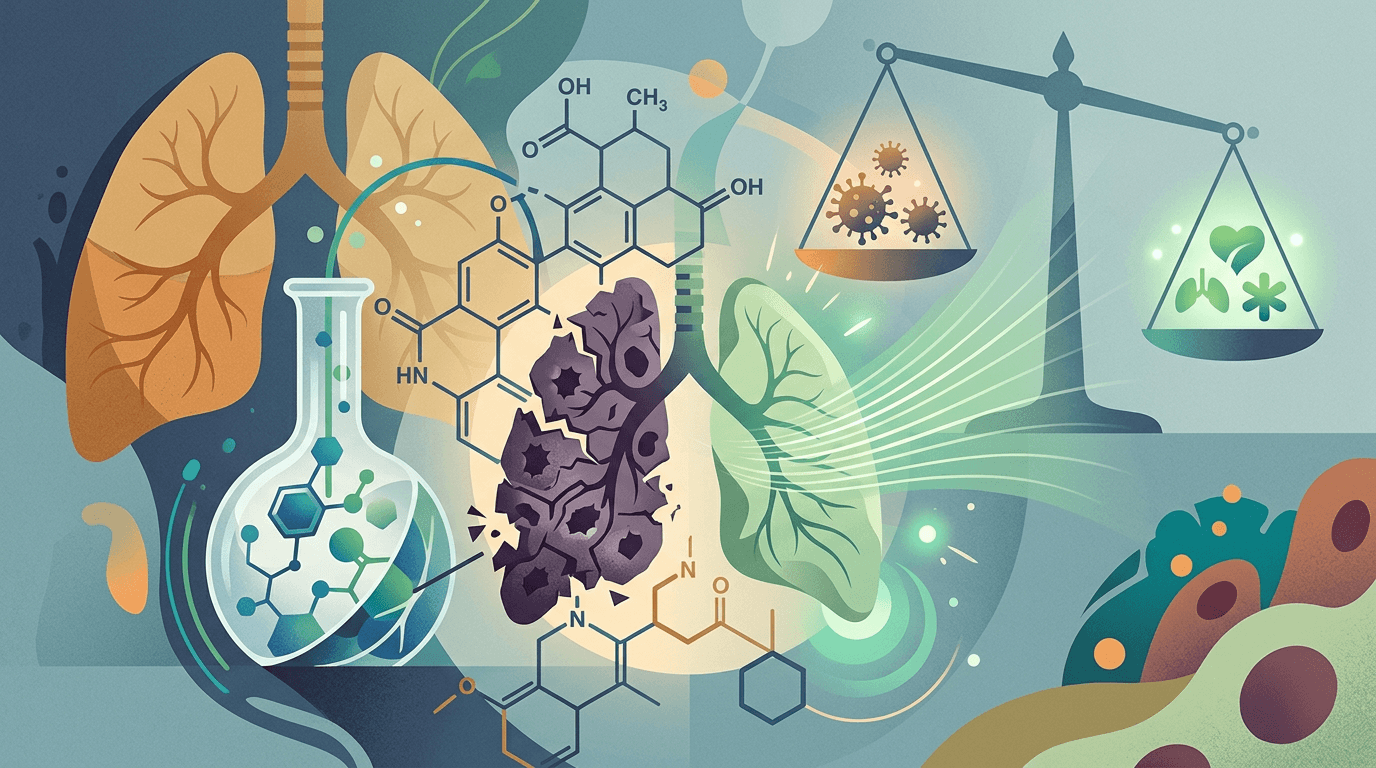

For the first time, a Phase 3 trial proved an antibody-drug conjugate can replace brutal platinum chemotherapy in first-line lung cancer. Merck and Kelun-Biotech's sac-TMT just redrew the treatment map, and the timing couldn't be worse for Pfizer.
For decades, the playbook for treating advanced lung cancer has started the same way: pump the patient full of platinum-based chemotherapy and hope it works long enough. It's brutal, it's toxic, and for most patients, it buys months, not years.
Now, for the first time ever, a Phase 3 trial has shown that a smarter class of drug can replace platinum chemo entirely in first-line lung cancer treatment. And the results aren't even close.
The drug is called sacituzumab tirumotecan (sac-TMT), developed by Merck and Kelun-Biotech. It belongs to a class called antibody-drug conjugates, or ADCs. Think of an ADC like a guided missile: it uses an antibody to find cancer cells, locks onto a specific protein on their surface, then delivers a toxic payload directly inside. Traditional chemo, by contrast, is more like carpet-bombing an entire city to hit one building.
Sac-TMT targets a protein called TROP2, which sits on the surface of many solid tumor cells. Once the antibody latches on, the cancer cell swallows the whole package. Inside, a chemical linker breaks apart, releasing a potent cell-killing agent (a topoisomerase I inhibitor) that shreds the cancer cell's DNA. The payload can even leak into neighboring tumor cells, taking out bystanders that might have dodged the initial hit.
The key insight: what if you could pair this precision weapon with immunotherapy and skip the platinum chemo altogether?
Merck and Kelun ran two major Phase 3 studies testing sac-TMT plus pembrolizumab (Keytruda) in previously untreated advanced non-small cell lung cancer, which accounts for roughly 85% of all lung cancers.
OptiTROP-Lung05 enrolled patients whose tumors expressed PD-L1 (a biomarker that predicts immunotherapy response). The combo of sac-TMT plus Keytruda beat Keytruda alone on the primary endpoint of progression-free survival, with a positive trend in overall survival. BMO Capital Markets noted that 12-month overall survival hit 80.4% in the sac-TMT arm versus 68.9% for Keytruda monotherapy.

Phathom's Voquezna just became the first and only drug with an FDA label for non-erosive GERD, the most common form of heartburn that PPIs consistently fail to treat. With 50-70% of all GERD patients falling into this category, the approval could reshape a market that hasn't seen real innovation in three decades.


Join thousands of biotech professionals who start their day with our free, daily briefing.

OptiTROP-Lung06 tackled the harder population: PD-L1-negative patients, who typically need chemotherapy because immunotherapy alone doesn't cut it. This trial compared sac-TMT plus Keytruda against the current gold standard of Keytruda plus platinum-based chemo. The ADC combo met its primary endpoint, significantly improving progression-free survival over the control arm.
No new safety signals emerged. Both trials hit their primary endpoints at prespecified interim analyses.
Leerink Partners called this "the first direct proof-of-concept for an ADC replacing platinum-based chemo in a first-line standard-of-care regimen for NSCLC." That's Wall Street analyst-speak for: this has literally never been done before.
Platinum chemotherapy has been the backbone of lung cancer treatment for so long that it's almost hard to imagine oncology without it. But platinum comes with a laundry list of problems: kidney damage, hearing loss, severe nausea, bone marrow suppression, nerve damage. Even with the addition of immunotherapy over the past several years, about 74% of patients still see their disease progress within five years. Extending chemo beyond four to six cycles doesn't improve survival; it just piles on toxicity.
Replacing that backbone with a targeted ADC isn't just an incremental improvement. It's a structural change in how we think about treating the most common form of lung cancer.
The timing makes this even more striking. Pfizer's ADC sigvotatug vedotin, inherited from the $43 billion Seagen acquisition, recently failed its own Phase 3 lung cancer trial. That study (in previously treated NSCLC, not first-line) couldn't beat docetaxel on overall survival.
Different target (integrin β6, not TROP2), different setting (second-line, not first-line), different comparator. But the optics are unavoidable: Pfizer spent a historic sum acquiring Seagen's ADC platform, and its lung cancer ADC stumbled. Merck's partnered ADC, developed with a much smaller Chinese biotech, just delivered the kind of result the entire field has been chasing.
Pfizer still has a first-line NSCLC trial running for sigvotatug vedotin combined with Keytruda. But Merck just set the bar considerably higher.
Sac-TMT isn't operating in a vacuum. The ADC landscape in lung cancer is getting crowded, fast. AstraZeneca and Daiichi Sankyo have datopotamab deruxtecan (Dato-DXd), another TROP2-targeting ADC with positive Phase 3 signals in previously treated NSCLC. Trastuzumab deruxtecan (T-DXd) already has approval in HER2-selected lung cancer. And several other ADCs targeting c-MET, HER3, and other proteins are moving through late-stage trials.
But none of them have first-line, chemo-replacement data. That's what makes sac-TMT's position unique: it's not just showing that ADCs work in lung cancer, it's showing they can replace the thing oncologists have relied on for decades.
Leerink highlighted sac-TMT's "workhorse potential," suggesting it could become a backbone treatment across multiple lung cancer populations. RBC Capital Markets emphasized that the PD-L1-negative win extends the validated combo into the segment where patients have the fewest good options.
A few important caveats before we declare chemotherapy dead.
First, overall survival data are still maturing. Both trials showed positive OS trends, but definitive proof that sac-TMT helps patients live longer (not just delay progression) requires more follow-up. Second, much of the clinical data comes from trials conducted primarily in China; global regulatory submissions and broader validation are still ahead. Merck has its own global Phase 3 program, TroFuse-007, in high PD-L1 NSCLC.
Third, there's the question of cost and access. ADCs are expensive, and replacing cheap generic platinum chemo with a cutting-edge biologic raises serious health economics questions that payers and regulators will scrutinize closely.
But the direction of travel is clear. As DelveInsight put it, these findings "position the ADC plus immunotherapy approach as a promising new treatment paradigm." Analysts see sac-TMT as a core asset in Merck's strategy to sustain its lung cancer dominance as Keytruda's patents eventually expire.
For patients, the promise is more direct: a treatment that targets their cancer with precision instead of poisoning everything in its path. The data say it works better, too. That's not a minor upgrade. That's a new era knocking on the door.
The FDA just rejected a liver cancer drug for the third consecutive time, and the reason has nothing to do with whether the drug actually works. Hengrui and Elevar's manufacturing woes are becoming a cautionary tale for every biotech relying on overseas factories.